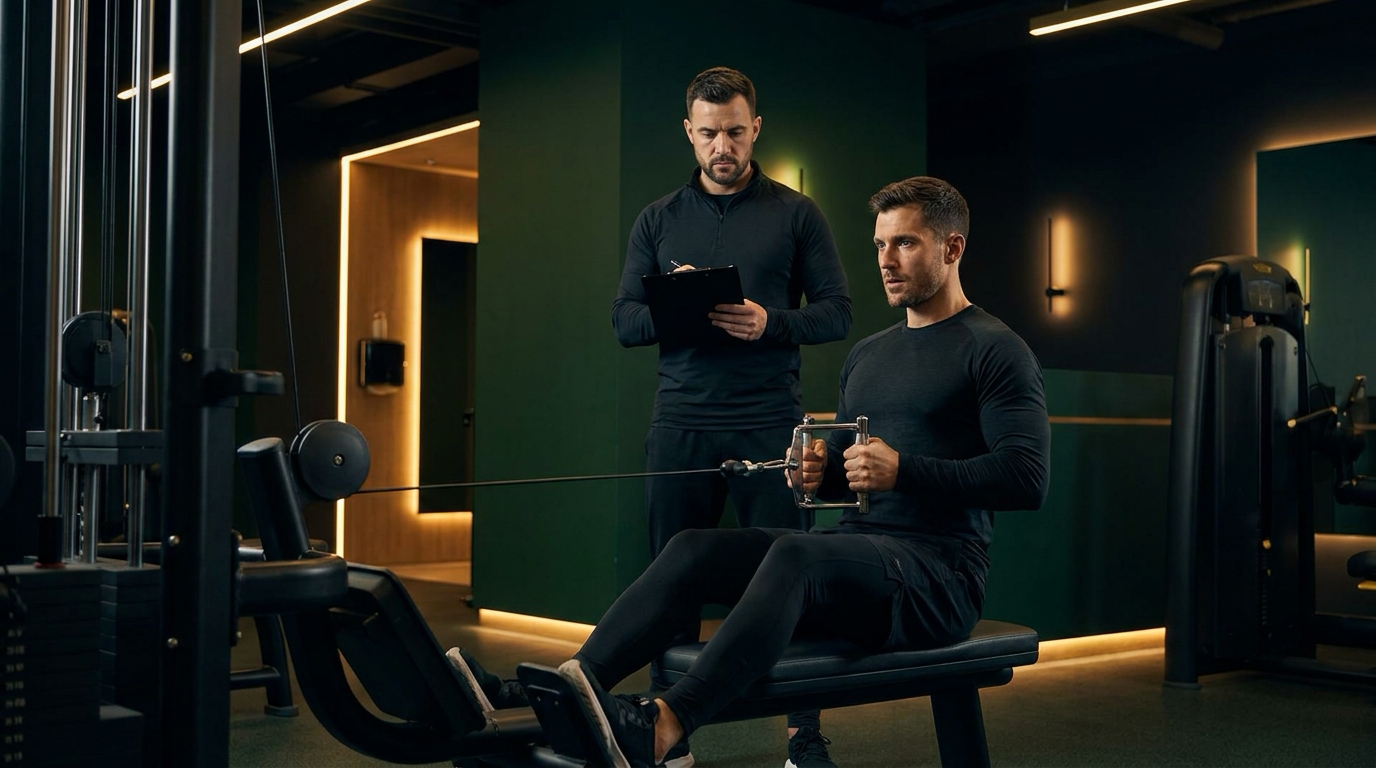
Better back training combines vertical pulls, rows, scapular control and progress you can measure.
Back Training in Massanassa: Pulldowns, Rows and Technique You Can Actually Feel
Author
Alphafit Team
Editorial team at Alphafit Gym Massanassa
Reviewed by
Alphafit Technical Coaching Team
Strength training and personal coaching team in Massanassa
The back is one of those muscle groups many people train without being sure they are doing it well. You do pulldowns, rows, another machine or two, your arms feel pumped, and you leave thinking: “did I train my back or just my biceps?”
At Alphafit Gym Massanassa, we see this often. The problem is usually not lack of effort. It is lack of order: which movements to cover, how to set your body, how to pull without turning every exercise into arm work, and how to progress without losing technique.
This guide helps you build a stronger back with a simple idea: fewer random exercises, more well-chosen pulling.
What Back Training Actually Means
Training back does not mean training one single muscle. In one session, you may involve the lats, rhomboids, middle and lower traps, rear delts, spinal erectors, grip and biceps.
That is why it helps to think in patterns, not just machine names:
- vertical pulls, such as pull-ups or lat pulldowns,
- horizontal rows, such as seated cable rows, machine rows or dumbbell rows,
- scapular control work, such as face pulls or light high rows,
- trunk stability so every set does not become a swinging contest.
The WHO recommends muscle-strengthening work at least 2 days per week for adults. For a gym member, the back belongs in that foundation because it supports many real movements: pulling, rowing, carrying, holding posture and stabilising the upper body.
Why Pulling Hard Is Not Enough
Pulling more weight can be useful, but only if the back stays the main driver. If every rep ends with momentum, a tense neck and biceps at the limit, the number on the stack can go up while the real stimulus becomes messy.
The ACSM position stand summarises key resistance-training variables such as load, volume, frequency, effort and progression. In the gym, that means you do not need to punish your back with ten exercises. You need enough useful sets, close enough to the right effort, with technique you can measure.
A good back-training set usually has these signs:
- you feel the elbow pulling, not just the hand,
- your chest stays stable without over-arching the low back,
- you control the return of the weight,
- your neck does not shrug toward your ears,
- the final reps are hard, but they do not fall apart.
If you cannot keep those signs, the load is probably above what you can currently control.
The 4 Movements You Should Cover
You do not need an endless list of exercises. These four blocks are enough to build a solid routine.
1. Lat Pulldown or Assisted Pull-Up
Pulldowns and pull-ups train the vertical pulling pattern. They are a strong base for the lats, grip and scapular control.
Technique cues:
- start with the shoulders away from the ears,
- drive the elbows down and slightly toward your sides,
- avoid pulling the bar behind your neck,
- do not turn every rep into a torso swing,
- let the weight rise under control before repeating.
If you cannot do full pull-ups yet, that is fine. A well-controlled assisted pull-up or pulldown usually gives you more than five messy attempts.
2. Seated Row or Machine Row
The horizontal row helps train the mid-back. It also teaches you to bring the shoulder blades together and control them without relying only on the biceps.
Key points:
- set your feet and hips firmly,
- start the pull by driving the elbow back,
- pause briefly at the end without exaggerating the chest lift,
- return slowly, letting the arm reach without losing posture.
If your torso is moving as if you are doing crunches, lower the weight. A row should not be a momentum competition.
3. Single-Arm Row
One-arm work helps correct side-to-side differences and lets you find the path more clearly. You can use a dumbbell, cable or unilateral machine.
It is especially useful if:
- one side feels much less coordinated,
- one shoulder drifts forward too much,
- you want to learn to drive the elbow toward the hip,
- or you need to feel the lat without the biceps taking over.
Keep the trunk stable and avoid twisting the body to fake more range. If you want to improve that stability, pair this guide with core training in Massanassa.
4. Rear Delts and Lower Traps
Not all back work needs to be heavy. Face pulls, reverse pec deck, rear-delt flyes and light high rows help balance the shoulders and improve upper-back control.
The goal here is not to move the biggest possible weight. It is to feel the rear shoulder and mid-upper back without shrugging the traps through every rep.
A Practical 2-Day Back Routine
Use this structure if you train upper/lower, full body or a pull-day split. Choose loads that make the last reps challenging without breaking technique.
Day A: Strong Base
| Exercise | Sets | Reps |
|---|---|---|
| Lat pulldown or assisted pull-up | 3-4 | 6-10 |
| Seated cable row | 3-4 | 8-12 |
| Single-arm dumbbell or cable row | 2-3 | 10-12 each side |
| Face pull | 2-3 | 12-15 |
Day B: Control and Volume
| Exercise | Sets | Reps |
|---|---|---|
| Chest-supported machine row | 3-4 | 8-12 |
| Neutral-grip pulldown | 3 | 10-12 |
| Reverse pec deck or rear-delt fly | 2-3 | 12-20 |
| Cable pullover | 2-3 | 10-15 |
If you train back once per week, do not simply cram everything in. Choose 4 or 5 exercises and make the sets count. If you train it twice, split vertical pulls and rows so you arrive fresher to each block.
How Much Volume Should You Do?
Volume depends on your level, recovery and the rest of your routine. A beginner can progress with a small number of well-executed sets. An intermediate lifter may need more weekly sets, but also better fatigue control.
The review by Schoenfeld and colleagues on training frequency points to a practical idea: distributing work across the week can help you accumulate quality volume. That does not mean training back more days is automatically better. It means spreading sets can help when one session becomes too long or loses quality.
A simple reference:
- beginner: 6-8 direct back sets per week,
- intermediate: 8-14 weekly sets,
- advanced: more volume only if you recover well and keep progressing.
If you arrive tired, sleep poorly or already do a lot of deadlifts, pull-ups and heavy rows, do not add sets just to add them. Review execution, rest and progression first.
How To Progress Without Losing the Back Feel
Progression is not only adding plates. The ACSM has described progression models using load, repetitions, sets, rest and frequency. In the gym, that gives you several options.
You can progress by:
- using the same weight and adding 1 or 2 reps per set,
- keeping reps stable and increasing load slightly,
- improving range of motion,
- controlling the lowering phase better,
- reducing swinging,
- or repeating more weeks with stable technique before changing exercises.
A simple example: if you do a pulldown for 3 x 8 at 45 kg with good technique, try to reach 3 x 10 before adding weight. When you increase the load, accept going back to 3 x 8 and build again.
If you are not sure when to add weight, our guide to load progression in the gym gives you a fuller system.
Common Back-Training Mistakes
These are the ones we see most often:
- always starting with the heaviest exercise even when you cannot control it,
- turning pulldowns into arm pulls,
- rowing with so much momentum that the pause disappears,
- shrugging the traps on every rep,
- training back after exhausting the biceps,
- changing grips every week without measuring progress,
- doing too many exercises that all look the same,
- forgetting that rest between sets affects performance too.
Another common mistake is thinking that no soreness means no work. Soreness is not the goal. A good session is better judged by technique, effort, useful reps and accumulated progression.
How To Fit Back Into Your Week
If you train full body, include a vertical pull and a row in each session, or alternate emphasis. For example, heavy pulldown and light row one day; main row and moderate pulldown on another.
If you train upper/lower, it usually works well to place 2 or 3 back exercises in each upper-body day.
If you train push/pull/legs, the pull day can handle more volume, but avoid adding so many exercises that the final sets become filler.
If you do not know which split suits you, read the guide to choosing full body, upper/lower or PPL. Your back progresses better inside a week you can repeat, not inside a perfect routine you abandon.
When To Ask For Help
Ask for help if you always feel biceps before back, if you do not know how to position the shoulders and shoulder blades, if pulldowns or rows bother your neck, or if you have spent months using the same machines without improving load or control.
At Alphafit, we can review your technique, choose grips that suit you and build a realistic progression around your training days. Sometimes a small adjustment in the elbow, torso or exercise order changes the whole feel of the session.
If you want to train back without guessing, visit Alphafit Gym Massanassa or write to us through contact. We will help you turn pulldowns and rows into progress you can feel and measure.
Sources
- American College of Sports Medicine Position Stand. Resistance Training Prescription for Muscle Function, Hypertrophy, and Physical Performance in Healthy Adults: An Overview of Reviews · Medicine & Science in Sports & Exercise
- Physical activity · World Health Organization
- Resistance training frequency and skeletal muscle hypertrophy: A review of available evidence · Journal of Science and Medicine in Sport
- Progression models in resistance training for healthy adults · Medicine & Science in Sports & Exercise