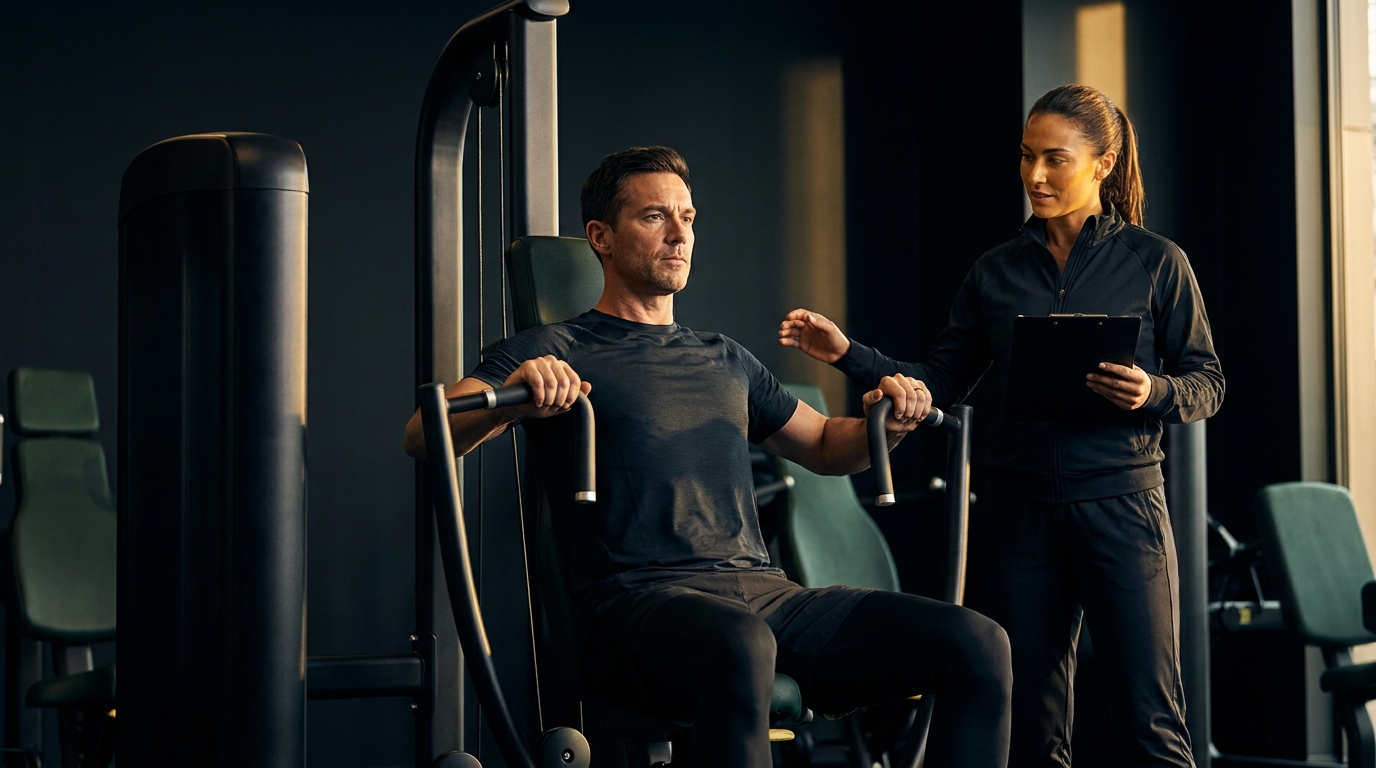
Better chest training is not only about the bench press: technique, range and progression matter more than ego.
Chest Training in Massanassa: Bench Press, Machines and Technique Without Overloading the Shoulder
Author
Alphafit Team
Editorial team at Alphafit Gym Massanassa
Reviewed by
Alphafit Technical Coaching Team
Strength training and personal coaching team in Massanassa
The bench press has a reputation as a mandatory gym exercise. You walk in, see the bar, hear people talk about numbers and personal records, and suddenly chest training seems to come down to one question: “how much do you bench?”
At Alphafit Gym Massanassa, we look at it differently. Training chest is not about proving something in one set. It is about choosing good pressing movements, setting technique, progressing without letting the shoulder take over, and repeating a structure you can actually sustain.
If you enjoy bench press, great. If it makes you nervous, if you train alone, if you feel more shoulder than chest, or if you prefer machines, there is still a clear path. What matters is that your chest gets a useful stimulus and that you can measure whether it is improving.
What Chest Training Really Means
Chest training is not five similar press variations until you are exhausted. The pecs work mainly during pressing and arm-adduction patterns, but most chest exercises also involve the front shoulder and triceps.
That is why it helps to think in patterns:
- a horizontal press, such as bench press, dumbbell press or machine chest press,
- an incline press if you want more emphasis on the upper chest,
- a fly or crossover, such as pec deck or cables, for lower external load,
- and enough back and core work to keep the torso stable.
The CDC recommends muscle-strengthening activity at least 2 days per week for adults, covering major muscle groups including chest, back, shoulders, arms, abdomen and legs. In the gym, that means chest should fit into a balanced week instead of taking attention away from everything else.
Bench Press Is Not Mandatory
The bench press is useful, measurable and motivating. It is also an exercise where many people overload, shorten the range or turn every rep into a negotiation with the shoulder.
You do not have to choose between “barbell or nothing.” You can progress with:
- machine chest press,
- dumbbell press,
- Smith machine if it gives you more control,
- assisted dips if they suit you,
- cable crossovers,
- pec deck,
- or a combination of several options.
The ACSM resistance-training update points to the variables that matter most in practice: load, volume, frequency, effort, technique and progression. The exact exercise name matters less than being able to repeat it well and progress with a plan.
In plain gym language: if a machine helps you feel the chest better, train with more confidence and add reps for several weeks, it can be an excellent choice. If the barbell motivates you and your technique is solid, that works too.
Signs of a Good Chest Rep
You do not need a perfect burn in every set, but you should check a few signals.
A good rep usually has:
- firm feet and a stable torso,
- shoulders away from the ears,
- shoulder blades set without forcing an uncomfortable position,
- enough range without losing control,
- a controlled lowering phase,
- a strong press without bouncing,
- and effort across chest, shoulder and triceps without sharp or unusual pain.
The Mayo Clinic emphasizes that proper technique helps improve results and reduce injury risk. If adding weight makes you lose range, twist your body or feel a sharp irritation, you have not progressed: you have changed the exercise.
If pain persists, if you have a previous injury, or if the same discomfort keeps returning, stop and speak with a healthcare or qualified training professional before pushing through it.
Barbell, Machine, Dumbbells or Cables: How To Choose
There is no single winning tool. There is a tool that fits your level, goal and body right now.
Barbell Bench Press
Use it if you want a clear strength reference, enjoy the movement and can perform it with solid technique. Progress is easy to measure because the load is clear.
Be careful if you train alone very close to failure, do not have safety supports, or every set ends up feeling more like shoulder than chest.
Machine Chest Press
This is very useful for beginners, for people training alone with more confidence and for accumulating quality sets. The guided path reduces the need for stabilisation and lets you focus on pressing with control.
It is not “cheating.” It is a tool. The key is adjusting seat height, handles and range so the press starts from a comfortable position.
Dumbbell Press
Dumbbells give grip freedom and let each side work more independently. They can be a great option if you control the setup and exit.
The less friendly part: getting heavy dumbbells into position is a skill. If you lose control before the set even starts, the exercise is not the best choice yet.
Cables and Flyes
Cable crossovers, pec deck and flyes help train the chest with less absolute load. They work well as accessories, but you do not need a whole session of almost identical variations.
Pick one fly pattern, do it well and progress. More exercises do not always mean more stimulus.
A Practical 2-Day Chest Routine
This structure fits upper/lower, push/pull/legs or full-body training. Choose loads that leave most sets with 1-3 reps in reserve.
Day A: Main Press
| Exercise | Sets | Reps |
|---|---|---|
| Bench press or machine chest press | 3-4 | 6-10 |
| Incline dumbbell press | 3 | 8-12 |
| Pec deck or cable crossover | 2-3 | 12-15 |
| Cable triceps extension | 2-3 | 10-15 |
Day B: Control and Volume
| Exercise | Sets | Reps |
|---|---|---|
| Converging machine chest press | 3 | 8-12 |
| Neutral-grip dumbbell press | 2-3 | 10-12 |
| Low-to-high cable crossover | 2-3 | 12-15 |
| Controlled push-ups or light press | 2 | near technical failure |
If you train chest once per week, do not merge both days. Choose one main press, one secondary press, one fly and maybe a triceps accessory. Eight to ten good sets are usually better than 18 sets where the last ones no longer do much.
How Much Volume Should You Do?
Volume depends on your experience, recovery and how much pressing you already do for shoulders and triceps. A simple reference:
- beginner: 6-8 direct chest sets per week,
- intermediate: 8-14 weekly sets,
- advanced: more only if you recover well and keep progressing.
The Mayo Clinic Health System recommends starting light, increasing weight gradually and building enough rest between sessions for the same muscle group. That idea matters: the chest does not improve because you punish it every day. It improves when you give it a stimulus you can recover from and repeat.
If you are not sure how to distribute the work, read our guide to choosing full body, upper/lower or PPL. The best routine is the one you can repeat for several weeks without guessing.
How To Progress Without Losing Technique
You do not need to add weight every Monday. Use double progression:
- Pick a range, for example 8-12 reps.
- Keep the same weight until you approach the top of the range in all sets.
- Increase load slightly.
- Accept going back to 8-9 clean reps.
- Repeat.
Example on a chest press machine:
| Week | Load | Sets |
|---|---|---|
| 1 | 45 kg | 10, 9, 8 |
| 2 | 45 kg | 11, 10, 9 |
| 3 | 45 kg | 12, 11, 10 |
| 4 | 50 kg | 9, 8, 8 |
That is real progress. Not always dramatic, but measurable.
If you want a fuller system, read the guide to load progression in the gym.
Common Chest-Training Mistakes
1. Lowering More Than You Can Control
Range is useful when you control it. If you bounce, lose tension and rely on the joints, lower the load.
2. Flaring the Elbows Too Much
You do not need to pin the elbows to the ribs, but you also do not need to press from an awkward position. Find a strong and repeatable angle.
3. Doing Too Many Fly Variations
Pec deck, high cable, low cable, dumbbell flyes and crossovers in the same session are usually redundant. One or two well-executed variations are enough.
4. Forgetting the Back
A strong torso is not built by pressing alone. If you train chest hard but train back randomly, balance suffers. Pair this with our guide to back training in Massanassa.
5. Chasing Soreness
Soreness is not the main scoreboard. Track load, reps, control, range and recovery.
How To Fit It Into Your Week
If you train full body, include one chest exercise 2 or 3 days per week, but it does not always need to be heavy. For example: main press one day, moderate machine work another day, and push-ups or light cable work later in the week.
If you train upper/lower, split chest work across the two upper-body days. One can be heavier and the other more technical.
If you train push/pull/legs, the push day already loads chest, shoulders and triceps. Do not turn it into an endless list of presses. Leave room to progress.
The goal is not to leave destroyed. It is to look at your log four weeks later and see that you press better, with more control or with more clean reps.
When To Ask For Help
Ask for help if you always feel shoulder before chest, if the barbell makes you nervous, if you do not know how to adjust the machine, if you train alone and are unsure how to approach effort safely, or if you have spent months doing the same thing without progress.
At Alphafit, we can review your technique, choose variations that fit you and build a realistic progression around your training days.
If you want to train chest without guessing, visit Alphafit Gym Massanassa or write to us through contact. We will help you turn presses, machines and cables into progress you can feel and measure.
Sources
- ACSM Publishes Updated Resistance Training Guidelines · American College of Sports Medicine
- Adult Activity: An Overview · Centers for Disease Control and Prevention
- Weight training: Do's and don'ts of proper technique · Mayo Clinic
- 10 weight training tips for beginners · Mayo Clinic Health System