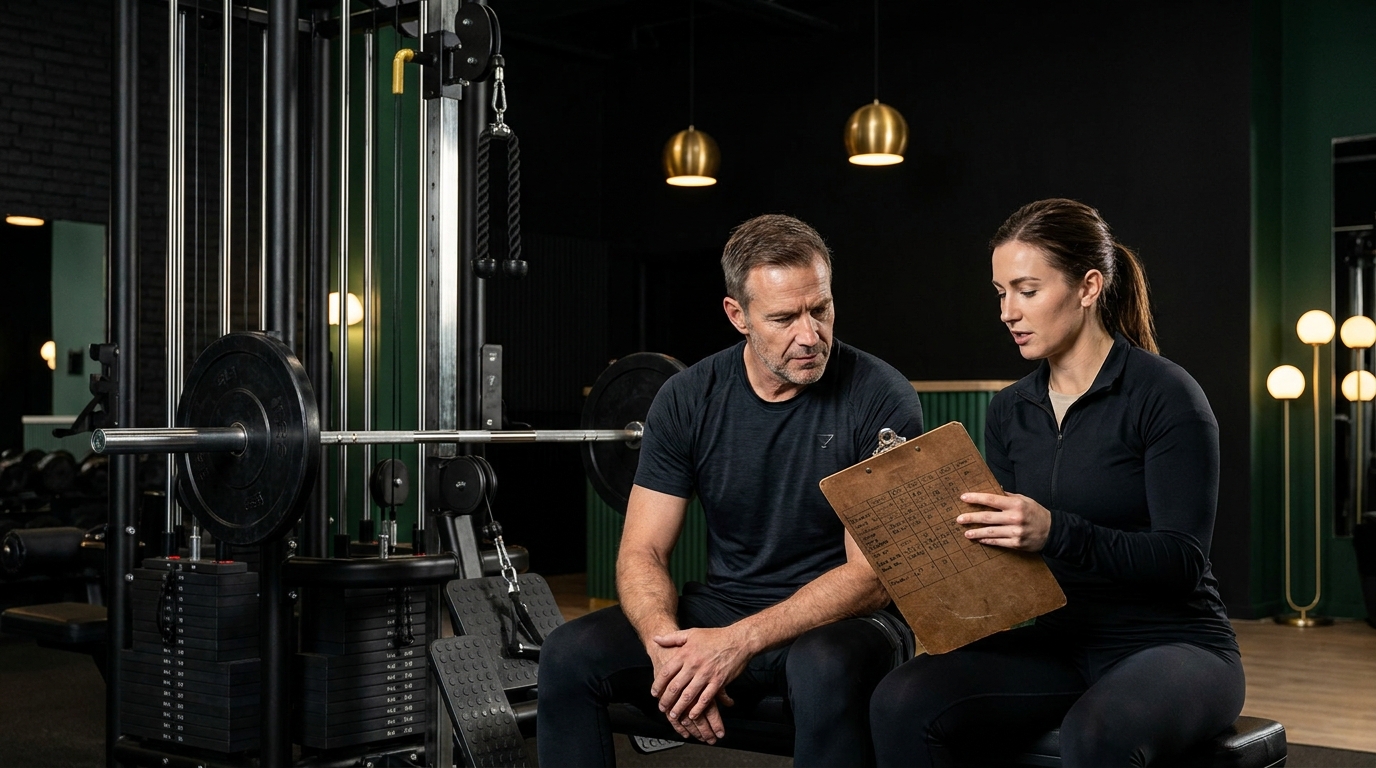
When progress stalls, the first fix is usually better tracking before adding more training.
Not Seeing Gym Results in Massanassa: How to Find What Is Holding You Back
Author
Alphafit Team
Editorial team at Alphafit Gym Massanassa
Reviewed by
Alphafit Technical Coaching Team
Strength training and personal coaching team in Massanassa
Few things feel more frustrating than coming to the gym for several weeks, sweating, leaving tired and thinking: “I am not seeing results.”
Sometimes that thought shows up in the mirror. Sometimes it appears when the scale does not move, when you have been using the same weight on the leg press for months, or when you feel you train “a lot” but your body does not seem to show it.
At Alphafit Gym Massanassa, we usually start with one simple idea: if you are not seeing progress, the missing piece is not always effort. Very often it is diagnosis. Before changing the whole routine, it helps to know what signal you are measuring, what you are repeating, and which part of the plan is breaking down.
First: define the result you actually want
“Seeing results” can mean very different things:
- reducing waist size,
- getting stronger,
- gaining muscle,
- improving posture,
- having more energy,
- training without pain,
- or rebuilding consistency after years away from the gym.
If you do not choose a main indicator, almost any week can feel like a bad one. You can gain strength while body weight stays stable. You can lose fat while the scale barely changes. You can improve technique before the mirror shows a dramatic change.
The WHO notes that any amount of physical activity counts and that muscle-strengthening activity benefits everyone. For a physique or performance goal, though, movement is not enough. You need a plan you can measure.
1. You do not have a clear starting point
The most common mistake is not training badly. It is starting without reference points.
If you do not know where you started, it is hard to know whether you have changed. Instead of relying only on how you feel, track 4 simple data points for 4 weeks:
- weekly average body weight, not one isolated day,
- waist measurement at the same time of day,
- photos in the same light every 2 or 3 weeks,
- loads and reps for 5-8 key exercises.
This avoids a very common trap: looking in the mirror every day and missing progress because real physical change is gradual.
If your goal is body composition, pair this guide with our article on body recomposition in Massanassa. It will help you read the scale without obsessing over it.
2. Your consistency feels high, but your real average is not
Some people train 6 days one week, 2 days the next, stop for 10 days, return motivated and feel they have “been training for months.” On the calendar, yes. In accumulated training stimulus, not quite.
For the body to change, it needs repeated weeks. Not perfect weeks. Repeated weeks.
Run this audit:
- how many sessions did you complete in the last 4 weeks?
- how many were close to the plan?
- how many included recorded exercises, sets and loads?
- how many weeks in a row could you repeat the block without starting over?
If the answer is irregular, the goal is not a harder routine. It is a routine you can complete during a normal week of work, study, family and life around Massanassa.
If your main issue is fitting training into real days, read how many days to strength train each week or how to choose your training split.
3. You are exercising, but not progressing
Exercising and training with progression are not exactly the same thing.
You can sweat a lot and still use the same loads. You can leave tired without improving technique. You can change exercises every week and never have a reliable comparison.
The updated ACSM position stand reviews resistance training prescription and gives a useful takeaway: resistance training improves strength, hypertrophy and physical function when variables such as load, volume, frequency, effort and progression are programmed.
On the gym floor, that means:
- repeat enough key exercises for several weeks,
- record weight, reps and effort,
- increase one variable when technique is stable,
- avoid changing everything every Monday,
- and do not turn every set into an ego test.
If you are unsure when to add weight, use our specific guide to load progression in the gym.
4. Your training dose is off
When someone is not progressing, the first instinct is often to do more. Sometimes that is right. Other times they need less noise and a better dose.
You may need more stimulus if:
- you do too few useful sets,
- you always train far from meaningful effort,
- you do not repeat important movement patterns,
- you rest so long between sessions that momentum never builds.
But you may also be carrying too much fatigue if:
- you train to failure on almost everything,
- you add hard HIIT after every leg session,
- you sleep poorly and keep increasing volume,
- you replace rest with more exercises,
- or your sessions are so long you cannot sustain them.
The right dose feels challenging, but repeatable. If every workout leaves you wrecked for three days, you do not necessarily have a more serious plan. You may have a plan you cannot recover from.
5. Nutrition and recovery are not supporting the work
The gym gives the signal. Adaptation happens when you eat, recover and repeat.
If your goal is muscle gain or recomposition, protein cannot be left to chance. The ISSN position stand gives a practical range of 1.4 to 2.0 g of protein per kilogram of body weight per day for most active people aiming to build or maintain muscle mass.
You do not need to weigh food forever. You should check:
- whether each meal has a clear protein source,
- whether you train with energy or arrive empty,
- whether the weekend wipes out the weekday deficit,
- whether you drink enough water,
- and whether your eating actually matches the goal you say you have.
Sleep matters too. The CDC explains that quality sleep supports health, energy, attention and metabolism. In gym language: if you sleep poorly for long enough, it becomes harder to perform, recover and make good decisions.
6. You are using the wrong scoreboard
If you only watch the scale, you can miss real progress.
Common examples:
- you gain strength and muscle, but body weight barely drops,
- your waist goes down, but leg training increases water retention,
- your technique improves, but loads have not risen yet,
- you return from a break and regain performance before visible body changes appear.
That is why we like a simple dashboard:
| Goal | What to track | How often |
|---|---|---|
| Fat loss | waist, photos, average weight | weekly and every 2-3 weeks |
| Strength gain | loads, reps, RIR | every session |
| Muscle gain | measurements, photos, performance | every 2-4 weeks |
| Better consistency | completed sessions | weekly |
You do not need to track everything forever. You need enough information to avoid quitting because of an incomplete reading.
A quick 14-day audit
If you have not seen results for a while, try this before changing the whole routine:
- Choose 5 key exercises and log every set.
- Keep the same structure for 2 weeks.
- Set a realistic minimum number of sessions.
- Track steps or daily activity roughly.
- Include protein in 3 meals per day.
- Note sleep hours and training energy.
- Measure waist and average weight, not only daily weight.
At the end of 14 days, you do not need a transformation. You need a reading: what is being completed, what is failing and which adjustment will matter most.
When to ask for help
Ask for help if:
- you have spent months changing routines without knowing whether you are improving,
- you are afraid to add weight because of technique,
- you do not know whether you are training too much or too little,
- you eat “well” but cannot explain it with basic data,
- or you are frustrated enough to consider quitting.
At Alphafit, we can review your routine, your loads, your real availability and your goal. Most of the time you do not need to start from zero. You need to organize the plan and decide what to measure from now on.
If you want to stop guessing, contact Alphafit Gym Massanassa and we will review what is holding back your results.
Sources
- American College of Sports Medicine Position Stand. Resistance Training Prescription for Muscle Function, Hypertrophy, and Physical Performance in Healthy Adults: An Overview of Reviews · Medicine & Science in Sports & Exercise
- Physical activity · World Health Organization
- International Society of Sports Nutrition Position Stand: protein and exercise · Journal of the International Society of Sports Nutrition
- About Sleep · Centers for Disease Control and Prevention