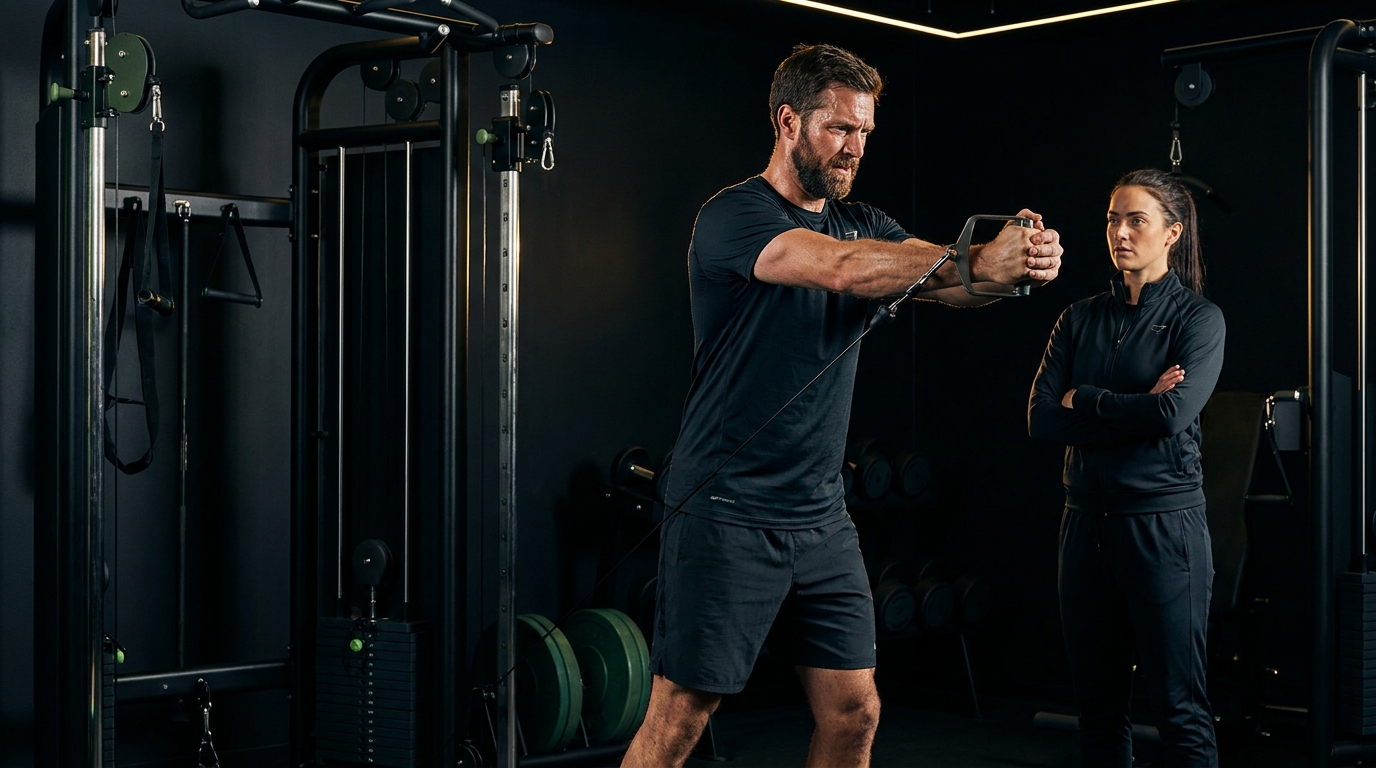
Core training is not only for visible abs: it helps you control your body when load, fatigue and movement show up.
Core Training in Massanassa: Abs, Stability and Strength for Better Lifting
Author
Alphafit Team
Editorial team at Alphafit Gym Massanassa
Reviewed by
Alphafit Technical Coaching Team
Strength training and personal coaching team in Massanassa
Many people come to the gym with one very clear idea: “I need to do abs.” Usually that means crunches, leg raises or a 10-minute finisher that makes the midsection burn.
The problem is that your core is not only there so you can feel your abs. In a squat, Romanian deadlift, lunge, row or even when carrying bags after training, the middle of the body helps transfer force and control the trunk under load.
At Alphafit Gym Massanassa, we prefer to frame it this way: you do not need hundreds of ab reps. You need core training that is useful inside your real routine.
What the core actually is
The core is not just the “six-pack”. It includes the muscles that help stabilise the trunk, pelvis and hips: abs, obliques, lower back, deeper trunk muscles, glutes and part of the back.
ACSM’s Health & Fitness Journal separates core strength from core stability and explains that the trunk can work through flexion, extension, lateral flexion and rotation. In the gym, that means doing the same floor crunch every session is a very narrow approach.
A practical way to see it:
- anti-extension: stopping the lower back from arching too much,
- anti-rotation: resisting trunk rotation when a load pulls you sideways,
- anti-lateral flexion: staying upright when weight sits on one side,
- flexion and dynamic control: moving the trunk when the exercise asks for it, without losing tension.
That is why a good core routine mixes planks, dead bugs, Pallof presses, carries, side work and controlled progressions.
Why train it
A strong core does not guarantee a perfect back or fix every ache on its own. It is worth being honest here. A review on stabilisation exercises for low back pain found they can help, but they are not clearly superior to other forms of active exercise in the long term (Smith et al., 2014).
The useful takeaway for a gym member is this: core work is not magic, but training it well can improve body control and support your broader strength work.
It is especially useful if:
- you lose position in squats, presses or rows,
- your lower back feels like it is doing too much in exercises that should not mainly load it,
- you run, play racket sports or do intense classes,
- you sit for many hours and need to move better,
- you want to train abs without relying only on crunches,
- or you struggle to keep tension when the weight goes up.
The WHO recommends muscle-strengthening activity at least 2 days per week for adults. Core work can sit inside that structure, not as punishment at the end, but as a small, well-placed part of the plan.
The 5 patterns worth covering
You do not need twenty exercises. Five well-chosen patterns give you a strong base.
1. Breathing and bracing
Before planks or cable work, learn how to create tension. Think about filling the abdomen with air, keeping the ribs down without rounding, and preparing the trunk as if you were about to receive a gentle push.
Useful exercises:
- 90/90 breathing,
- paused dead bug,
- short hollow hold,
- supine marching with lower-back control.
The goal is not to hold your breath for the whole set. It is to create tension, move and keep breathing without losing position.
2. Anti-extension
Here you train the back not to arch when the arms or legs move away from the body.
Exercises:
- front plank,
- dead bug,
- body saw,
- ab wheel from the knees if you already have control.
If the ab wheel gives you lower-back discomfort or your hips drop, you have gone too far. Shorten the range and build back up.
3. Anti-rotation
This pattern transfers well to gym training because many loads try to rotate you.
Exercises:
- cable or band Pallof press,
- single-arm dumbbell press,
- controlled single-arm row,
- plank shoulder tap.
In the Pallof press, the goal is not to move huge weight. The cable pulls you sideways and your trunk stays stable.
4. Anti-lateral flexion
Here you train the ability to avoid bending sideways.
Exercises:
- farmer carry with one dumbbell,
- suitcase carry,
- side plank,
- Copenhagen plank progression if you already have the level.
Carries are useful because they look simple, but they make you control grip, posture, breathing and pelvis while walking.
5. Flexion and direct ab work
Crunches are not banned. They simply should not be your whole core routine.
Options:
- cable crunch,
- reverse crunch,
- hanging knee raise,
- machine crunch if you can control the range.
If your goal is aesthetic, remember that ab training builds muscle, but seeing it depends mostly on body fat percentage, nutrition and consistency with the whole plan.
How to fit it in without making sessions longer
The best core routine is the one you actually do. If you try to add 30 extra minutes after every session, you will probably skip it.
Try one of these options:
| If you train | Recommended core work | Example |
|---|---|---|
| 2 days/week | 2 blocks of 8-10 minutes | dead bug + Pallof press + side plank |
| 3 days/week | 2-3 exercises at the end | plank + carry + cable crunch |
| 4 days/week | 2 alternating micro-blocks | anti-extension one day, anti-rotation another |
| 5 days/week | low volume, higher frequency | 1 technical exercise before or after |
You can also use it inside your warm-up before strength training. A light dead bug or Pallof press before a leg session can help you start with better control, as long as it does not fatigue you.
A practical gym core routine
Do this 2 times per week for 4 weeks. Rest 45-75 seconds between sets.
Day A: control and anti-extension
- dead bug: 3 x 6-8 per side,
- front plank: 3 x 20-40 seconds,
- Pallof press: 3 x 8-10 per side,
- farmer carry: 3 x 20-30 metres.
Day B: lateral control and direct abs
- side plank: 3 x 15-30 seconds per side,
- suitcase carry: 3 x 20 metres per side,
- reverse crunch: 3 x 8-12,
- controlled single-arm row: 2-3 x 10 per side.
You progress when you keep position, breathing and control. Add seconds, metres, reps or a small amount of load. If technique breaks, that is not the right progression.
If you are unsure how to make it harder without losing form, use the same logic as load progression in the gym: technique first, then reps or time, then load.
Common mistakes when training abs
We see these often:
- doing abs at the end when there is no energy or attention left,
- turning every plank into a test of how long you can suffer,
- using the ab wheel without controlling the pelvis,
- training only flexion and forgetting rotation, side control and carries,
- thinking more burn always means a better stimulus,
- copying advanced exercises without owning the basics,
- expecting core work to compensate for a poorly planned routine.
NHS inform recommends a gradual return to movement after back problems and adjusting if pain gets worse. The same caution applies in the gym: if a core exercise creates unusual pain, reduce the difficulty or ask for a technique review.
If you sit for many hours, combine this guide with our article for back and hips when you sit most of the day. Often the missing piece is not only abs. It is better movement, stronger glutes, back training and active breaks.
How to know you are doing it well
Good core work shows up in small signs:
- you breathe better under load,
- your ribs and pelvis stay more controlled,
- planks feel like abs, not neck or lower back,
- single-arm presses and rows are more stable,
- you can walk with a heavy dumbbell without leaning,
- you recover position between reps without thinking as much.
You do not need to end wrecked. You need to collect clean reps.
When to ask for help
Ask for help if you do not know which exercises to choose, if every ab exercise bothers your back, if you want better squat or deadlift technique, or if you have trained core for a while but do not feel it transferring to your lifts.
At Alphafit, we can check how you breathe, how you brace, which exercises match your level and where to place them in your week. Sometimes 8 well-done minutes are enough to make the whole session feel more organised.
If you want to train your core without guessing, visit Alphafit Gym Massanassa or write to us through contact. We will help you turn ab work into a real tool for better training.
Sources
- Core Training: Separating Fact from Fiction · ACSM's Health & Fitness Journal
- Physical activity · World Health Organization
- An update of stabilisation exercises for low back pain: a systematic review with meta-analysis · BMC Musculoskeletal Disorders
- Exercises to help with back pain · NHS inform