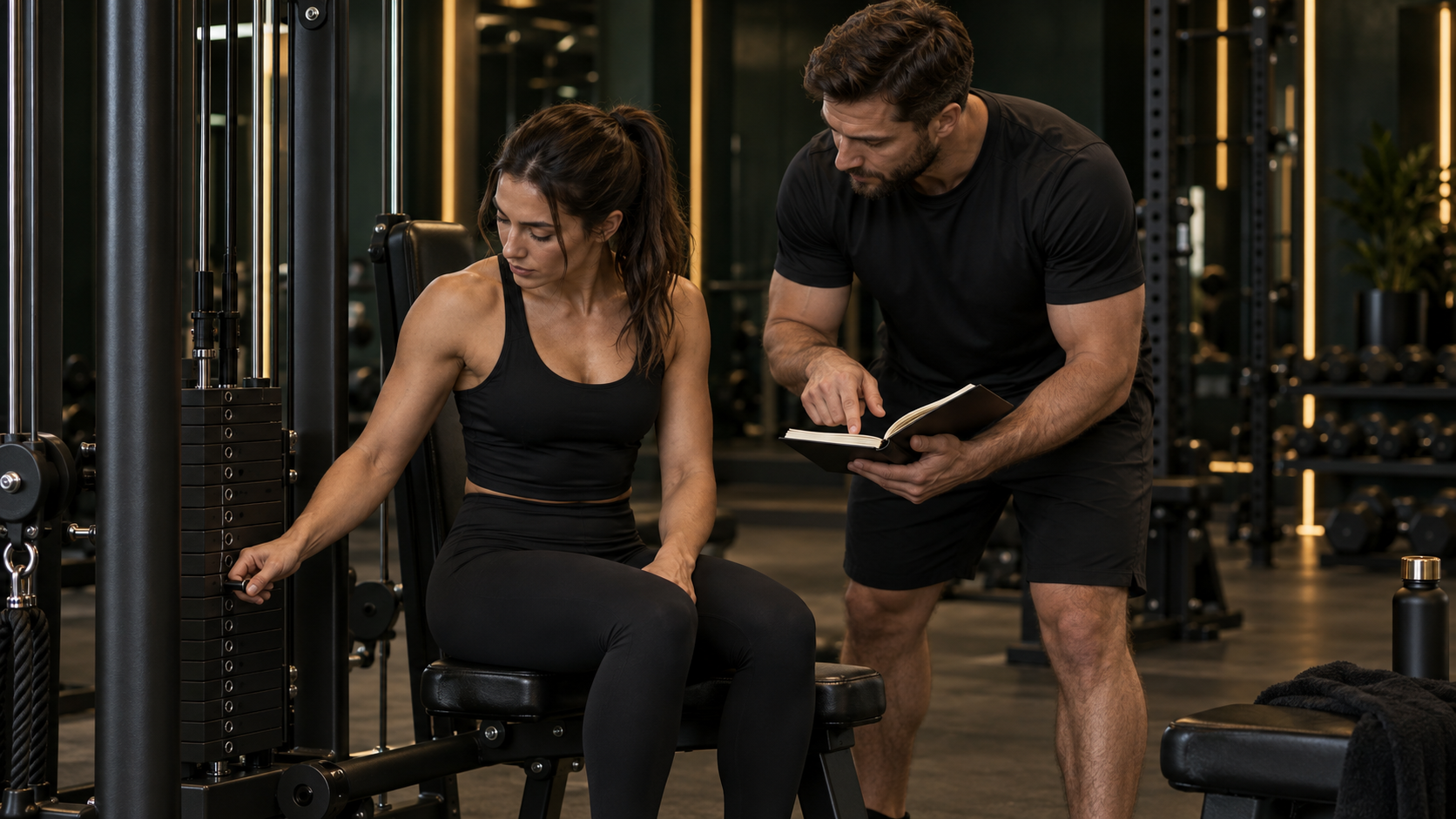
A starting load is not guessed or copied: it is tested, adjusted, and recorded with technique as the reference point.
How Much Weight Should You Lift at the Gym? A Starting-Load Guide for Massanassa
Author
Alphafit Team
Editorial team at Alphafit Gym Massanassa
Reviewed by
Alphafit Technical Coaching Team
Strength training and personal coaching team in Massanassa
You sit down at a machine, look at the weight stack, and the question appears: which pin should I use? You do not want the set to feel pointless, but you also do not want to discover halfway through that you cannot control the load. Someone nearby is lifting twice as much, and their number looks like a reference even though it is not.
There is no universal kilogram chart for men, women, or beginners. The right weight changes with the exercise, the machine, your experience, your range of motion, and how you feel that day. The useful skill is not guessing a perfect number. It is following a process that finds a trainable, repeatable load.
At Alphafit Gym Massanassa, we use technique, a repetition range, and effort as the reference points. This guide shows you how to test a new exercise in a few minutes, decide whether to add or remove weight, and leave your first session with a number you can improve.
The short answer: the right weight depends on the set
To begin, choose a load that lets you complete the planned range while keeping:
- the agreed range of motion;
- a stable position;
- a reasonably controlled speed;
- and about 2-4 possible repetitions at the end.
Those possible repetitions are called repetitions in reserve, or RIR. If you finish 10 reps and estimate that you could complete 3 more with the same technique, you trained at roughly 3 RIR.
You do not need to identify RIR with perfect accuracy. A review of RIR scales concluded that they can be a practical way to adjust intensity, but estimates tend to improve when a set is closer to the limit (Halperin and colleagues). A beginner should therefore combine how the set feels with visible signals: range, control, and consistency between repetitions.
Why another person’s kilograms are not your answer
Two people can train equally well with very different numbers. Even you will need different loads for a leg press, row, lateral raise, or hamstring curl. Resistance also changes between machines: 40 kg on one stack may not feel like 40 kg on another because of the pulley system, lever, and movement path.
A review of 18 studies found that people given vague instructions to choose their own resistance selected an average load of about 53% of their one-repetition maximum. The authors noted that this could work in some contexts, but its value depended on the goal and the number of repetitions performed (Steele and colleagues). The practical lesson is not to calculate that percentage. It is that “choose a comfortable weight” is not enough guidance.
You need a range, a technique standard, and a decision for the next set.
The five-minute test for choosing a starting load
Use this process the first time you try a machine or a new exercise. It is not a maximum test; it is a controlled search.
1. Set up the exercise before looking at the weight
Adjust the seat, backrest, grip, and safety stops. Perform a few repetitions with no load or the lightest option. Decide which range you can repeat without pain and which parts of your body should remain stable.
If the seat height or foot position changes every set, the number is no longer comparable.
2. Make the first load deliberately easy
Perform about 8 repetitions. The goal is to check the movement, not create fatigue. If you feel sharp pain, a joint seems blocked, or you cannot keep your position, stop and review the exercise. Muscular effort and pain are not the same signal.
3. Add one small step and rest
If the first test was very easy, increase the load by the smallest reasonable jump available. Rest long enough for the next set to test the load rather than the fatigue caused by rushing through your trials.
4. Perform a set of 8-12 repetitions
This range is convenient when learning because it gives you enough repetitions to practise without forcing you to use a maximal load. It is not a magic range, and it is not ideal for every goal; it is simply a practical starting point.
When the set ends, ask: “How many more repetitions could I have completed in the same way?” Use this guide:
| Result | What it means | Next decision |
|---|---|---|
| You could do 5 or more | Too easy for this working set | Add one small step |
| You had 2-4 left | Good starting load | Keep it and record it |
| You had 1 left with stable technique | Demanding; it may suit a familiar exercise | Keep it or reduce one step while learning |
| You miss the range or compensate | The load is too high today | Reduce the weight |
| Sharp or unusual pain appears | This is not an effort problem | Stop and review the exercise |
5. Confirm it with a second set
One set does not validate a load. Rest and repeat it. If your repetitions fall sharply or your range becomes shorter, the first set may have been too demanding, the rest too short, or your pacing still unfamiliar.
A good starting load makes your sets resemble one another. It is not the load that produces the largest number in your log.
How hard should it feel for your current goal?
If this is your first week
Leave about 3-4 repetitions in reserve and focus on learning the setup, range, and breathing. Your first week does not need to prove how much you can lift. It needs to give you a safe reference for your return.
If you want to build muscle
You can progress with different loads when your sets involve enough effort and you can accumulate good-quality work. A major review found that many resistance-training prescriptions increase hypertrophy and that load differences matter less for muscle growth than they do for maximising strength (Currier and colleagues).
In practice, choose a repetition range that suits the exercise and usually finish with 1-3 repetitions in reserve once you know the movement. Do not turn every set into technical failure.
If you want to maximise strength
High loads play a larger — and literal — role in the outcome. A network meta-analysis with 178 studies in its strength network ranked prescriptions above 80% of 1RM highest for strength gains (Ramos-Campo and colleagues).
That does not mean a new lifter should test a maximum. First build technique, tolerance, and consistency. A programme can then introduce lower repetition ranges and heavy loads in a planned way.
If you are returning after a break
Do not immediately use the weights you lifted before. Start below them, leave room, and watch how you recover over the next 24-48 hours. Your memory of the movement may return before your tolerance for training volume.
Machines, dumbbells, and barbells: the number is not the whole story
On a machine
Record the equipment name or description, seat setting, and backrest position. Two chest-press machines can display the same number while providing different resistance.
With dumbbells
Write down the weight per dumbbell, not the total, to avoid confusion. If the next available jump is too large, keep the current load and progress through the repetition range first.
With a barbell
Count the bar and the plates. If you are still learning a squat, press, or Romanian deadlift, the quality of the pattern matters more than finding a supposed standard starting weight.
In unilateral exercises
Begin with the side that needs more control, then use the same load and repetitions for both sides. Do not add extra work to the stronger side.
What to record during your first two weeks
You do not need a complicated app. A phone note with five details is enough:
- exercise and machine setup;
- weight used;
- repetitions in each set;
- approximate RIR;
- one short note about technique or discomfort.
For example: seated row, seat 4, 30 kg, 12/11/10, RIR 3/2/2, no rocking.
Repeat the same setup in your next session. If every set reaches the top of the range with the planned margin still available, you have a reason to add load. Our guide to progressive overload explains how to use this double-progression method without changing weight and repetitions at the same time.
Common mistakes when choosing a weight
Starting with someone else’s load
Their workout does not tell you what yours should be. Copy their tracking habit if you like, but not their number.
Testing a maximum “for reference”
A beginner does not need a 1RM test to choose useful loads. You can find a productive set by adding weight gradually and leaving room instead of turning day one into an exam.
Confusing an ugly repetition with a hard repetition
It can be normal for the final rep to slow down. Changing the range, bouncing, or losing your position to complete it means the set is no longer measuring the same movement.
Using the same load for every exercise
Your legs, back, shoulders, and arms do not produce the same force, and every machine changes the leverage. Load selection is an exercise-by-exercise decision.
Adding weight every time you have a good day
Confirm the load across more than one session first. Better sleep, a different rest period, or arriving with less fatigue can improve performance without requiring a permanent jump yet.
Quick questions about your starting load
How much should a beginner man or woman lift?
There is no useful number based only on sex or body weight. Follow the testing process and choose a load that respects your technique, repetition range, and margin. The result will be different for every exercise.
Should the last repetition feel hard?
Yes. A working set should feel more demanding at the end than at the beginning. But “hard” does not mean losing range or accepting pain. Finishing with 2-4 possible repetitions while learning gives you a reasonable base.
How do I know when a weight is too light?
If you reach the top of your range and could complete five or more identical repetitions, add one small step in the next set or session. There is no need to skip several plates.
What if the next dumbbell is too heavy?
Keep the current one and add repetitions within your range. Once every set reaches the top with room remaining, try the next dumbbell even though you will return to the lower end of the range at first.
Do I have to reach failure to know my RIR?
Not in every set. You can occasionally calibrate on a stable, safe machine, but current ACSM guidance does not consider constant failure necessary for results. Read our guide to training to failure and using RIR for a deeper explanation.
Your first number only needs to be useful
Choosing a starting load is not about finding the kilograms you “should” lift. It is about finding a reference you can repeat with good technique, record, and improve.
Test from lighter to heavier, leave room while you learn, and use the second set as confirmation. A few weeks from now, the value of that first weight will not be whether it looked high or low. It will be that it allowed you to build a clear progression.
At Alphafit Gym Massanassa, we can help you set up each machine, recognise the right level of effort, and turn your first numbers into a plan. Explore our training services or book your trial if you want to start from your own reference instead of the load used by the person beside you.
Sources
- American College of Sports Medicine Position Stand. Resistance Training Prescription for Muscle Function, Hypertrophy, and Physical Performance in Healthy Adults: An Overview of Reviews · Medicine & Science in Sports & Exercise
- Are Trainees Lifting Heavy Enough? Self-Selected Loads in Resistance Exercise: A Scoping Review and Exploratory Meta-analysis · Sports Medicine
- Feasibility and Usefulness of Repetitions-In-Reserve Scales for Selecting Exercise Intensity: A Scoping Review · Journal of Functional Morphology and Kinesiology
- Resistance training prescription for muscle strength and hypertrophy in healthy adults: a systematic review and Bayesian network meta-analysis · British Journal of Sports Medicine