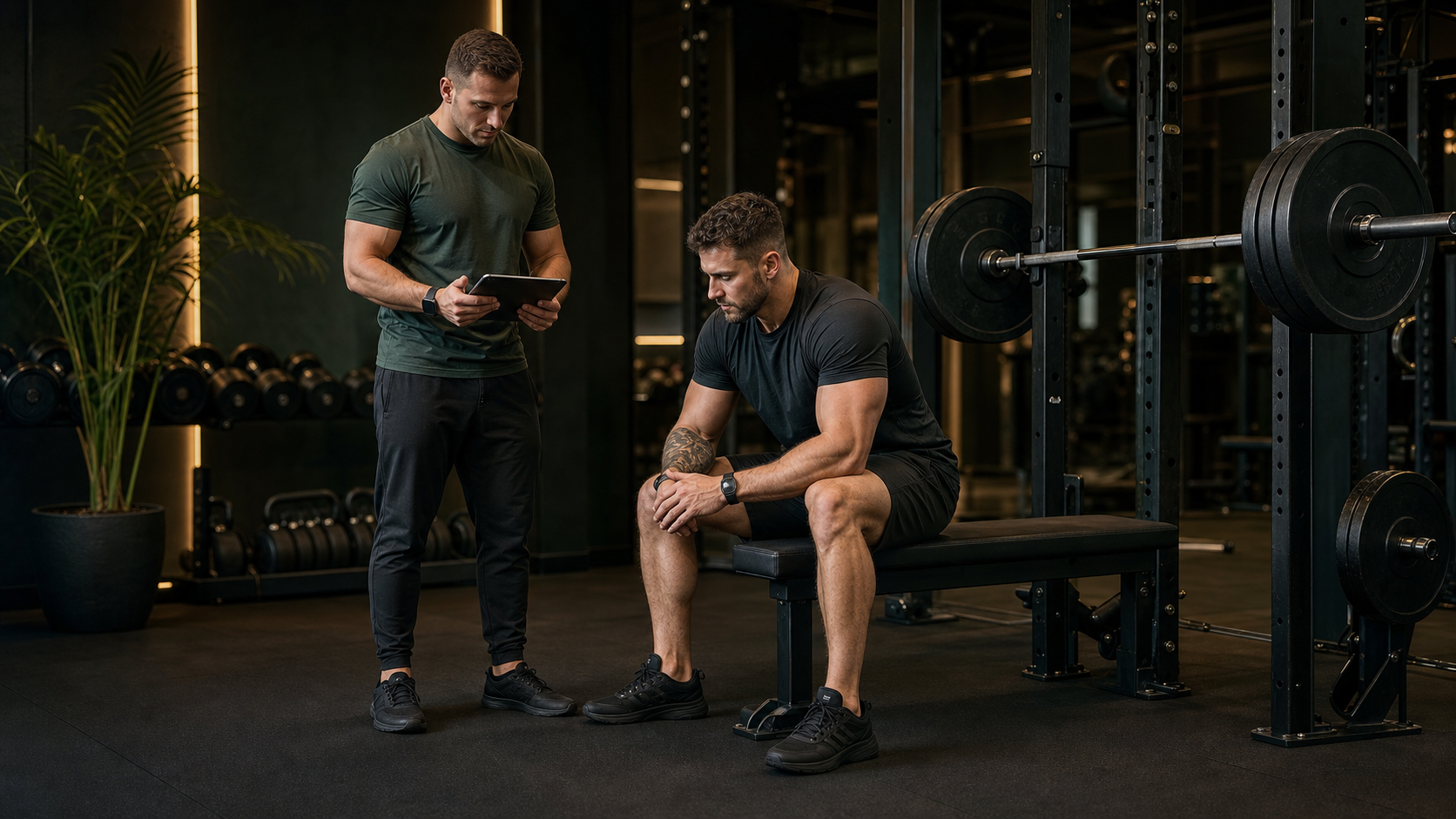
Resting between sets is not wasted time: it is how you match rep quality to the real goal of the session.
How Long to Rest Between Sets in Massanassa: A Practical Guide for Strength, Muscle and Fat Loss
Author
Alphafit Team
Editorial team at Alphafit Gym Massanassa
Reviewed by
Alphafit Technical Coaching Team
Strength training and personal coaching team in Massanassa
Some people rest 20 seconds because they want to “sweat more”. Others sit with their phone for five minutes and then wonder why the workout takes forever. The useful question sits in the middle: how long should you rest between sets to train better?
At Alphafit Gym Massanassa, we see this every week. Effort is rarely the missing piece. What people often need is a clearer way to decide when to recover properly, when to keep the pace moving and when a rest period has turned into a pause with no purpose.
The short answer: it depends on the goal and the exercise. The practical answer: if you want strength and clean technique, rest longer; if you are doing accessories or conditioning work, you can shorten it; if your goal is fat loss, do not sacrifice lifting quality just to move faster.
Why rest changes the whole session
Rest between sets is part of programming, just like sets, reps, load and effort.
When you rest too little, fatigue builds earlier. That can be useful for density, conditioning or light accessory work. But it can also mean:
- you lift less weight,
- your reps drop too much,
- your technique gets worse,
- a strength session turns into random cardio.
A classic review on rest intervals in strength training summarizes that longer rest periods usually help lifters maintain more reps and load during heavy work (Sports Medicine). In the gym, that is straightforward: if your important set is worse because you rushed back too soon, you did not save time; you changed the training stimulus.
The quick guide by goal
Use this table as a starting point, not a rigid rule:
| Goal or set type | Suggested rest | How to use it |
|---|---|---|
| Technique, beginners or controlled machines | 60-120 seconds | Enough to breathe and repeat with control |
| Hypertrophy accessories | 60-120 seconds | A steady pace without losing range or control |
| Heavy hypertrophy compounds | 2-3 minutes | Better for holding load, reps and technique |
| Heavy strength work | 3-5 minutes | Recover breathing, grip and focus |
| Supersets or short workouts | 30-90 seconds | Only when patterns alternate and technique stays clean |
If you are unsure, look at the next set. If you repeat with solid technique and a similar level of effort, the rest period fits. If every set collapses, you are probably rushing or using too much load.
For strength: rest enough to perform
If you are doing squats, bench press, Romanian deadlifts, heavy assisted pull-ups, leg press or a demanding row, there is no need to hurry.
On main lifts, resting 2-4 minutes is often more useful than jumping back under the bar after 45 seconds. Not because longer rest is magic, but because it lets you move better, keep bar speed and accumulate quality sets.
One trial in trained men compared 1-minute and 3-minute rest periods over 8 weeks while keeping other training variables similar. The 3-minute group improved maximal strength more and showed greater gains in some muscle thickness measures (Schoenfeld et al., 2016).
That does not mean everyone must rest 3 minutes on every exercise. It means that if the goal of the set is performance, shortening rest by habit can work against you.
For muscle growth: short is not always better
For years, people repeated that muscle growth required short rest periods for a stronger pump. The pump can feel good, but it is not the only sign of a useful set.
For hypertrophy, the goal is usually to accumulate hard sets with stable technique and enough proximity to failure. If you rest so little that the load drops too much or your reps become accidental half-reps, you may be losing useful stimulus.
A simple rule:
- for heavy compound lifts, use 2-3 minutes;
- for machines and accessories, try 60-120 seconds;
- for smaller isolation work, such as lateral raises or curls, 45-90 seconds can work if quality stays high.
If you are using load progression, rest needs to be stable enough to compare weeks. A chest press log is less useful if one week you rested 3 minutes and the next week 50 seconds without noticing.
For fat loss: less rest is not always better
This is where a common mistake appears: assuming less rest burns more fat because you sweat more.
A denser workout can feel harder, but fat loss depends on the full picture: nutrition, steps, strength training, cardio placement, sleep and consistency. If resting too little turns your sets into low-quality reps, you weaken one of the most important pieces: preserving muscle and strength.
For fat loss, think like this:
- keep full rests on main lifts;
- shorten accessory rests slightly if technique stays clean;
- use smart supersets, not chaos;
- keep HIIT for when it actually fits, not as a disguise for every weight session.
If your schedule is tight, combine this with our guide to time-efficient strength training in Massanassa.
How to rest without losing focus
Resting does not mean checking out of the session.
Between sets, try this order:
- make the bar or machine safe;
- breathe and let your heart rate settle;
- log load, reps and how the set felt;
- choose one technical cue for the next set;
- go again when you can repeat with quality.
What to avoid:
- opening social media and losing track of time;
- starting the next set while still light-headed;
- talking so long that the session cools down;
- treating the timer like punishment when technique clearly needs more rest.
A timer helps, but quality leads. If your breathing is still out of control after a hard leg set, give yourself room. If you just did a light curl, you probably do not need two minutes.
Real examples at Alphafit
Lower-body strength day
- Heavy leg press: 3 minutes
- Romanian deadlift: 2-3 minutes
- Split squat: 90-150 seconds
- Hamstring curl: 60-90 seconds
- Calves or core: 45-75 seconds
Upper-body hypertrophy
- Incline press: 2-3 minutes
- Supported row: 2 minutes
- Chest machine: 90-120 seconds
- Lat pulldown: 90-120 seconds
- Lateral raises: 60-90 seconds
- Biceps or triceps: 45-75 seconds
45-minute express session
- Use big exercises with 90-150 second rests.
- Alternate push and pull when possible.
- Pair compatible accessories, such as lateral raises with triceps.
- Do not turn heavy squats and heavy deadlifts into a superset.
The goal of a short workout is not to rush. It is to remove filler and protect what matters.
How it fits your weekly split
Rest between sets also depends on how your week is structured.
If you train full body 2 or 3 days, you may need slightly longer rests on the main lifts because each session hits many areas. If you train upper-lower 4 days, you can distribute fatigue better and keep rest periods more consistent. If you train PPL 5 or 6 days, make sure total volume is not forcing you to cut rest so much that you are always training tired.
If you are still choosing your structure, read our guide on full body, upper-lower or PPL.
Signs you need to adjust your rests
You are resting too little if:
- you lose 3 or more reps between sets with the same load;
- technique breaks even though the weight is reasonable;
- you are limited more by breathlessness than by the target muscle;
- every exercise feels like HIIT.
You are resting too long if:
- the workout drags on for no clear reason;
- every set feels like starting from zero;
- you lose focus;
- accessories take as long as your main lifts.
The middle ground is not always 90 seconds. The middle ground is the rest period that lets the set do its job.
Conclusion: rest with intent
Resting well is not soft. It is good training.
If you want strength, let your body recover. If you want muscle growth, do not trade good sets for chasing a pump. If you want fat loss, remember that strength quality still matters. And if time is tight, cut distractions before cutting every rest period.
At Alphafit Gym Massanassa, we help you adjust rests, exercises and progression so every session has a reason behind it instead of copying generic timings from the internet.
If you want to train with a clearer structure, visit Alphafit Gym Massanassa or contact us through the contact page.
Sources
- Rest interval between sets in strength training · Sports Medicine
- Longer Interset Rest Periods Enhance Muscle Strength and Hypertrophy in Resistance-Trained Men · Journal of Strength and Conditioning Research
- WHO guidelines on physical activity and sedentary behaviour · World Health Organization
- American College of Sports Medicine position stand. Progression models in resistance training for healthy adults · Medicine & Science in Sports & Exercise