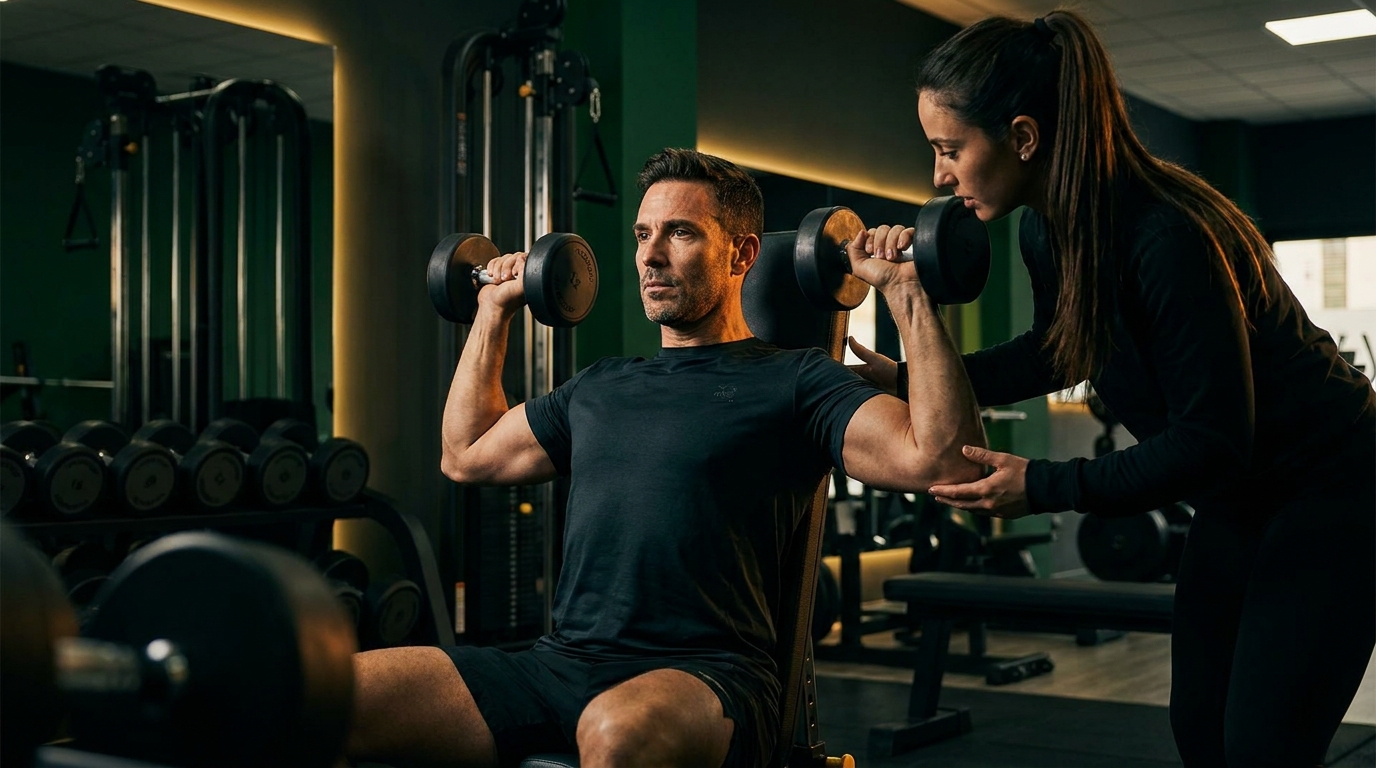
Good shoulder training combines vertical pressing, lateral raises, rear-delt work and technical control.
Shoulder Training in Massanassa: Presses, Lateral Raises and Rear Delts without Loading Your Neck
Author
Alphafit Team
Editorial team at Alphafit Gym Massanassa
Reviewed by
Alphafit Technical Coaching Team
Strength training and personal coaching team in Massanassa
Shoulders tend to create two very different questions. One person walks in thinking they must do a heavy overhead press no matter what. Another does lateral raises with more weight than they can control, feels the neck before the delt and leaves wondering why the side shoulder never seems to grow.
At Alphafit Gym Massanassa, we see both patterns. Effort is usually not the missing piece. Structure is: one vertical press you can control, precise lateral work, rear-delt training for balance and enough technique so your neck, low back and ego do not run the session.
This guide helps you train shoulders with a clear plan instead of turning every upper-body day into an endless list of presses and raises.
What shoulder training really means
The shoulder is not trained well by thinking about one exercise only. The deltoid has three areas worth covering:
- anterior deltoid, heavily involved in shoulder presses and many chest exercises,
- lateral deltoid, key for the visual width of the shoulder,
- rear deltoid, important for balancing pressing work and improving upper-back control.
Trap muscles, rotator cuff, shoulder blades, core and triceps also contribute depending on the exercise. That is why a good session is not just “overhead press and done”.
The CDC recommends muscle-strengthening activity at least 2 days per week, including major muscle groups such as shoulders, chest, back, arms, abdomen, hips and legs. In the gym, that means shoulder work should sit inside a balanced week instead of fighting chest and back for all the volume.
Pressing is useful, but not mandatory for everyone
The barbell overhead press is powerful, measurable and motivating. It also asks for shoulder mobility, core control and good technique so the movement does not turn into a low-back extension.
If it suits you, great. If it does not, you still have solid options:
- seated dumbbell shoulder press,
- shoulder press machine,
- Smith-machine press,
- neutral-grip press,
- landmine press if the setup is available,
- or slightly inclined variants that feel more stable.
The question is not “which press is the purest”. The question is: can you do quality sets, progress for several weeks and finish without odd pain?
If yes, that press can be your base. If not, reduce the load, change the variation or ask for help before pushing through.
Signs of a good shoulder rep
A good press or raise does not need to look dramatic. It needs to be repeatable.
Look for these signs:
- firm feet and a stable torso,
- ribs controlled, without arching the low back to gain range,
- long neck, without shrugging the shoulders toward the ears,
- wrist and elbow aligned on presses,
- controlled lowering,
- comfortable range without bouncing or jerking,
- clear effort in shoulder and triceps, not only traps and neck.
The Mayo Clinic emphasizes proper technique, balance between muscle groups and rest as ways to get better results and reduce injury risk. On the gym floor, that shows up quickly: if adding weight makes you lose posture, cut range or feel pain, the load has not improved the exercise. It has changed it.
The 4 blocks your shoulder training should include
You do not need ten exercises. For most people, these four blocks cover what matters.
1. A vertical press
This can be an overhead press, a dumbbell press or a machine press. It is the easiest block to measure because you can track load, reps and control from week to week.
Key points:
- start with a variation that gives you confidence,
- do not push your head forward or arch your back,
- lower to a comfortable range,
- keep 1-3 reps in reserve on most sets,
- do not treat every set like a max test.
If you are coming from a heavy chest day, remember that the front delt has already worked. You do not always need more heavy pressing.
2. Lateral raises
This is where many people miss because they get ambitious. They grab too much weight, swing the torso, lift with traps and then wonder why they do not feel the side delt.
Make it simpler:
- elbows slightly bent,
- arms slightly in front of the body, not straight out in a cross,
- raise to shoulder height or a little below,
- control the way down,
- use dumbbells, cable or machine depending on what you feel best,
- prioritize 10-20 clean reps before chasing heavier weights.
A light, precise lateral raise usually gives more than a heavy one where the whole body helps.
3. Rear delts
Rear delts are easy to forget because you do not see them in the front mirror. But they help balance all that pressing, improve shoulder stability and connect well with back training.
Useful options:
- reverse pec deck,
- rear-delt flyes with dumbbells,
- face pulls,
- reverse cable flyes,
- light high rows with elbows open if you control them.
Think about sending the elbows out and back without shrugging the neck. You do not need to lift heavy here. You need to feel the back of the shoulder.
4. Upper back and scapular control
Shoulders do not live alone. If you only push and barely pull, the upper body becomes lopsided.
Combine shoulder work with pulldowns, rows and some shoulder-blade control. Our guide to back training in Massanassa helps you organize that side so everything does not depend on pressing.
Practical 2-day shoulder routine
This structure fits well into an upper/lower, full-body or push/pull/legs week. Choose loads that make the last reps challenging without breaking technique.
Day A: press and lateral control
| Exercise | Sets | Reps |
|---|---|---|
| Dumbbell or machine shoulder press | 3-4 | 6-10 |
| Dumbbell lateral raise | 3 | 12-20 |
| Reverse pec deck or rear-delt fly | 2-3 | 12-20 |
| Light face pull | 2 | 12-15 |
Day B: volume and rear delts
| Exercise | Sets | Reps |
|---|---|---|
| Light seated press or Smith-machine press | 2-3 | 8-12 |
| Single-arm cable lateral raise | 3 | 12-18 per side |
| Reverse cable fly or reverse pec deck | 3 | 12-20 |
| Shrug or farmer carry if needed | 2 | 10-15 or 30-40 m |
If you train shoulders once per week, do not merge both full days. Choose one press, one lateral raise, one rear-delt movement and maybe one accessory. Eight to twelve good sets beat twenty sets where the last ones only load your neck.
How to progress without forcing the shoulder
Progress does not have to mean heavier dumbbells every week. You can progress in several ways:
- add 1 or 2 reps with the same load,
- improve range without pain,
- control the lowering better,
- use less momentum,
- repeat more quality sets,
- add a small amount of load once you own the rep range.
The classic ACSM position stand on resistance-training progression describes gradual load increases once the person can exceed the target reps with good execution. In practice, that means there is no rush: clean reps first, more load later.
Example with lateral raises:
| Week | Load | Sets |
|---|---|---|
| 1 | 6 kg | 14, 13, 12 |
| 2 | 6 kg | 16, 14, 13 |
| 3 | 6 kg | 18, 16, 15 |
| 4 | 7 kg | 13, 12, 11 |
That is progress even if it does not look heroic. Shoulders usually appreciate patience.
Common shoulder-training mistakes
1. Doing too many front raises
The front delt already works hard in bench press, incline press and shoulder press. Front raises are not useless, but many routines add them by habit while the lateral and rear delts need more attention.
2. Turning laterals into a trap exercise
If every rep ends with the shoulders by the ears, reduce the load. Think about moving the arms away from the body, not lifting the dumbbells at any cost.
3. Arching the back on presses
Some body tension is normal. But if your press looks like a low-back bridge, the weight or variation is not right. Try seated, dumbbells or a machine while you improve control.
4. Training shoulders tired from chest
If the previous day included lots of bench press, incline press and dips, do not expect the shoulder to be fresh. Adjust order and volume. The guide to chest training in Massanassa can help you distribute pressing better.
5. Ignoring persistent discomfort
Muscle fatigue is one thing. Sharp pain, a catching sensation, loss of strength or recurring discomfort is another. The NHS recommends getting help if shoulder pain gets worse, does not improve after 2 weeks or makes it very difficult to move the arm. In the gym, our rule is simple: do not train through pain that changes your technique.
How to warm up before shoulders
You do not need twenty minutes of band work. You do want to reach the first press with your upper body ready.
Use a short version:
- 3 easy minutes of rowing, bike or general mobility.
- 10 scapular retractions.
- 10 very light face pulls.
- 8 very easy dumbbell presses.
- 2-3 warm-up sets for the first exercise.
If you always start cold or your press feels awkward, revisit our guide to warming up before strength training.
How to fit it into your week
If you do full body, you can place a press or a lateral raise into 2 or 3 sessions without needing a whole shoulder day.
If you do upper/lower, split presses and laterals across both upper-body days. Rear delts can sit next to back work.
If you do push/pull/legs, the push day already loads chest, shoulders and triceps. Do not turn it into an endless press list. Leave room for recovery and progression.
The goal is not to leave with destroyed shoulders. It is to look at your log in four weeks and see better reps, more control or a slightly higher load without discomfort.
When to ask for help
Ask for help if you always feel neck before shoulder, if lateral raises never click, if pressing forces you to arch your back, if you have previous discomfort or if you do not know how to distribute chest, back and shoulders in the same week.
At Alphafit, we can review your technique, choose variations that fit you and adjust volume so your shoulders progress without guesswork.
If you want to train shoulders with a clear structure, visit Alphafit Gym Massanassa or write to us through contact. We will help you turn presses, laterals and rear-delt work into progress you can measure.
Sources
- Adult Activity: An Overview · Centers for Disease Control and Prevention
- Weight training: Do's and don'ts of proper technique · Mayo Clinic
- Progression models in resistance training for healthy adults · Medicine & Science in Sports & Exercise
- Shoulder pain · NHS