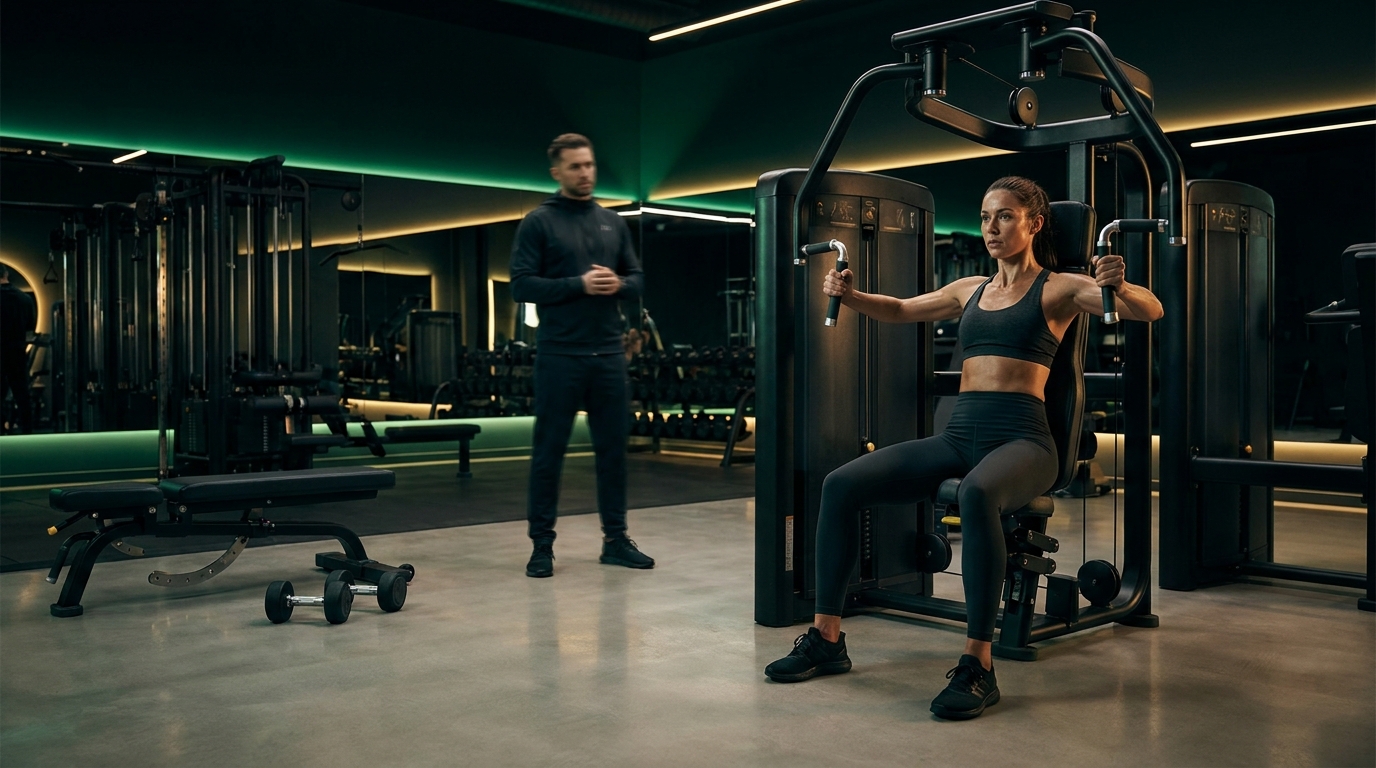
A good gym start is built on support, technique, and progression before unnecessary complexity.
How to Start at the Gym in Massanassa as a Beginner: Machines, Free Weights, and a 3-Day Plan
Author
Alphafit Team
Editorial team at Alphafit Gym Massanassa
Reviewed by
Alphafit Technical Coaching Team
Strength training and personal coaching team in Massanassa
Starting the gym from scratch usually does not fail because of low motivation. It fails because there is too much noise.
You walk into the room, see machines on one side, barbells and dumbbells on the other, hear about upper-lower splits, full body, cardio, HIIT, abs, steps… and within half an hour it feels like you need a master’s degree just to train.
At Alphafit Gym Massanassa we see this a lot with people coming in for the first time, or with people who have only ever touched a gym casually: the question is not only “what do I do today?” but where do I start without feeling ridiculous, getting hurt, or disappearing after two weeks.
The good news is simple: your first month does not need complexity. It needs a structure that is simple, repeatable, and matched to your real starting point.
The first big question: machines or free weights?
This is one of the most common beginner questions right now: should you start with guided machines, or go straight to dumbbells, barbells, and freer movement patterns?
The short answer is less dramatic than the internet makes it sound. The 2026 ACSM Position Stand concluded that equipment type and exercise complexity do not consistently change outcomes for most healthy adults starting resistance training. A 2023 systematic review and meta-analysis also found no clear difference between free weights and machines in the direct comparison of strength and hypertrophy outcomes.
In gym language: there is no single correct entrance door.
What does exist is a more useful or less useful starting point for your situation:
- machines if you need security, less coordination, and more confidence at first,
- free weights if you can learn technique with supervision and tolerate less guided movement well,
- and a blend of both if you want to progress without turning either side of the gym into an identity.
When it makes sense to start with machines
For a lot of beginners, machines are a very good ramp into training.
They tend to fit especially well if:
- you have never really done strength training before,
- the free-weight area feels intimidating,
- your basic technique is not there yet,
- you are coming from a long inactive period,
- or you want to learn effort first without also fighting balance and bar path.
Machines are not “for newbies” in a dismissive sense. They are tools.
They help you:
- understand which muscles should be working,
- control the load more easily,
- approach hard effort with less fear,
- and leave the session thinking, “I can do that again.”
That matters because in the first weeks adherence matters more than the perfect exercise. If a beginner in Massanassa strings together 6-8 consistent training weeks without dread, that person is already building the base that makes real progress possible later.
When free weights can also make sense from day one
Free weights do not mean forcing yourself into a heavy back squat with an Olympic bar on your first Monday.
Free weights also include:
- a goblet squat with a dumbbell,
- a dumbbell press,
- a light Romanian deadlift,
- a supported one-arm row,
- or farmer carries with moderate load.
If you have someone who can coach your setup, if coordination does not freeze you up, and if you start with simple movements, free weights can give you useful benefits early on:
- more body awareness,
- better control of posture and tension,
- and a more natural transition into patterns you may later load more heavily.
The problem is not free weights themselves. The problem is trying to begin with the most technical, heaviest, or ego-driven version of free-weight training.
If you recognise yourself in thoughts like “the free-weight area makes me nervous” or “big barbells scare me,” you are not alone. That objection shows up again and again in beginner communities. That is exactly why we prefer a progression that lets you build confidence before asking for heroics.
The best path for most people: a hybrid approach
For most beginners, the smartest route is usually a mix.
You do not need to pick a side. You need to pick exercises you can learn, repeat, and progress.
A very useful starter block often combines:
- a stable lower-body pattern such as a leg press or goblet squat,
- an upper-body push on a machine or with dumbbells,
- a pull such as a seated row or pulldown,
- a simple hinge such as a dumbbell Romanian deadlift,
- and core or loaded carry work.
That lines up well with current evidence: the 2026 ACSM Position Stand emphasises that going from no strength training to regular strength training already creates meaningful improvements, even without complicated programming. Your body does not reward exercise prestige. It rewards a solid stimulus repeated over time.
How many days do you actually need at the start?
This is where many beginners overshoot.
The WHO recommends adults perform muscle-strengthening work for major muscle groups at least 2 days per week, alongside enough aerobic activity for general health. A review on resistance-training frequency found that strength gains generally improved as weekly frequency increased, but that does not mean a beginner needs to live in the gym to make progress.
In practice, for most people starting well:
- 2 days can already work if you are consistent,
- 3 days is often the sweet spot for building the habit and learning,
- and 4 or 5 days is usually unnecessary at first if you do not yet manage technique, recovery, and volume well.
If you are thinking, “I’ll just go Monday to Friday so I force myself,” be careful. That often lasts ten days and then disappears. Three good weeks beat one heroic week and two weeks of guilt.
A simple 3-day plan for your first 4-6 weeks
It is not the only way to do it, but it is a very useful one if you want to start in Massanassa with some structure.
The general idea:
- 5-7 minutes of easy warm-up,
- 4 or 5 main exercises,
- 2 or 3 sets per exercise,
- 8-12 reps most of the time,
- leaving 1-3 reps in reserve,
- and walking out feeling trained, not destroyed.
Day A
- leg press or goblet squat
- machine chest press or dumbbell press
- seated row
- dumbbell Romanian deadlift
- plank or dead bug
Day B
- lunge or assisted split squat
- lat pulldown
- incline dumbbell press or machine press
- hip thrust or glute bridge
- farmer carry or core work
Day C
- lighter goblet squat or leg press
- supported row or pulldown with a different grip
- vertical press on a machine or with dumbbells
- hamstring curl or light hinge work
- 10-12 minutes of easy cardio at the end
If you can only train 2 days, alternate A and B in week one, then B and C in week two. The key is not perfect calendar symmetry. The key is staying with a recognisable structure for several weeks.
If you are not fully new and are actually returning after time away, it may also help to pair this with our guide on returning to the gym after a break.
How to move from machines to free weights without making it a leap
You do not need a dramatic jump. You need progression.
A very natural sequence could look like this:
- leg press -> goblet squat
- machine chest press -> dumbbell press
- seated row -> supported dumbbell row
- glute bridge -> dumbbell Romanian deadlift
The useful question is not “when do I quit machines forever?” The useful question is “which movement pattern do I now control well enough to make it less guided?”
You are usually ready for that step when:
- you keep your posture without overthinking it,
- you understand how to regulate effort,
- you can repeat the same pattern with control for several weeks,
- and you no longer train with fear attached to every rep.
Common mistakes in the first month
Several patterns show up again and again:
1. Copying an advanced routine
Too much volume, too many exercises, and no context. You do not need a bodybuilding split to learn how to train.
2. Changing everything every week
If the exercises are always different, you cannot tell whether you are progressing or just improvising.
3. Treating soreness as success
Finishing wrecked does not mean you trained better. Very often it just means you overshot your current level.
4. Using cardio as punishment
Cardio can help, but it should not compensate for a weak strength structure. If you want more context here, our guide to the benefits of strength training is a good next read.
5. Judging everything by the mirror after two weeks
Early progress also looks like this:
- you understand the machines better,
- you add a little load or a few reps,
- you recover better between sessions,
- and you walk into the gym with less mental tension.
How to tell that you are really progressing
Your first goal is not to look like a different person in twenty days. Your first goal is to make the gym feel like a place that no longer pushes you out.
Good signs usually look like this:
- you no longer waste ten minutes deciding where to start,
- you repeat exercises with more confidence,
- weights or reps go up slightly,
- you need less heroic motivation to show up,
- and you leave tired, but not wrecked.
That is the kind of progress that later allows for more visible body changes.
And if you want that progress to last, recovery matters more than it seems. If you notice accumulating fatigue, worse sleep, or soreness that never settles, check our guide to muscle recovery after training.
How we approach it at Alphafit Massanassa
At Alphafit Gym Massanassa, we do not treat beginners like people who should be thrown straight into a cage of barbells, but we also do not treat them like people who should stay locked into guided machines forever.
We aim for something far more useful:
- learning basic movement patterns,
- building confidence quickly,
- training with enough technical quality,
- and progressing without constant overwhelm.
Sometimes that starts with more machines, sometimes with more dumbbells, and very often with a mix of both. If you want help fitting that progression to your real starting point, our strength and coaching services are a solid next step.
Conclusion
If you are a beginner, starting well at the gym does not depend on choosing “the right side” of the room.
It depends on something much simpler:
- a structure you can repeat,
- exercises matched to your level,
- enough effort to matter but not so much that it blows up the week,
- and consecutive weeks without disappearing.
Machines and free weights are not a religion. They are tools. What matters is using them in the order that helps you build technique, confidence, and consistency.
If you want to start with a realistic, well-guided plan in Massanassa, at Alphafit Gym we can help you build that first block without improvising.
Sources
- WHO guidelines on physical activity and sedentary behaviour · World Health Organization
- American College of Sports Medicine Position Stand. Resistance Training Prescription for Muscle Function, Hypertrophy, and Physical Performance in Healthy Adults: An Overview of Reviews · Medicine & Science in Sports & Exercise
- Effect of free-weight vs. machine-based strength training on maximal strength, hypertrophy and jump performance - a systematic review and meta-analysis · BMC Sports Science, Medicine and Rehabilitation
- Effect of Resistance Training Frequency on Gains in Muscular Strength: A Systematic Review and Meta-Analysis · Sports Medicine