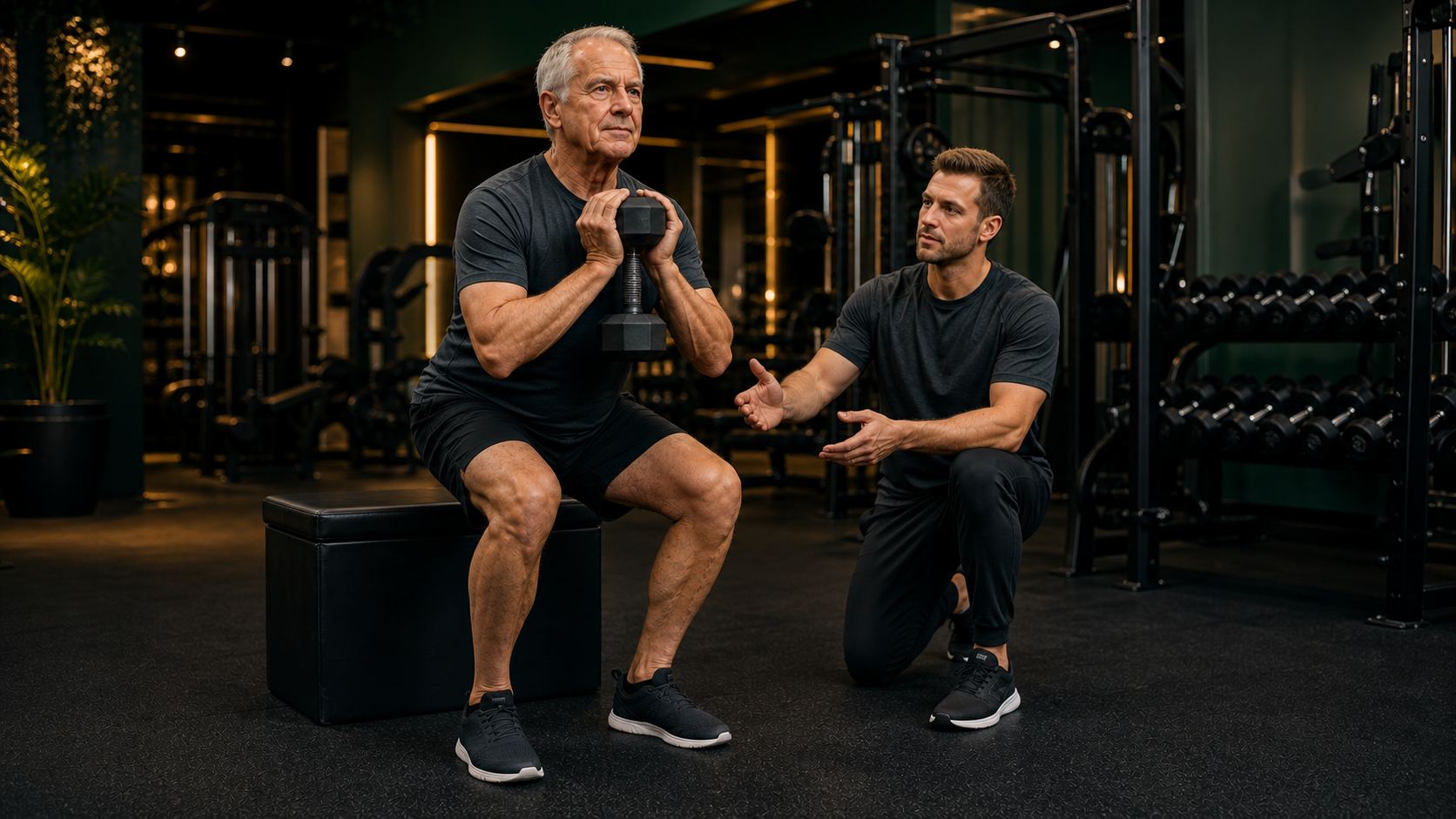
Strength after 60 starts with controlled movements, clear support and measurable progression.
Strength Training Over 60 in Massanassa: How to Build Confidence, Balance and Independence
Author
Alphafit Team
Editorial team at Alphafit Gym Massanassa
Reviewed by
Alphafit Technical Coaching Team
Strength training and personal coaching team in Massanassa
Starting strength training after 60 does not mean training like a bodybuilder or doing sessions that leave you exhausted for three days. It means something far more useful: building confidence to stand up, walk, climb stairs, carry shopping bags and keep living with more independence.
At Alphafit Gym Massanassa, we hear the same concern from older adults and their families: “Is it too late to start?” The short answer is no. The better answer is: it is not too late, but it is worth starting with method, progression and a realistic view of balance, mobility and health history.
This guide is for people over 60 who want to move again, for those who already walk but feel they lack strength, and for family members who want to support a safe first step.
Why strength matters so much after 60
As we age, it is normal to lose some muscle mass, power and confidence when moving. But “normal” does not mean every effect is inevitable or impossible to improve. Strength can be trained, and doing it well can make simple daily tasks feel easier again.
The WHO notes that physical activity in adults and older adults is linked with lower risk of chronic disease, better mental health, better sleep and lower fall risk. In the gym, that becomes something very practical: the goal is not lifting more for ego, but recovering capacity for daily life.
The focus also changes. After a certain age, “doing a bit of cardio” is not enough. A useful plan should combine:
- strength for legs, back, chest, arms and core,
- balance to react better to trips,
- mobility to move with less stiffness,
- and light or moderate aerobic activity, such as walking.
If you are under 60 but already feel you need to train with more structure, read our guide to strength training after 40 in Massanassa.
How much training do you really need?
For adults 65 and older, the CDC gives a simple weekly mix: aerobic activity, at least 2 days of muscle-strengthening activity and balance work. That does not need to become an impossible schedule.
A realistic starting point could be:
- 2 strength sessions in the gym,
- 2 or 3 comfortable walks each week,
- 5 minutes of balance and mobility on most days,
- 1 or 2 days of rest or very light activity.
The key is not starting perfectly. It is repeating without fear and without changing the plan every week.
Before you start: safety without panic
If you have uncontrolled cardiovascular disease, frequent dizziness, recent falls, sharp pain, advanced osteoporosis, recent surgery or medication-related doubts, speak with your doctor or physiotherapist first. That does not mean you cannot train. It means the plan should be adapted well from the beginning.
On the gym floor, we use three rules:
- The exercise should feel challenging, but controlled.
- Sharp pain, dizziness or unusual breathlessness should not be pushed through.
- Technique matters more than weight.
This mindset avoids two opposite mistakes: being so afraid that you do nothing, or trying to make up for years of inactivity in two weeks.
Machines, free weights or chair exercises
When starting after 60, machines can be an excellent tool. They help you learn movement, adjust range of motion and build confidence without controlling too many variables at once. That is why our gym machines guide in Massanassa can be useful early on.
But not everything needs to be machine-based. A good plan can combine:
- sit-to-stands from a chair to practise a daily-life movement,
- leg press to strengthen the legs with support,
- seated row for back and posture,
- machine chest press for controlled pushing,
- light Romanian deadlift to learn a hip hinge,
- carries with light dumbbells for grip, core and stability,
- low step-ups for stairs and balance.
The goal is not to look young. It is to train movements you can feel at home, outside and in everyday life.
Intensity: neither disguised walking nor punishment
Many older adults train too lightly because they are afraid. Others start very motivated and do too much. Neither extreme helps.
The NSCA position statement on resistance training for older adults supports adapted resistance training to improve strength, function and independence in older populations. In practice, that means using enough intensity to progress without losing control.
A simple reference:
- during the first weeks, finish each set with 3 or 4 reps “in reserve”,
- once technique is stable, sometimes work with 1 to 3 reps in reserve,
- increase weight only if the movement stays clean,
- rest long enough to repeat well, usually 60-120 seconds.
There is no prize for an ugly rep. Good progress can look calm from the outside, but it feels very different from the inside.
A 2-day routine to start
This example does not replace an individual assessment, but it shows a reasonable structure for someone starting at Alphafit who wants more strength, balance and confidence.
| Day A | Sets and reps | Technical focus |
|---|---|---|
| Sit-to-stand or leg press | 2-3 x 8-12 | Control the lowering phase and push the floor |
| Machine chest press | 2-3 x 8-12 | Relax shoulders, use a comfortable range |
| Seated row | 2-3 x 10-12 | Pull elbows back without shrugging |
| Light Romanian deadlift | 2 x 8-10 | Hips back, neutral spine |
| Dumbbell carry | 3 x 20-30 m | Walk tall without swaying |
| Balance near support | 3 x 20-30 s | Keep a hand close to a stable surface |
| Day B | Sets and reps | Technical focus |
|---|---|---|
| Low step-up | 2-3 x 8 each leg | Step up with control, lower slowly |
| Lat pulldown | 2-3 x 8-12 | Chest tall, pull with the back |
| Light shoulder press | 2 x 8-10 | Avoid arching the lower back |
| Glute bridge | 2-3 x 10-12 | Squeeze the glutes at the top |
| Pallof press with cable or band | 2 x 10 each side | Keep the trunk stable |
| Easy walk | 10-20 min | Comfortable pace, controlled breathing |
Before each session, spend a few minutes warming up. If you are unsure how to do that, use this practical guide to warming up before strength training.
How to progress without getting injured
Progression does not always mean adding weight. After 60, progress often means:
- doing the same exercise with better control,
- gaining range of motion without discomfort,
- standing up from a lower chair,
- walking with more stability,
- resting less without losing technique,
- or completing one more consistent week of training.
When those pieces are stable, then it makes sense to increase load a little.
A simple method:
- Choose a range, for example 8-12 reps.
- Keep the same weight until you reach the top of the range with good technique.
- Add a small plate or a light dumbbell.
- Return to the lower end of the range and repeat.
If you want to understand this logic better, read our guide to load progression in the gym.
Balance: the part many people forget
Balance is not only trained with strange exercises on unstable surfaces. It also improves when you strengthen legs, glutes, feet and core, and when you practise movements that resemble real life.
The Vivifrail project frames multicomponent exercise as a tool to maintain function and independence in older adults. That word, “multicomponent”, matters: strength, balance, mobility and endurance do not compete. They support each other.
Simple examples:
- standing up from a chair without using your hands,
- walking in a line near a wall,
- holding a single-leg stance with one hand nearby,
- stepping onto a low box,
- carrying two light dumbbells while walking straight.
It does not need to be risky to work. Balance is trained best when the challenge is clear and the environment is safe.
Signs you are on the right track
In 4-8 weeks, you do not need a dramatic transformation. Look for more useful signals:
- standing up from a chair feels easier,
- stairs feel more confident,
- you feel less afraid to move,
- your walking feels steadier,
- you recover better between sessions,
- you understand what weight to choose on each machine,
- you want to repeat the plan next week.
That is real progress. And it often arrives before big visual changes.
When to ask for coaching
Ask for help if you do not know how to adjust machines, if you are afraid of falling, if you have previous injuries, if you train with pain, if routines confuse you or if you need someone to set a sensible pace.
At Alphafit, we can help you build a strength plan adapted to your age, level, schedule and safety needs. Some people should start with machines and assisted exercises. Others can move quickly toward dumbbells, cables and more dynamic work. The difference comes from assessment, not age alone.
If you want to start strength training after 60 in Massanassa, contact Alphafit Gym and we will help you choose the most sensible first step.
Sources
- Physical activity · World Health Organization
- Older Adult Activity: An Overview · Centers for Disease Control and Prevention
- Resistance Training for Older Adults: Position Statement From the National Strength and Conditioning Association · Journal of Strength and Conditioning Research
- Vivifrail project · Vivifrail