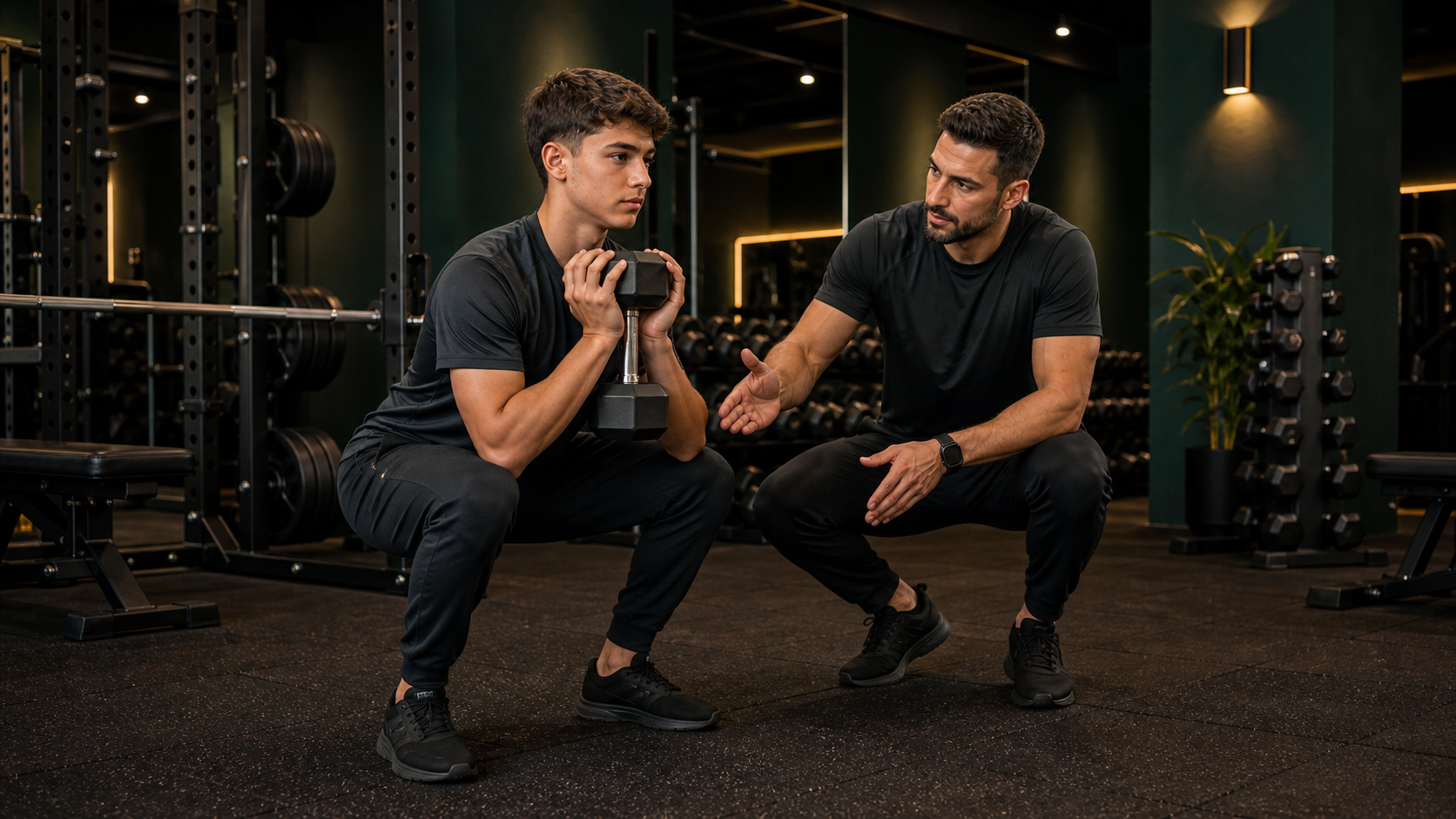
For a teenager, starting strength training is not about lifting the most weight: it is about learning technique, building confidence, and creating a safe habit.
Strength Training for Teenagers in Massanassa: How to Start Safely Without Copying TikTok
Author
Alphafit Team
Editorial team at Alphafit Gym Massanassa
Reviewed by
Alphafit Technical Coaching Team
Strength training, beginner onboarding and personal coaching team in Massanassa
More and more teenagers want to join the gym. Some come because of a sport, some want to build strength, some have seen routines online, and some simply want to feel better in their body.
The question many families in Massanassa ask is completely reasonable: “Is it safe for my son or daughter to strength train? Where should they start? Machines, dumbbells, classes, an internet routine?”
The useful answer is not to forbid the gym out of fear, and it is not to leave a teenager on the gym floor copying the first thing they see. The middle path is better: start with supervision, technique, moderate loads, realistic goals, and clear communication between the teenager, family, and coaching team.
At Alphafit Gym Massanassa, we would frame it like this: first learn to move well; then progress.
The key idea: strength training yes, but not any way
Teen strength training should not look like an ego challenge. It does not start by testing a bench press max, doing every exercise from a viral routine, or training six days because “otherwise it does not count.”
It starts with something much more basic:
- learning movement patterns;
- controlling posture;
- knowing how to adjust a machine;
- understanding what a clean repetition looks like;
- leaving margin before failure;
- and building consistency without unusual pain or aesthetic pressure.
Youth activity recommendations already include muscle-strengthening work. The CDC explains that children and adolescents aged 6 to 17 should accumulate at least 60 minutes of moderate-to-vigorous activity each day, including muscle- and bone-strengthening activities several days per week. That does not mean every teenager needs a formal gym plan, but it does challenge the idea that getting stronger is only for adults.
Is lifting weights safe for teenagers?
It can be safe when it is planned well. It can also be a poor idea when it is improvised.
The National Strength and Conditioning Association position statement recognizes that resistance training can benefit children and adolescents when it is appropriately prescribed and supervised. The important part of that sentence is not “weights.” It is appropriately prescribed and supervised.
In practice, that means:
- starting with exercises the teenager can control;
- avoiding max tests, ego contests, and forced technique;
- using loads that still allow coaching and correction;
- progressing gradually;
- warming up well;
- and checking any pain that is not normal training fatigue.
If there is an injury, medical condition, persistent pain, relevant medication, or previous medical advice, the priority is to speak with a health professional before starting or intensifying training.
What families should check before a teenager joins
Before talking about a workout plan, check the context.
Useful questions:
- does the teenager want to train, or do they feel pushed?
- are they looking for health, sport performance, aesthetics, confidence, or social connection?
- do they understand that technique comes before weight?
- is there real supervision, or only access to machines?
- does the gym explain rules, schedules, minimum age, and family authorization?
- is there an initial plan, or will they have to improvise from videos?
This matters. A teenager can have plenty of energy and still have little experience managing intensity, comparison, and the rush to see changes. Adult support does not remove autonomy; it protects it.
If the goal is choosing the right environment, our guide on how to choose a gym in Massanassa can also help.
Machines or free weights: where to start
There is no single correct door. There is a sensible progression.
For many teenagers, machines are a useful first tool because they:
- reduce some of the initial coordination demand;
- help the teenager feel the target muscle;
- make load adjustments easier to control;
- teach effort without too much technical complexity;
- and build confidence on the gym floor.
That does not make machines an “easy” or “inferior” area. If you want more detail on setup and technique, read our gym machines guide in Massanassa.
Free weights can also appear early, but through simple versions:
- goblet squat with a dumbbell;
- light Romanian deadlift;
- dumbbell press;
- supported row;
- farmer carry;
- core work such as dead bug or pallof press.
What we would avoid at the start is not free weights themselves. We would avoid starting with the most technical, heavy, or competitive version of the exercise.
The first plan: simple, repeatable, and with margin
For a beginner teenager, a 2- or 3-day weekly structure usually works better than a huge routine that cannot be sustained.
The WHO emphasizes that youth physical activity should be regular, varied, and age-appropriate. In a gym, that means the first week should not become a survival test.
A first session might include:
- 5-8 minutes of general warm-up;
- 2 leg or hip exercises;
- 2 upper-body exercises;
- 1 core or postural-control exercise;
- 2-3 sets per exercise;
- 8-12 repetitions;
- and 2-3 reps in reserve most of the time.
Example:
| Block | Exercise |
|---|---|
| Entry | easy bike, hip and shoulder mobility |
| Legs | leg press or goblet squat |
| Pull | seated row or lat pulldown |
| Hips | light dumbbell Romanian deadlift |
| Push | machine chest press or dumbbells |
| Core | dead bug, pallof press or side plank |
The routine does not need to be spectacular. It needs to be repeated, improved, and leave the teenager wanting to come back.
Technique before intensity
The most common mistake is not training “too easy.” It is trying to prove too much too soon.
Signs that the load is well chosen:
- back and pelvis stay stable;
- the movement looks similar on each repetition;
- there is no sharp pain;
- the teenager can follow instructions while training;
- the set feels challenging but controlled;
- the next day brings normal fatigue, not unusual joint pain.
Before adding weight, they should be able to answer simple questions: what exercise they did, why it was included, what load they used, how many reps they completed, and what they felt.
That is training education. And it is worth more than adding weight out of pride.
Warm-up: required, but not endless
A good teen warm-up does not need to last half an hour. It needs to prepare the body and teach attention.
It can include:
- 3-5 minutes of easy cardio;
- dynamic mobility for hips, ankles, shoulders, and upper back;
- one light set of the first exercise;
- and a quick explanation of the technical focus for the day.
For a more specific structure, pair this with our guide to warming up before strength training.
The idea is not to get tired before starting. It is to arrive at the first real set knowing what will be practiced.
Social media: inspiration, not the program
TikTok, Instagram, and YouTube can motivate. They can also confuse.
The problem is not watching videos. The problem is copying:
- exercises without knowing if they fit your level;
- routines built for advanced adults;
- excessive arm or glute volume;
- techniques that require mobility you do not yet have;
- or messages promising fast physical changes.
A teenager needs a filter: “This looks good, but does it make sense for my starting point?”
At Alphafit, we prefer social media to be inspiration, not the main coach. The real plan should come from an assessment, from watching technique, and from adapting exercises to how that person moves.
Nutrition, sleep, and aesthetics: be careful with pressure
With teenagers, the conversation should not revolve around aggressive dieting, supplements, or mirror obsession.
The priorities should be:
- eating enough and with variety;
- sleeping as much as real life allows;
- staying hydrated;
- not skipping meals to “cut”;
- not using supplements as shortcuts;
- and understanding that bodies change at different speeds.
The gym can improve strength, coordination, confidence, and habits. But if it becomes another source of comparison, something is going off track.
If the goal is muscle gain, fat loss, or body-composition change, families should avoid improvised restrictive diets. For minors, any specific nutrition plan should be reviewed with qualified professionals.
Signs the plan is going well
A good start is not measured only by more weight on the dumbbell.
It is going well if the teenager:
- arrives with reasonable motivation, not anxiety;
- learns to adjust machines and loads;
- asks questions;
- improves technique;
- respects rest periods;
- does not train through pain;
- can combine the gym with studies, sport, and social life;
- and understands that progress takes weeks and months.
It is also going well if the family sees more autonomy and responsibility, not just more tiredness.
Signs to slow down
Review the plan if you notice:
- persistent joint pain;
- discomfort that worsens session after session;
- obsession with training every day;
- fear around eating;
- constant comparison with social-media physiques;
- tiredness affecting studies or sleep;
- or loss of enjoyment.
Reducing volume, lowering load, or changing exercises is not failure. It is smart training.
How we apply this at Alphafit
With teenagers, the goal is not to put an adult routine into a young body. The goal is to build a base.
We would work with:
- an initial assessment of the real starting level;
- clear explanation of rules, technique, and safety;
- simple exercise selection;
- gradual progression;
- load review;
- communication with the family when needed;
- and a plan that does not compete with studies, sport, or sleep.
If you are a family in Massanassa and want to see whether the gym is a good fit for your son or daughter, you can review our training services or message us through contact. We will look at the case, age, goal, and best way to start without improvising.
Sources
- Child Activity: An Overview · Centers for Disease Control and Prevention
- WHO guidelines on physical activity and sedentary behaviour · World Health Organization
- Youth resistance training: updated position statement paper from the National Strength and Conditioning Association · Journal of Strength and Conditioning Research
- Physical Activity Guidelines for Americans, Second Edition · U.S. Department of Health and Human Services