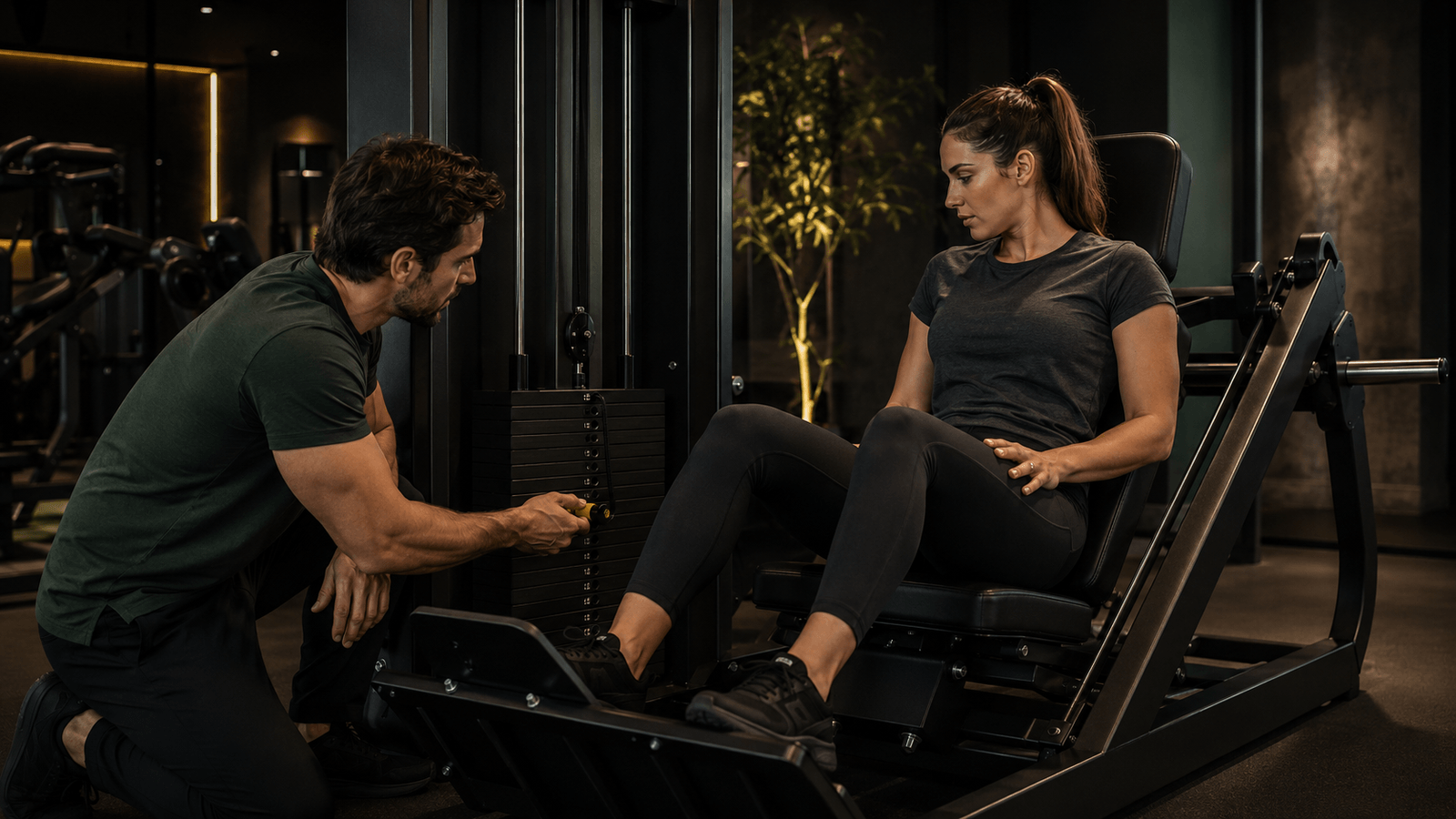
When sleep falls short, adjusting the load after the warm-up can preserve the habit without forcing a maximal session.
Should You Train After a Bad Night's Sleep? How to Adjust Your Workout in Massanassa
Author
Alphafit Team
Editorial team at Alphafit Gym Massanassa
Reviewed by
Alphafit Technical Coaching Team
Strength training, recovery, and personal coaching team in Massanassa
Your alarm goes off after a short night. You slept five or six hours, your head feels foggy, and today was meant to be an important strength session. The question appears immediately: should you go to the gym, reduce the workout, or rest?
The answer is neither “always push through” nor “one bad night ruins your progress.” Poor sleep can reduce performance, increase perceived effort, and impair attention, but the effect varies with the individual, the type of session, and whether this was one isolated night or a pattern.
At Alphafit Gym Massanassa, we use a more useful decision: assess how you feel, test it during the warm-up, and adjust the workout before fatigue makes the choice for you.
The short answer: one bad night does not always mean cancelling
If you slept a little less than usual, feel alert, and move normally, you can train. Start conservatively and let your warm-up confirm the plan.
If you can barely keep your eyes open, feel dizzy, notice clearly poorer coordination, or have accumulated several bad nights, this is not the day to chase records, take sets to failure, or complete a punishing HIIT session. Switch to a short, stable workout, choose active recovery, or rest.
There is no hour count that makes the decision for everyone. The joint recommendation from the American Academy of Sleep Medicine and Sleep Research Society is for adults to sleep seven or more hours regularly to support health. “Regularly” matters: one six-hour night is not the same as living with insufficient sleep every week.
What happens to performance when sleep is limited
A systematic review and meta-analysis brought together 69 publications on acute sleep loss and found an overall negative effect across physical tasks, including strength, endurance, power, and skill. The result was not identical in every study: the type of sleep restriction, time awake, and time of testing all influenced the outcome.
That nuance explains something many gym members experience. After a poor night, you may still be able to move a heavy load, but it can be harder to focus, the same weight may feel more demanding, or your technique can lose quality earlier than usual.
Strength-specific evidence is mixed too. A 2025 systematic review included studies where some measures of strength, power, or muscular endurance declined and others where a short night did not change one-repetition maximum performance. The practical conclusion is not that sleep is irrelevant; it is that you cannot predict the whole workout from the clock alone.
Use this traffic-light check before training
This traffic-light system is a coaching tool, not a medical scale. It helps you make a simple decision without overreacting or ignoring clear warning signs.
| How you feel on arrival | Practical decision | Suggested adjustment |
|---|---|---|
| Green: one slightly short night, normal attention, no dizziness or illness | Train | Keep the plan, but do not chase personal bests if the warm-up feels worse |
| Amber: obvious sleepiness, several short nights, irritability, or an unusually heavy warm-up | Modify training | Reduce load by 5-10% or remove 1 set per exercise; leave 3-4 RIR |
| Red: nodding off, poor coordination, dizziness, illness, or inability to concentrate | Change the session | Walk, do gentle mobility, or rest; avoid heavy barbells, explosive work, and drowsy driving |
The amber percentages are not a universal scientific prescription. They are a conservative starting point to protect technique and recovery. If you still perform poorly after reducing the load, shorten the workout.
Let the warm-up become your test
You do not have to predict your performance from bed. Complete an 8-10-minute warm-up and gather information.
- Walk, cycle, or row gently for 3-5 minutes.
- Use the dynamic mobility your first exercise requires.
- Complete two or three ramp-up sets, increasing weight gradually.
- Compare technique, speed, and effort with a normal day.
If a load that usually feels easy moves slowly, your range of motion changes, or you need to psych yourself up for every repetition, adjust. Do not try to “wake up” by adding more weight.
Our guide to warming up before strength training gives you a complete structure for this check.
How to turn it into a productive workout
Poor sleep does not force you to choose between maximal training and doing nothing. You can protect the habit with a smaller dose.
Option 1: a 35-45-minute technical strength session
- Choose four or five stable exercises.
- Prioritise machines or variations you control well.
- Perform two working sets per exercise.
- Keep three or four repetitions in reserve.
- Rest long enough to preserve technique.
A full-body example could include the leg press, machine chest press, seated row, leg curl, and a core exercise. This is not the time to test a maximal deadlift or learn a new variation requiring a lot of coordination.
Option 2: easy cardio and mobility
Complete 20-30 minutes on a bike, elliptical, or treadmill at a pace that allows you to talk, then add gentle mobility. This option preserves the ritual of going to the gym at a low fatigue cost.
Option 3: genuine rest
If you are in the red, resting does not break your consistency. Consistency is measured over months, not by winning an argument with fatigue on a Tuesday. Reorganise the week and return when you can train safely and attentively.
One bad night and one bad week are different problems
An isolated short night calls for flexibility. A run of short nights calls for a change to your weekly workload.
If you have slept clearly less than you need for three or more nights:
- keep familiar exercises and reduce volume;
- avoid accumulating failure training, HIIT, and long sessions;
- retain two or three short workouts if they help you keep your routine;
- do not try to recover all missed work in one session;
- review your schedule, stress, caffeine use, and training time.
The expert consensus on sleep in athletes emphasises individualisation: duration, quality, regularity, and context all matter. It also suggests creating more sleep opportunity before demanding periods rather than relying on a rescue strategy after fatigue has arrived.
If your performance decline lasts for several weeks, review the whole plan. Our guide to what to do when you are not seeing gym results helps separate training, recovery, and expectation problems.
Can a nap or caffeine help?
A nap can improve alertness and mood, especially after a short night. The athlete consensus includes short naps, usually under 30 minutes, to reduce the chance of waking with sleep inertia. Aim for early afternoon rather than so late that the nap disrupts the following night.
Caffeine can make you feel more awake, but it does not replace sleep or guarantee that your coordination and judgement are normal. A large dose in the late afternoon or evening can extend the problem. Do not turn “poor sleep → more caffeine → another bad night” into your recovery system.
Evening training does not automatically ruin sleep
You do not need to abandon evening workouts if that is the schedule you can sustain. A systematic review and meta-analysis of evening exercise did not find that it harmed sleep overall, although vigorous exercise ending one hour or less before bed could impair some sleep measures.
If a late session leaves you too alert:
- finish with a few easy minutes rather than another intense block;
- avoid caffeinated pre-workout late in the day;
- leave time to eat, shower, and wind down;
- test a slightly earlier schedule for two weeks and compare.
Do not copy a universal ban. Observe your response and choose the best time to train within your real life.
When this is no longer just a training problem
An occasional poor night is normal. Speak to a healthcare professional if tiredness lasts for weeks, affects daily life, or comes with loud snoring, pauses in breathing, gasping at night, or constant daytime sleepiness. Health services such as the NHS recommend assessing these signs, because a gym routine cannot diagnose or resolve a sleep disorder.
If you are too sleepy to drive to the gym safely, the decision has already been made: do not drive.
The rule to remember tomorrow
After a poor night:
- Assess alertness, not only hours slept.
- Use the warm-up as a test.
- Reduce load, volume, or complexity if your body is not responding.
- Rest when coordination and attention are not safe.
- Adjust the week when insufficient sleep is no longer an isolated event.
A modified workout still counts. What does not pay off is turning one tired day into poor technique, more fatigue, and another worse night.
At Alphafit Gym Massanassa, we can help adapt loads, exercises, and frequency to your real schedule, including difficult weeks. Explore our training services or book your trial to build a plan that progresses without asking you to ignore recovery.
Sources
- Recommended Amount of Sleep for a Healthy Adult: A Joint Consensus Statement of the American Academy of Sleep Medicine and Sleep Research Society · Sleep
- Effects of Acute Sleep Loss on Physical Performance: A Systematic and Meta-Analytical Review · Sports Medicine
- Implications of Sleep Loss or Sleep Deprivation on Muscle Strength: A Systematic Review · Sleep and Breathing
- Sleep and the Athlete: Narrative Review and 2021 Expert Consensus Recommendations · British Journal of Sports Medicine