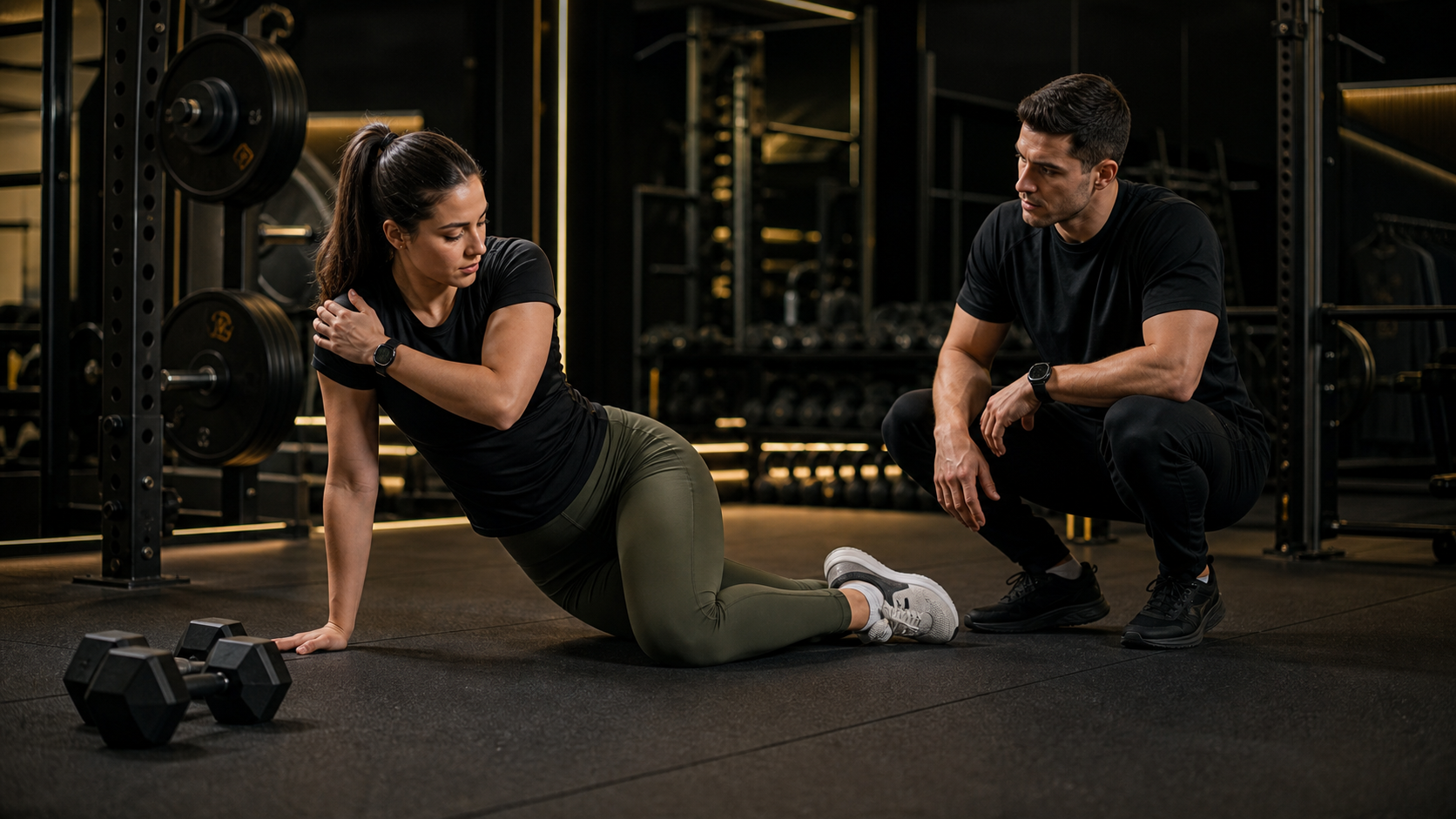
Muscle soreness is not a perfect progress score: the useful move is adjusting the next session without turning every workout into a pain test.
Training with Muscle Soreness in Massanassa: When to Keep Going, Lower the Load or Stop
Author
Alphafit Team
Editorial team at Alphafit Gym Massanassa
Reviewed by
Alphafit Technical Coaching Team
Strength training, technique and personal coaching team in Massanassa
You finish leg day feeling great, then the next morning walking downstairs feels like a different sport. Or you return to the gym after months away and the question appears: should I train today with sore muscles, or rest completely?
The useful answer is not a universal yes or no. It depends on how intense the soreness is, whether it feels symmetrical, which muscle group you want to train and whether the previous session was new, heavier or simply too ambitious.
At Alphafit Gym Massanassa, we frame it like this: soreness is information, not a badge. It tells you that your body met a stimulus it was not used to, but it does not prove the workout was perfect or that you should repeat it the same way.
What muscle soreness actually is
Post-workout soreness is often called delayed onset muscle soreness, or DOMS. It tends to happen after new exercise, higher-than-usual intensity or a lot of eccentric work: lowering into a squat, controlling a lunge, slowing a weight down or running downhill.
Cheung, Hume and Maxwell’s review on DOMS explains that this soreness is common in both athletes and beginners, and that it can affect performance, range of motion and coordination for a few days (PubMed review).
In gym terms:
- feeling stiffer 24-48 hours later is not unusual;
- it does not automatically mean injury;
- it also does not mean “the more it hurts, the better”;
- it appears more often when you change exercises, volume, intensity or technique;
- it usually becomes easier to manage when progression is gradual.
If you are starting from zero, pair this with our guide to starting the gym in Massanassa.
Is soreness a good sign?
Sometimes it is a normal sign of adaptation. But it is not the goal.
You can build strength, muscle and technique without spending every week walking strangely. Research by Nosaka and colleagues found that delayed muscle soreness does not necessarily reflect the magnitude of eccentric exercise-induced muscle damage (PubMed study). Put simply: more soreness does not always mean more progress.
In the gym, we tend to see three different scenarios:
| Situation | What it usually means |
|---|---|
| Mild, general soreness | Normal adaptation to a new or harder stimulus |
| Medium stiffness that limits you a little | Too much volume, too much controlled lowering or too fast a jump |
| Strong pain that changes how you move | Lower the load, change the session or recover more |
The better question is not “am I sore?”. It is: can I move well and train with clean technique?
A simple traffic-light rule
Use this scale before choosing the session.
Green: soreness 1-3/10
You can train, but start more gently.
What to do:
- warm up for 8-10 minutes;
- use lighter ramp-up sets;
- keep technique clean;
- avoid chasing personal records;
- if discomfort eases as you move, continue sensibly.
This is the common case after a new but well-dosed workout.
Yellow: soreness 4-6/10
You can train, but change the plan.
Useful options:
- train another muscle group;
- reduce load by 10-30%;
- reduce total sets;
- use stable machines;
- replace exercises with a lot of eccentric lowering;
- choose easy cardio, mobility or technique work.
Example: if your quads are very sore after leg day, repeating heavy squats is probably not the right move. You could train upper body, walk gently, work on hip mobility and use a light hinge pattern if it does not bother you.
If you are not sure how to adjust weight and reps, read our guide to load progression in the gym.
Red: soreness 7-10/10 or unusual pain
This is not the moment to prove discipline. It is the moment to listen.
Avoid hard training if:
- you limp or clearly change technique;
- pain is sharp or located in a joint;
- there is marked swelling;
- one side hurts much more than the other;
- you notice unusual weakness;
- your urine is dark, reddish or cola-colored after a very intense effort.
MedlinePlus lists dark urine, weakness, muscle pain and reduced urine output among symptoms related to rhabdomyolysis, a rare but serious condition that needs medical assessment (MedlinePlus). This is not to make normal soreness scary; it is to avoid mistaking a warning sign for “I just trained hard.”
Should you stretch hard to remove soreness?
Not as the main solution.
Gentle stretching may feel good or help you move more comfortably, but forcing a sore muscle because you think it will “break up” soreness is not the plan. A Cochrane review on stretching and muscle soreness found that stretching before or after exercise does not meaningfully reduce soreness (Cochrane).
Think instead about:
- comfortable mobility, without sharp pain;
- an easy walk or bike;
- a more gradual warm-up;
- good hydration;
- enough protein and food;
- better sleep;
- repeating the same stimulus with less volume next time.
If your issue is starting cold or stiff, our warm-up before strength training guide will help more than an aggressive stretching session the next day.
What to do in the first 48 hours
1. Move, but lower the ambition
Complete rest is not always necessary. Many people feel better after walking, easy cycling or light mobility. The key is that movement should not increase pain or make your technique worse.
A recovery session could be:
- 10 minutes of walking or easy cycling;
- hip, ankle, upper-back and shoulder mobility;
- 2-3 exercises with light load and a comfortable range;
- calm breathing to bring intensity down.
This is not a replacement for strength training. It is a way to arrive better at the next real session.
2. Eat and drink like you want to recover
After a hard session, your body needs energy, protein and water. You do not have to eat perfectly, but avoid the pattern we see often: train hard, eat too little, sleep badly and push again the next day.
For the broader recovery picture, pair this with our guide to muscle recovery after training.
3. Do not repeat the same punishment
If lunges wrecked you on Tuesday, Thursday does not need to prove that you can suffer through more lunges. You can:
- reduce depth;
- switch to leg press;
- reduce sets;
- space leg sessions further apart;
- keep the same exercise but use less load;
- train a different movement pattern.
That is not losing progress. It is dosing the work.
4. Write down what caused it
Soreness teaches a lot when you record the context:
- a new exercise;
- more sets than usual;
- very slow lowering phases;
- returning after a break;
- poor sleep;
- leg day plus hard cardio;
- a functional class that was too demanding.
After two or three weeks of notes, the pattern is usually obvious.
How to prevent excessive soreness
The goal is not to never feel anything. The goal is to stop soreness from breaking consistency.
What works better:
- increase volume gradually;
- leave 1-3 reps in reserve while learning technique;
- repeat exercises for several weeks before changing them;
- avoid copying advanced routines;
- warm up with ramp-up sets;
- adjust the workout if you slept badly;
- do not stack heavy legs, HIIT and hard running in the same window without a plan.
If you tend to overdo it, you may not need more motivation. You may need a better-structured week. Our deload week guide can help you understand when lowering load is a smart move, not quitting.
Quick examples
| Case | Smart decision |
|---|---|
| Mild chest soreness | Train back or legs; warm up well if it is an upper-body day |
| Strong leg soreness | Avoid heavy squats; choose upper body, easy cardio or mobility |
| Glute soreness after hip thrusts | Reduce hinge and hip-thrust volume for a few days |
| Specific knee pain | Do not treat it like soreness; review technique and lower load |
| General stiffness after returning to the gym | Use 2-3 weeks of gradual progression before pushing |
How we adjust it at Alphafit
When someone arrives sore, we do not give an automatic answer. We look at:
- what they trained;
- how much changed from the previous week;
- whether pain improves during the warm-up;
- whether there is joint pain or asymmetry;
- what session is planned today;
- what goal that person is working toward.
Then we adjust the dose: fewer sets, another variation, more rest, technique work, mobility or a different muscle group.
The goal is not to leave destroyed every time. The goal is to train better next week than this week.
If you want a plan that helps you progress without living between soreness and doubt, come see us at Alphafit Gym Massanassa or message us through contact. We will help you train hard, with judgment.
Sources
- Delayed onset muscle soreness: treatment strategies and performance factors · Sports Medicine
- Delayed-onset muscle soreness does not reflect the magnitude of eccentric exercise-induced muscle damage · Scandinavian Journal of Medicine & Science in Sports
- Stretching to prevent or reduce muscle soreness after exercise · Cochrane Database of Systematic Reviews
- Rhabdomyolysis · MedlinePlus Medical Encyclopedia