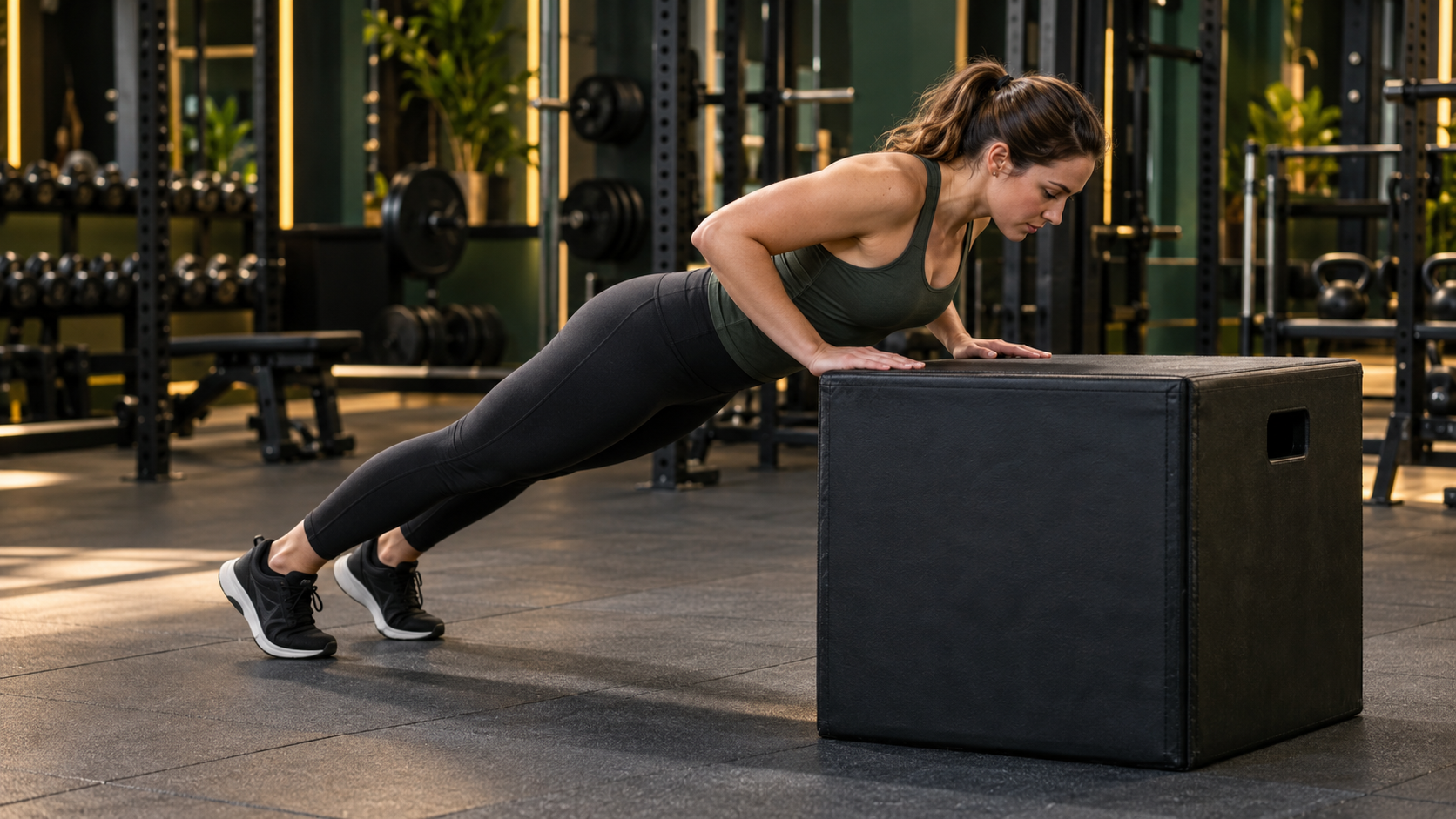
Adjusting the support height lets you change the difficulty while practising the movement. AI-generated illustrative image.
Your First Push-Up in Massanassa: Where to Start and When to Lower the Support
Author
Alphafit Team
Editorial team at Alphafit Gym Massanassa
Reviewed by
Alphafit Technical Coaching Team
Strength training and personal coaching team in Massanassa
You get down on the floor, lower yourself and cannot push back up. Or you manage a few repetitions, but your hips rise before your chest. A push-up looks straightforward until you try to complete your first controlled repetition.
If you train in Massanassa or travel from Catarroja or Alfafar, you can work on this goal during your usual gym visits. The first useful decision is to find a support height that lets you practise several complete repetitions. That gives you something specific to repeat and measure.
This guide is for healthy adults getting started. It offers a way to organise practice, without promising a push-up by a particular date or replacing individual adjustments if you have an injury.
Why raising your hands can help
In a study of 23 people, push-ups with elevated hands and kneeling push-ups produced lower peak vertical forces than standard push-ups. This is evidence about mechanical load, not how many weeks learning will take (Ebben and colleagues).
The practical application is to change the support until the difficulty is manageable. Instead of repeatedly attempting a repetition you cannot yet complete, you can train a range you control and lower the support later.
Push-ups can also provide strength training: an eight-week trial in 18 young men found similar strength and muscle-thickness improvements to light-load bench pressing when difficulty was adjusted. The small sample does not establish equivalence for every person or programme (Kikuchi and Nakazato).
Find your starting point in the first session
Start with a high support. Wall press-ups are one introductory option included in the NHS strength exercises. You can then try a raised horizontal surface that supports your weight without sliding or tipping.
In the gym, ask the team to check the equipment. Avoid a bar that can roll, an unstable stack of plates or an unsecured bench with wheels. A stable support matters before its height does.
After a few minutes of gentle movement and an easy set, try five repetitions. If they are smooth and you could do several more, rest and try a slightly lower support. If you can barely push up or lose your position, use a higher one. Keep this search to a few attempts: you need a reference point, not an exhausting tour of every option.
| What happens | Practical decision |
|---|---|
| You cannot push back up from the bottom | Raise your hands and try an easier version |
| You complete several repetitions with a similar range | Keep that height for your first sessions |
| The support moves or slides | Stop the attempt and change the equipment |
| Your wrist, elbow or shoulder hurts | Stop that variation; do not force the repetition |
What to check on each repetition
Use these cues as things to observe, rather than compulsory joint angles for every body:
- Place your hands roughly shoulder-width apart or slightly wider, with firm contact.
- Space your feet as needed for balance and maintain a steady line through your head, trunk and legs.
- Bring your chest towards the support, bending your elbows in a comfortable direction without flaring them fully sideways.
- Let your chest and pelvis move together. Avoid reaching with your chin to create the appearance of extra depth.
- Push back to the starting position without leaving your hips behind.
- Keep breathing; you can breathe in as you lower and out as you push up.
Choose a comfortable depth you can repeat. To work towards a full push-up, gradually bring your chest close to the level of your hands while maintaining your position. If you need to shorten the movement substantially, raise the support and practise there. A side-view recording, respecting other people’s privacy, can help you compare your first and final repetitions.
Twice-weekly practice that fits your routine
As an initial coaching suggestion, choose two non-consecutive days, such as Tuesday and Friday. If learning the push-up is your priority, practise after warming up and before demanding chest or triceps exercises.
| Part of the practice | Starting suggestion |
|---|---|
| Preparation | One easy set of 5 repetitions on a higher support |
| Main work | 2 sets of 5-8 repetitions at your chosen height |
| Rest | Around 2 minutes between sets; longer if needed to regain control |
| Effort | Finish when you think you could still complete about 2 similar repetitions |
| Record | Note the support, height, repetitions and how well you held your position |
These numbers are a coaching proposal, not a validated protocol for achieving your first push-up. If five repetitions already take you to your limit, raise the support. If you cannot estimate how many are left, finish before the upward movement stalls or your position changes noticeably.
Count these sets towards the pressing work you already do. If your session contains several presses, you can replace one with this practice with your coach’s help. Adding push-ups after everything else, then doing them again at home, can accumulate much more work than planned. Our chest training guide helps you organise the whole session.
When to lower the support and when to keep it
One practical trigger for trying the next level is completing both sets of eight repetitions, with a similar range and some effort to spare, in two separate sessions. This is not a scientific test and does not guarantee that a floor push-up is already within reach.
On the next visit, lower the support slightly and return to the bottom of the repetition range. If the height difference is large and you cannot maintain the movement, keep the previous level until you find an intermediate step. Change one thing at a time: height, repetitions or number of sets.
For example, you might move from 6 and 5 repetitions to 8 and 8 on the same box over several visits. Returning to 5 and 5 when you try a lower support does not mean going backwards: the difficulty has changed. Record it in your training diary so you can compare equivalent sessions.
How to try your first floor push-up
Once you control a low support, you can make one attempt near the beginning of a session, after warming up. Aim for a controlled descent and an ascent in which your chest and hips move together. If you cannot push back up, put your knees down to finish and return to your training variation.
Avoid repeated maximum attempts. Missing the repetition today does not erase the progress you have made. If you complete one, keep most of your practice at the level that allows several repetitions; one very demanding push-up is not yet a repeatable working set.
Common questions when getting started
Do I have to go through kneeling push-ups?
You can use them if they feel comfortable, but they are not a compulsory stage. Elevated hands let you practise with your legs straight. Choose a variation you can adjust and record; avoid switching every session without a reason.
What if I can only lower myself?
Lowering alone does not complete the goal of pushing back up. Raise your hands until you find a level where you can do both parts. You do not need to add extremely slow descents or finish on the floor with every repetition.
What if my wrists hurt?
Stop the painful variation. Review the support and difficulty with a professional; if discomfort persists, is severe or also occurs outside exercise, seek a healthcare assessment. Do not improvise handles with dumbbells that can roll, or treat pain as a sign of progress.
How long will it take, and should I practise every day?
There is no reliable deadline for everyone. Start with the suggested two sessions and check how you recover alongside the rest of your routine. Before adding days, review your support height, range and rest between sets.
Your next step in Massanassa
At your next session, find a stable support, record two sets and repeat the conditions on another day. That small record gives you a concrete decision: maintain the setup, add a repetition or try a lower height.
At Alphafit Gym Massanassa, explore our personal training services to fit this goal into your plan. Contact the team and tell us which variation you can currently do and where you get stuck.
Sources
- Kinetic analysis of several variations of push-ups · Ebben et al., Journal of Strength and Conditioning Research, 2011
- Low-load bench press and push-up induce similar muscle hypertrophy and strength gain · Kikuchi and Nakazato, Journal of Exercise Science & Fitness, 2017
- Strength exercises: wall press-ups · NHS