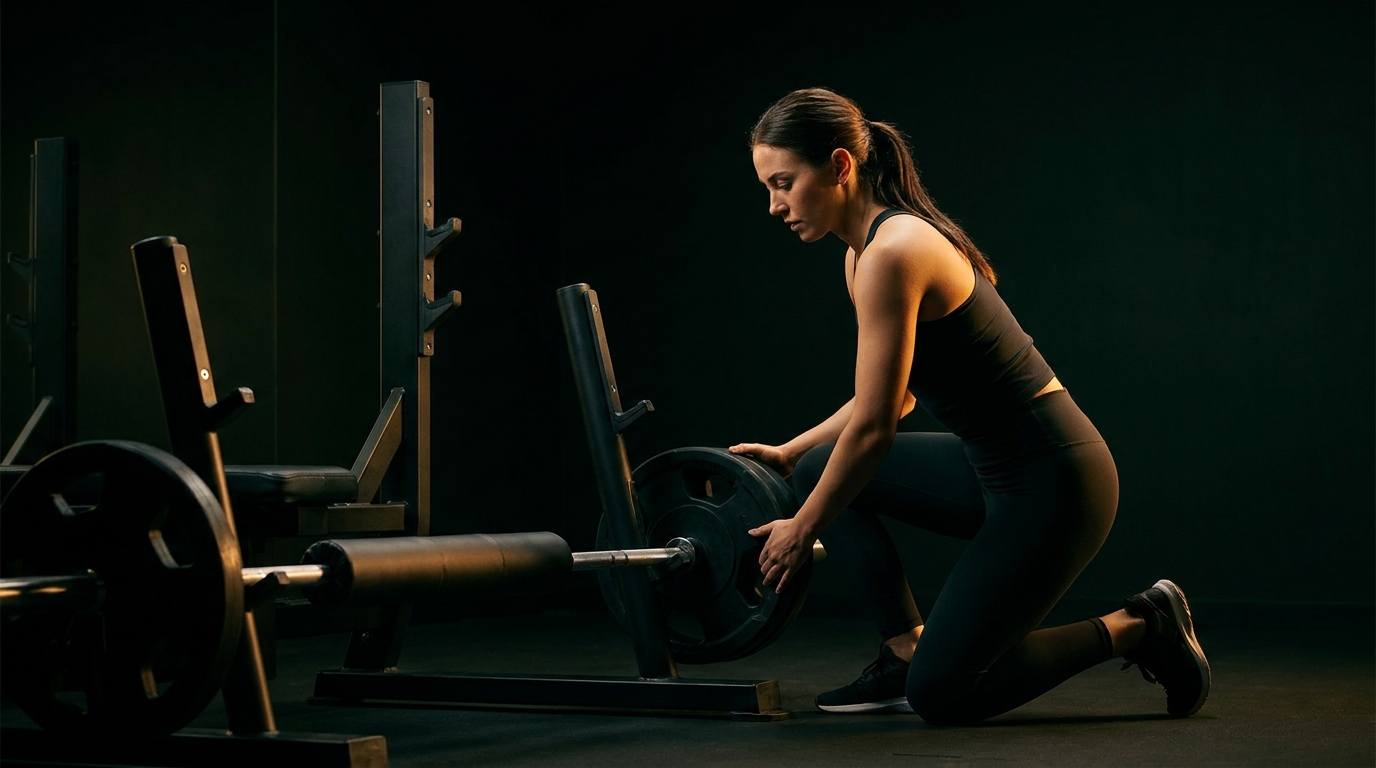
Good glute training starts with body position before adding more weight.
Glute Training in Massanassa: Hip Thrust Technique and a 2-Day Plan
Author
Alphafit Team
Editorial team at Alphafit Gym Massanassa
Reviewed by
Alphafit Technical Coaching Team
Strength training and personal coaching team in Massanassa
Glutes have become one of the most requested training goals in the gym. And not only for aesthetics. A stronger lower body helps with squats, lunges, Romanian deadlifts, running and plenty of everyday movement.
The problem is that many people arrive on the gym floor with a risky mix: saved videos, a desire to feel the burn and very little clarity around technique, volume and progression. The result is familiar: hip thrusts felt in the lower back, endless leg sessions and the idea that if you are not wrecked afterwards, it did not count.
At Alphafit Gym Massanassa, we prefer a cleaner approach: stronger glutes through well-chosen exercises, better setup and a progression you can repeat week after week.
First: there is no magic “women’s routine”
A common question is whether women need a different routine. The short answer: not because someone is a woman, but possibly because of goal, level, recovery and preferences.
Someone who wants to prioritize glutes can include more hip and lower-body work, but that does not mean ignoring back, chest, shoulders, core or cardio. The WHO recommends muscle-strengthening activities for major muscle groups at least 2 days per week for adults. In practice, train the whole body and give the lower body a little more attention if that matches your goal.
The key is not copying a viral routine. It is answering these questions:
- how many days can you actually train?
- which exercises do you feel in the right place?
- do you recover well between leg sessions?
- can you progress without joint or lower-back pain?
- are food and sleep supporting the plan?
If you are new to training, pair this with our guide to starting the gym from scratch.
What you are really trying to train
When people say “glutes”, they often group everything together. In training, it helps to separate the pieces:
- gluteus maximus, heavily involved in hip extension: hip thrusts, Romanian deadlifts, lunges, deep squats and leg press;
- gluteus medius and minimus, important for hip stability and abduction: abductions, single-leg work and knee-pelvis control;
- hamstrings and adductors, which support many lower-body variations and help build a more complete base.
That is why a solid glute routine does not need ten glute exercises. It needs movement patterns:
- hip thrust pattern,
- hip hinge,
- squat or leg press,
- single-leg work,
- abduction,
- and measurable progression.
Hip thrust: set up before you load up
The hip thrust can be an excellent exercise, but it is easy to turn it into a strange lower-back movement when it is rushed.
Before loading the bar, check this setup:
- rest the upper back on the bench, not the neck;
- place the bar over the hip crease with padding;
- aim for nearly vertical shins at the top;
- keep ribs down and abs active;
- drive through hip extension instead of arching the lower back;
- pause for a second at the top and squeeze the glutes;
- lower with control without losing position.
A useful signal: at the top you should feel glutes and hips, not a sharp sensation in the lower back. If pain appears, lower the load, shorten the range, review technique and ask for help. Muscle fatigue can be normal; sharp pain is not a badge of honour.
It cannot all be hip thrusts
The hip thrust is popular because it can be loaded and many people feel the glutes well. But it should not swallow the whole routine.
To build glutes properly, we usually combine:
1. Hip thrust or glute bridge
Very useful for practicing hip extension and progressing in 8 to 12 rep ranges.
2. Romanian deadlift
Trains glutes and hamstrings with a hip-hinge emphasis. The priority is a stable back, posterior-chain tension and not turning the exercise into a race to touch the floor.
3. Squat, leg press or hack squat
These are not “just quads”. With good depth, control and a variation that fits your body, they contribute a lot to lower-body development.
4. Lunge or Bulgarian split squat
Single-leg work helps identify side-to-side differences, improve stability and add stimulus without massive loads.
5. Abductions
Useful as an accessory, not as the whole base. They work well at the end for glute medius, hip control and a finishing pump, but they do not replace the main lifts.
How many days should you train glutes?
For most people, 2 days per week works very well. Research on training frequency suggests spreading weekly work can be useful, but total volume and set quality matter a lot (Sports Medicine).
More days does not always mean more progress. If you train glutes Monday, Tuesday, Thursday and Saturday with high intensity, you may not be creating more stimulus; you may simply be stacking fatigue.
A realistic starting point:
- 2 lower-body/glute sessions per week,
- 48-72 hours between hard sessions,
- 3-5 exercises per session,
- 8-14 direct weekly glute sets depending on level,
- and gradual progression.
If you are unsure when to increase weight, read our guide to load progression in the gym.
A 2-day glute plan
Use this as an example. On the gym floor, we would adapt it to your technique, schedule and available equipment.
Day A: strength and technique
| Exercise | Sets | Reps | Note |
|---|---|---|---|
| Hip thrust | 3-4 | 8-10 | Pause at the top, abs active |
| Leg press or hack squat | 3 | 8-12 | Stable range |
| Romanian deadlift | 3 | 8-10 | Hamstring and glute tension |
| Machine abduction | 2-3 | 12-20 | Control, no bouncing |
| Anti-extension core | 2 | 8-12 | Plank, dead bug or similar |
Day B: single-leg and volume
| Exercise | Sets | Reps | Note |
|---|---|---|---|
| Bulgarian split squat or lunge | 3 | 8-12 each leg | Stable step |
| Glute bridge or light hip thrust | 3 | 10-15 | More control than load |
| Leg curl | 3 | 10-15 | Strong hamstrings support the plan |
| Cable glute kickback | 2-3 | 12-15 | Keep hips quiet |
| Abduction or lateral walk | 2 | 15-25 | Technical finisher |
You do not need to hit failure on every set. The ACSM review on resistance training highlights that load, volume, proximity to failure and exercise selection are adjusted according to goal and experience. Put simply: a hard set is useful; a chaotic routine is not.
Progress without wrecking technique
For hypertrophy, everything does not have to be extremely heavy. A review comparing high and low loads found that different loading ranges can produce hypertrophy when sets are performed with enough effort (Journal of Strength and Conditioning Research).
On the gym floor, we apply that like this:
- learn the movement first;
- choose a range, such as 8-12 reps;
- when you complete the top of the range with similar technique across sets, increase slightly;
- if more load costs you range, pelvis position, knee control or stability, step back;
- track weights and reps.
Glutes respond to good work, not to adding plates just to survive the set.
Common mistakes
Arching the back at the top of the hip thrust
If the end of the rep comes from the lower back, reduce the load and think ribs down.
Doing too many accessories
Five kickback variations do not replace progressing in a thrust, hinge, squat or lunge pattern.
Training legs without enough recovery
If every session starts with heavy soreness and worse performance, you may need better volume management, not more motivation.
Changing exercises every week
Variety is entertaining, but progression needs repeated movements across several weeks.
Chasing only the burn
Feeling a burn does not guarantee progress. A set can burn a lot and stimulate little if load, range and technique are poor.
How we coach it at Alphafit
At Alphafit, we do not hand you an endless exercise list and leave you guessing. We adjust:
- hip thrust, leg press, Romanian deadlift and lunge technique;
- exercise selection for your body and experience;
- weekly volume so you can progress without living in soreness;
- load progression;
- and balance with upper body, cardio, nutrition and recovery.
If you want to prioritize glutes, legs or body recomposition, you do not need a more complicated routine. You need one you can execute well and improve.
Book your free trial here and we will help you build a training week that fits your goal.
Sources
- Resistance Training Prescription for Muscle Function, Hypertrophy, and Physical Performance in Healthy Adults: An Overview of Reviews · Medicine & Science in Sports & Exercise
- Physical activity · World Health Organization
- Strength and Hypertrophy Adaptations Between Low- vs. High-Load Resistance Training: A Systematic Review and Meta-analysis · Journal of Strength and Conditioning Research
- Effects of Resistance Training Frequency on Measures of Muscle Hypertrophy: A Systematic Review and Meta-Analysis · Sports Medicine