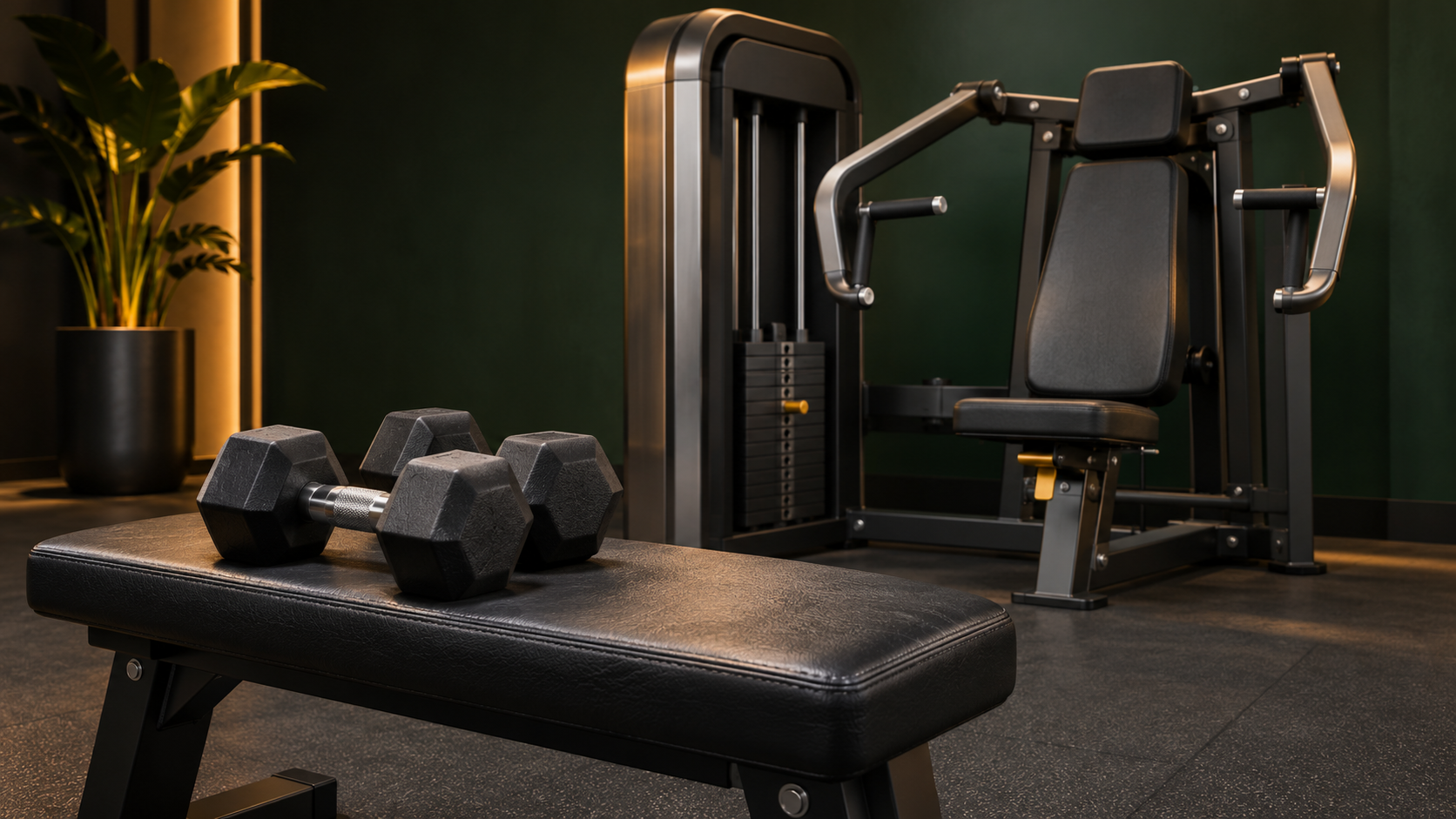
Machines and dumbbells can serve different purposes within the same plan. AI-generated illustrative image.
Machines vs Free Weights: How to Choose for Muscle and Strength
Author
Alphafit Team
Editorial team at Alphafit Gym Massanassa
Reviewed by
Alphafit Technical Coaching Team
Strength training and personal coaching team in Massanassa
There is a chest press machine available and a dumbbell bench nearby. Your programme says “chest”, but someone has told you machines do not count for as much. Someone else says dumbbells are too complicated for a beginner. Which do you choose?
Machines and free weights can both build muscle. If you want to improve a particular lift, practise that lift. Beyond that, your choice depends on how the exercise fits you, what you can control and how you will repeat it over the coming weeks.
At Alphafit Gym Massanassa, the practical aim is straightforward: build a session you understand and can keep doing. An argument about equipment does not need to overturn your whole programme.
What changes between machines, cables and free weights?
With a barbell or dumbbells, you direct the path of the load. A guided machine restricts part of that path and often provides support for your body. This changes the demands of the exercise, even when both options work similar muscles.
Cables need a little more explanation. The cable transmits resistance, but the handle may move quite freely. A seated cable row and a chest-supported row do not require exactly the same control. Look at the whole exercise, rather than simply whether it uses a cable or weight plates.
Machines are not synonymous with isolation, either. A leg press involves movement at the hip and knee; a dumbbell curl mainly involves the elbow. The distinction between compound and isolation exercises answers a different question.
For muscle growth, there is no universal winner
The 2023 review by Haugen and colleagues found no clear difference in hypertrophy between the two approaches. Only five studies contributed muscle-growth data: this does not establish that every machine and every free-weight exercise are interchangeable.
As a practical selection rule, look for an exercise with a repeatable range of motion that lets you work the intended area and adjust your effort. Consider whether the supports fit comfortably and whether you can increase difficulty in manageable steps.
For example, if every dumbbell press set ends because you lose balance before working your chest effectively, you could use a guided press for that part of the session. If learning the free-weight version also interests you, practise it separately with an easier load. You can organise those as two distinct tasks.
For strength, decide where you want to show it
The review by Heidel and colleagues, published in 2022, found that strength gains favoured the equipment used in training when testing used that equipment; results were similar on a neutral test. A practical application is to choose according to the movement you want to improve.
If your goal is a better barbell bench press, include barbell bench press practice. A machine press can complement that work, but it cannot replace all the experience of controlling the bar. If you want to progress on the leg press, tracking your performance on that particular machine makes sense.
For general strength goals, avoid treating one exercise as a compulsory exam. Choose movements suited to your experience and review them with a coach.
How to choose: five common situations
This table offers practical coaching guidance, rather than a scientific ranking of equipment.
| Your situation | A reasonable choice | What to check |
|---|---|---|
| You are learning and struggle to coordinate the movement | A supported machine or a simple free-weight variation | You understand the setup, starting position and how to finish the set |
| You want to improve a barbell lift | Practise that lift and add supporting exercises as needed | Technique and safety arrangements before increasing the load |
| You want muscular work but balance limits the set | Try a variation with more support | The movement path fits you and you can control the load |
| A machine forces you into an uncomfortable position | Review the settings or try another machine, cable or dumbbell variation | Do not force an uncomfortable path just to follow the programme exactly |
| Time is tight or equipment is occupied | A familiar alternative that serves a similar purpose | Record the change and establish its load independently |
If you choose a machine, use our guide to machine setup and technique. Seat position, stops and range of motion still matter when the path is guided.
Must you start on machines and then move to free weights?
There is no need to set a deadline for leaving machines behind. Keep them in your programme for as long as they are useful. You can also learn a dumbbell exercise from the outset if the variation is manageable and you have enough guidance.
One coaching suggestion for introducing free weights is to change just one exercise at a time. Choose something you want to learn, practise getting into position and use a load you can finish with control. Keep the rest of the plan stable so you are not learning five new movements at once.
Progress means understanding and performing the task better. You do not need to prove that you have earned access to an “advanced” part of the gym.
An example of combining both without doubling the work
Imagine your session already includes a chest push, a pull and lower-body work. You might choose:
- Dumbbell press if learning that movement is a priority.
- Chest-supported row if you want to focus on pulling from a stable position.
- Leg press as a guided lower-body exercise.
- Leg curl if your programme needs specific work on knee flexion.
This illustrates equipment selection; it is not a complete workout or a set prescription for everyone. The exact exercises depend on available equipment and your weekly programme.
If you replace the dumbbell press with a machine, do not automatically include both “just in case”. Decide whether you are replacing a task or adding work. Combining equipment may be convenient for general goals, but there is no compulsory fifty-fifty split between machines and free weights.
Why machine kilograms do not equal barbell kilograms
The number on the weight stack is only part of the picture. Pulleys, levers, incline and design change how resistance reaches your hands or feet. Two machines can feel very different despite displaying the same weight.
Pressing 60 kg on a machine therefore gives you no reliable conversion for choosing dumbbells. When changing equipment, start with a conservative load and adjust it using controlled repetitions. Do not try to preserve the previous number.
In your training diary, record the machine or variation, settings, load and repetitions. Compare sessions using the same reference. Also specify whether dumbbell weights are recorded per hand or as a combined total: this prevents an easy source of confusion from carrying into later sessions.
Common questions before you choose
Are machines always safer?
Supports can make control easier, but they do not guarantee safety. Learn how to use the stops and selector and how to exit the machine. With free weights, check how to position and return the load; use safety supports or suitable assistance for lifts that require them. Stop an exercise if pain occurs and seek assessment if it persists.
Do I have to train to failure on a machine?
No. A guided movement does not make failure compulsory. As an initial practice guideline, stop before you lose the range of motion you have learned. If your programme includes very high efforts, agree how to perform and stop them with whoever supervises it.
What if I simply prefer one option?
Preference is a valid practical consideration when the exercise fits the plan. You can keep a machine you find comfortable or learn a free-weight variation that interests you. Review your choice according to what it lets you do, rather than the status other people attach to it.
Make one decision for your next session
Choose an exercise you are unsure about and check three things: what you want to improve, what currently limits the set and how you will track progress. Keep the option that fits and change only what has a concrete reason to change.
If you train in Massanassa and want help matching that choice to your experience, explore Alphafit’s training services or contact the team. We can help you give machines, barbells and dumbbells a clear purpose within your training.
Sources
- Haugen et al. (2023): review of machines, free weights, strength and hypertrophy · BMC Sports Science, Medicine and Rehabilitation
- Heidel et al. (2022): review of equipment and muscular adaptations · The Journal of Sports Medicine and Physical Fitness