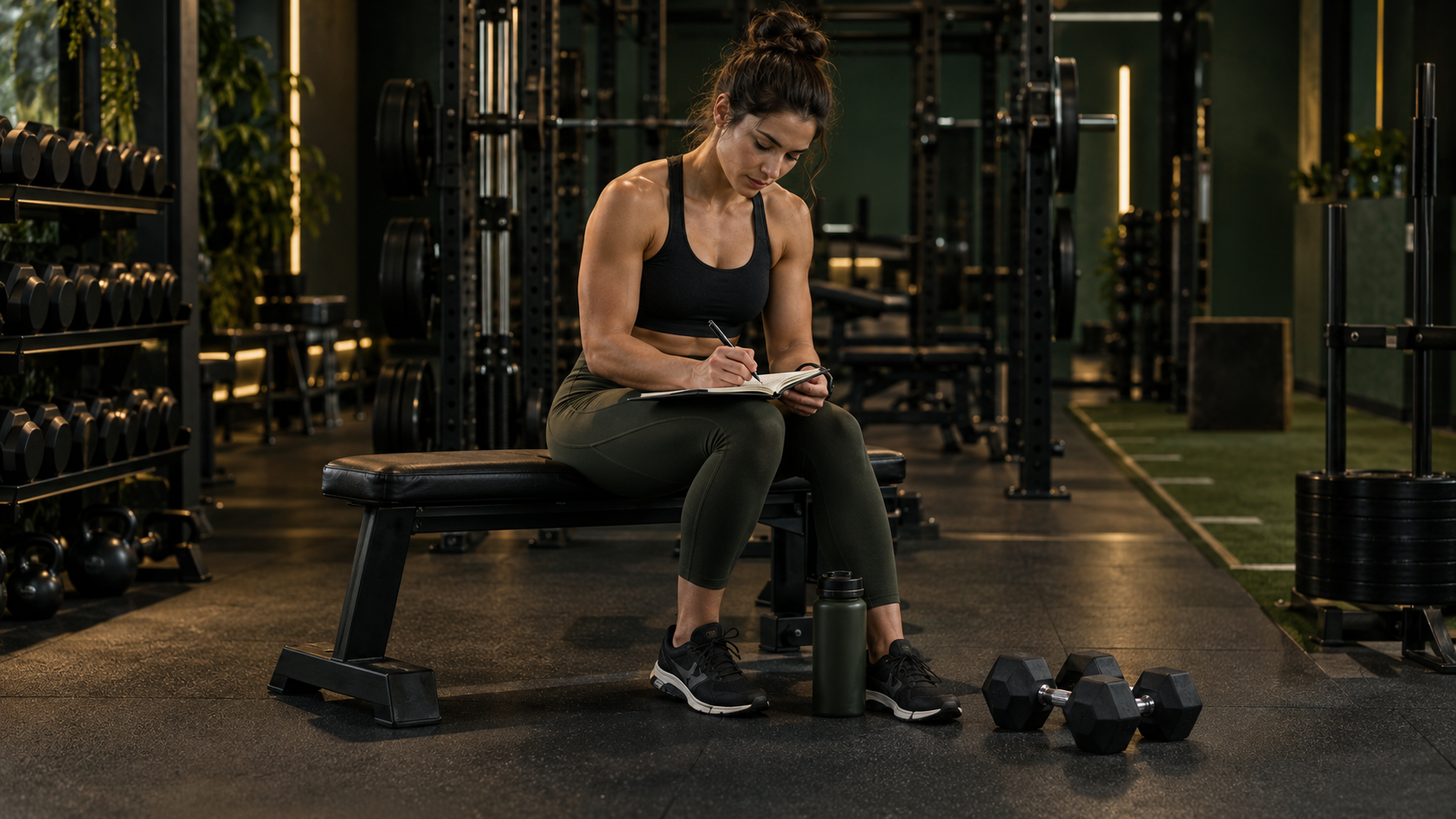
A brief record can help you prepare your next workout. AI-generated illustrative image.
Training Diary in Massanassa: What to Record and How to Read Your Workouts
Author
Alphafit Team
Editorial team at Alphafit Gym Massanassa
Reviewed by
Alphafit Technical Coaching Team
Strength training and personal coaching team in Massanassa
You reach the gym and recognise the machine, but cannot remember whether you used 30 or 35 kilos last time. You are also unsure whether you completed ten repetitions in every set or just the first. You choose a weight by feel and leave with the same question: am I moving forward?
A training diary can solve that part of the problem. It does not need charts, a paid app or a spreadsheet with twenty columns. It needs information you can read again and use. If you train in Massanassa around work, study and trips from Catarroja or Alfafar, recording your workout should fit into the session you already do.
This guide suggests a practical system for adults doing strength training. The examples are illustrative, rather than an individual programme or a promise of results. Our load progression guide covers when to increase weights; this article focuses on making your records meaningful.
What the diary is for
Before starting an exercise, your diary should answer three questions: what you did, under what conditions, and what you want to repeat or adjust today. It also helps you explain a question to your coach without relying on memory.
Writing down a workout does not demonstrate muscle growth. Nor does it guarantee better results on its own. It is an organisational tool. The ACSM’s 2026 guidance emphasises choosing a plan that fits your goals and schedule so you can stick with it. Our suggestion is to use the diary to support that process without creating another difficult obligation.
What to record: the essentials
Start with these fields:
- Date and session: for example, Monday, full body A.
- Exercise and variation: seated cable row with a neutral grip, rather than simply “back”.
- Load and unit: total kilos, kilos per dumbbell or assistance level.
- Repetitions in each working set: 10, 9 and 8, rather than writing 3 × 10 if that did not happen.
- Approximate effort: a brief estimate after each set, if you know how to use it.
- One relevant note: a change of machine, seat position, range of motion, rest or an interruption.
Distinguish warm-up sets from working sets. You can record both, but labelling them prevents you from counting every light preparation set as your main work.
You do not need to describe every sensation. “Seat 3; same technique” is more useful for repeating the exercise than a paragraph about whether the workout felt good or bad.
How to record weights clearly
With dumbbells, state whether the load is per hand. “Press: 12 kg per dumbbell” prevents you from reading 12 kilos as the combined weight of the pair a month later.
For a barbell, record the total including the bar when you know its weight. Do not assume every bar weighs the same. If you are unsure, ask the team and make your recording convention explicit.
For machines, add an identifier so you can recognise the equipment. Two leg presses showing 80 kilos can have different mechanisms and ranges of motion; changing machines does not automatically create a comparable record. For assisted exercises, label the number as assistance: more help does not mean you lifted a heavier load.
For a unilateral exercise, record repetitions on each side if they differ. “10 left / 9 right” tells you more than writing ten and forgetting what happened.
What RIR means and how to use it carefully
RIR means repetitions in reserve: how many additional repetitions you think you could have completed when you ended a set. It is an estimate, rather than an exact counter. If you think about two were left, you can write “RIR ≈ 2”.
A review of the accuracy of these predictions shows that estimating remaining repetitions has a margin of error. Do not treat a shift from RIR 2 to RIR 3 as proven improvement. If you cannot yet judge it, write “comfortable”, “challenging” or “very challenging” and ask for help learning to recognise effort.
You do not need to reach failure to test every estimate. Prioritise execution and use the note as context. Do not confuse muscular effort with pain: discomfort that makes you change the movement calls for stopping that exercise and assessing the situation, rather than chasing a better number.
A template you can copy
This is a fictional session; the loads are not recommendations:
| Exercise | Load | Working repetitions | Approximate RIR per set | Note |
|---|---|---|---|---|
| Dumbbell press | 12 kg per hand | 10 / 9 / 9 | 3 / 2 / 2 | Flat bench |
| Seated row | 30 kg, machine A | 12 / 11 / 10 | 3 / 2 / 2 | Seat 3 |
| Goblet squat | 16 kg | 10 / 10 | 3 / 2 | Same range |
Add the date and session name at the top. If rest differed from the plan, record it beside the exercise. Our rest between sets guide explains that variable.
Prepare the template before leaving home. During your rest, record the set you just completed; at the end, add one decision for the next visit. For example: “Repeat row with the same settings; review press technique”.
How to compare two sessions meaningfully
Compare the same exercise using the same load convention, a similar range of motion and similar rest periods. Record any important changes. A heavier set with a much shorter movement does not answer the same question.
Suppose you row 30 kg for 12, 11 and 10 repetitions one week. Next time you complete 12, 12 and 10 with similar estimated effort and the same settings. You have recorded one additional repetition under comparable conditions: a useful signal when reviewing progression, without needing to increase the weight that day.
If the machine was busy and you used another one, keep a separate baseline. Our exercise substitutions guide explains how to preserve the purpose of the session without transferring loads between movements as though they were equivalent.
Numbers that can mislead you
Tonnage—adding up weight multiplied by repetitions—describes part of the work, but does not directly measure muscle growth. It also cannot simply compare a leg press session with a squat session. If you find it useful, use it within a stable context rather than as a final score for the workout.
The estimated one-repetition maximum offered by some apps is not an actual test either. If the calculation changes after a high-repetition set, that does not mean you should attempt that weight. A basic diary can leave this number out.
More sweat, soreness or time spent in the gym does not establish that a session was better. Choose records linked to your goal: attendance, execution and performance on specific exercises. If your goal includes physical changes, assess those separately; a weight log does not replace that assessment.
Notebook, phone notes or an app
Choose a format you can maintain:
- Notebook: convenient if you want fewer distractions; allow one page per session.
- Phone notes: easy to start; keep names and units consistent.
- Spreadsheet or app: useful for organising your history, provided saving a set does not complicate your rest.
You do not need to transfer every old workout. Start today with the exercises already in your plan. If you use a digital service, check whether you can export your history and what personal information it asks for. Store only what you need.
Reviewing the diary without making it an exam
At the end of the week, check whether you completed the planned sessions and whether the entries are understandable. Then look at several comparable sessions before concluding that you have stalled.
One difficult afternoon does not require changing the whole programme. If performance drops repeatedly, bring your record and its context to your coach: schedule, rest, exercise changes and relevant observations. Reviewing helps you make decisions, rather than assign blame or compensate for missed workouts with improvised extra sets.
Your next workout in Massanassa
Copy the template, decide how you will write loads and record the sets in your next session. Afterwards, check whether you can understand them without reconstructing the workout from memory. If you can, the diary has already fulfilled its first purpose.
At Alphafit, you can explore our services and contact the team for guidance on your training. Bring your notes and questions: a specific question about your own sets is a useful starting point for adjusting your plan.
Sources
- ACSM 2026: key points for resistance training plans · American College of Sports Medicine
- Accuracy in Predicting Repetitions to Task Failure in Resistance Exercise: A Scoping Review and Exploratory Meta-analysis · Sports Medicine, 2022