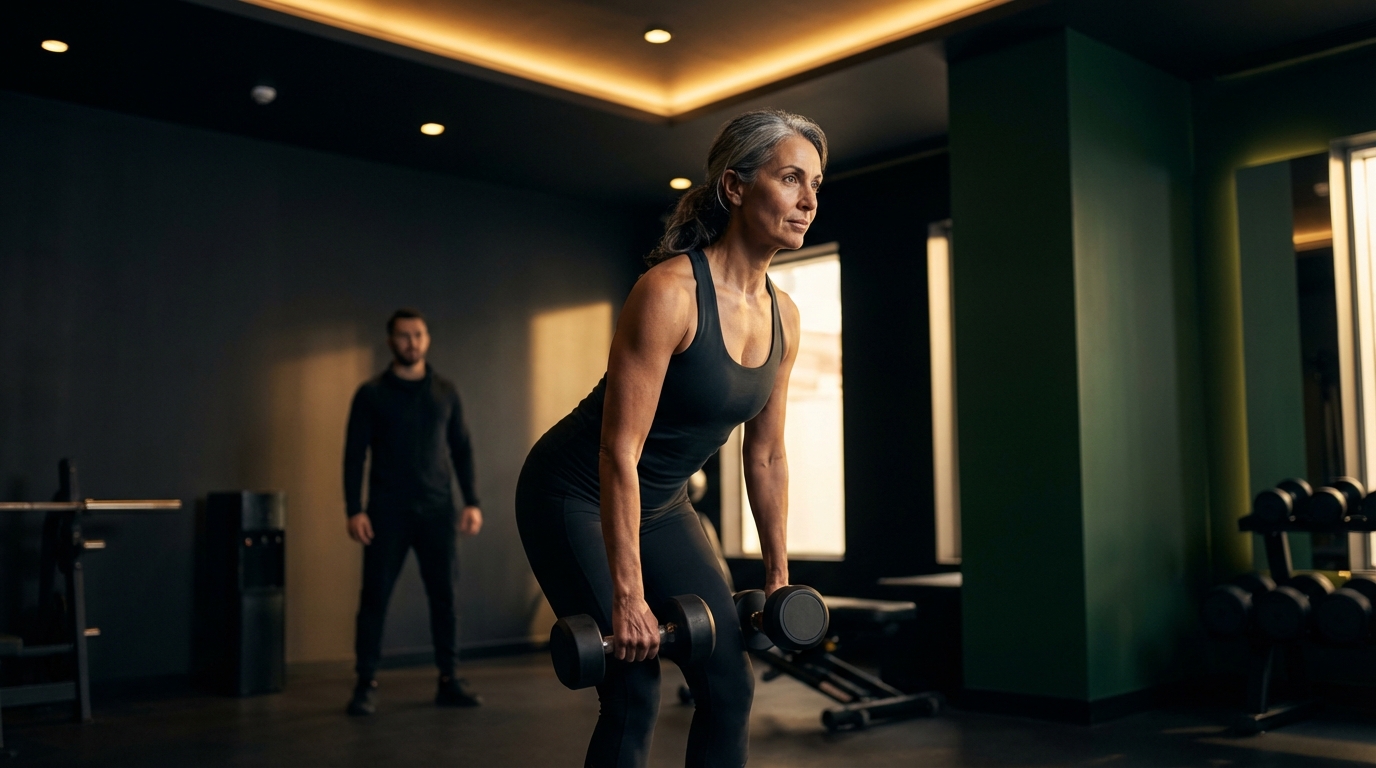
Well-programmed strength work during menopause helps support muscle, bone, and confidence inside and outside the gym.
Strength Training in Menopause in Massanassa: How to Maintain Muscle, Bone, and Energy
Author
Alphafit Team
Editorial team at Alphafit Gym Massanassa
Reviewed by
Alphafit Technical Coaching Team
Strength training and personal coaching team in Massanassa
Menopause does not make your training fragile, but it does change the context.
Many women in Massanassa come to the gym with the same feeling: it suddenly seems harder to hold on to muscle, body fat shifts more toward the midsection, sleep becomes less reliable, and the cardio that used to “work” no longer gives the same return. That is usually when the question shows up: should I do more classes, more sweating, or more strength work?
Our answer is fairly clear: strength training should become the base.
Not because it is the only useful tool, but because during perimenopause and menopause it helps protect exactly what tends to slide without the right stimulus: muscle mass, strength, work capacity, and physical function. The Menopause Society notes that aging is the main driver of weight gain in midlife, while menopause also plays an important role in shifting fat toward the abdomen.
What actually changes during menopause
The first step is to remove the drama and also remove the nonsense.
Not everything you notice is purely hormonal, and not everything is solved by “training harder.” What does commonly happen is a mix of factors:
- less muscle if you stop giving it a reason to stay,
- worse sleep because of hot flushes, broken nights, or stress,
- more tendency to store central fat,
- and less room to stack chaotic weeks without consequences.
According to The Menopause Society, muscle is gradually lost across adulthood, which lowers resting energy expenditure. At the same time, abdominal fat redistribution and changes in sleep or daily activity can make many women feel like they are “doing the same as before” while the body responds differently.
The useful conclusion is not to give up. The useful conclusion is that this is the stage where smart training matters more.
Why strength becomes the priority
The WHO recommends that adults include muscle-strengthening work for all major muscle groups at least 2 days per week, and for older adults it also emphasises multicomponent training that supports strength, balance, and functional capacity.
That fits the menopause transition very well, because the goal is no longer only “burning calories.” The goal is building and protecting a physical base that supports you for years.
The Women’s Health Concern and British Menopause Society guide summarises the approach well: menopause training should combine strength, steps, and restorative work. You do not need to choose between weights and walking; you need strength to stop being the optional part.
There is also growing evidence that properly structured exercise still produces meaningful benefits in postmenopausal women. A recent systematic review reported relevant physical and functional improvements with exercise programs in this population. In real-gym language: good training still works, but recovery usually needs more respect.
What a good gym plan should look like in this stage
You do not need an extreme program. You need a repeatable one.
At Alphafit Massanassa, we usually prioritise four things:
1. Big, stable movement patterns
The base often revolves around:
- a squat or leg press,
- upper-body pushing,
- rows or pulldowns,
- a hip hinge,
- core work,
- and some unilateral loading for stability.
Not because these are magical exercises, but because they let you train a lot of muscle clearly and efficiently without turning every session into a marathon.
2. Two or three very good days beat five inconsistent ones
For many women in perimenopause or menopause, 2 to 4 weekly sessions fit better than constantly trying to train every day. If consistency has been low lately, starting with 2 or 3 days is often the smartest move.
3. Progress without living at the limit
You do not need to finish destroyed for the session to count.
In fact, progress is often better when you:
- keep 1 to 3 reps in reserve,
- keep technique stable,
- repeat key patterns for several weeks,
- and add load or reps gradually.
If age or recovery is already on your mind, our guide to strength training after 40 may help too.
4. Adjust to your real energy, not your ideal week
This stage rarely feels the same every week. Poor sleep, higher stress, or heavier fatigue can change effort perception a lot.
That does not mean you should stop every time you feel off. It means adjusting intelligently:
- less volume in rough weeks,
- more machines and fewer technical lifts when you are tired,
- slightly longer rest periods,
- and walking or mobility when a hard push does not make sense.
A simple weekly structure that works well
If you want a realistic structure in Massanassa, a simple week could look like this:
Day 1
- leg press or goblet squat
- machine or dumbbell press
- seated row or pulldown
- light Romanian deadlift
- core
Day 2
- lunges or split squat
- incline press
- row or pulldown with a different grip
- hip thrust
- stability work
Day 3
- lighter squat or leg press
- vertical push
- upper-body pull
- hamstrings or glutes
- treadmill walk or easy cardio at the end
Between sessions, daily steps plus one or two gentle cardio or mobility slots work very well. If you want to organise that better, our smart cardio with heart-rate zones guide is a good next read.
Cardio matters, but it should not replace strength
This is one of the most common mistakes we see.
Many women in menopause respond to body-composition changes by increasing only:
- long walks,
- classes that feel very hard,
- or steady cardio to “compensate.”
The problem is that if strength drops out, it becomes harder to send the signal that helps maintain muscle and performance.
Walking is still useful. In fact, the Women’s Health Concern guide highlights it because it supports energy expenditure, cardiovascular health, and bone health. But walking works best on top of a strength base, not instead of one.
Nutrition and recovery decide a lot here
Strength training during menopause without recovery support only goes so far.
Three pieces usually matter most:
Enough protein
The same The Menopause Society note points out that protein helps preserve muscle mass and gives an orientation target of 1.2 g per kilogram of bodyweight per day in the context of midlife weight management. That does not mean obsessing over decimals, but it does mean stopping the guesswork.
Less chaotic sleep
If training quality is good but sleep is poor for weeks, tolerance for volume drops fast. In this stage, a sustainable plan beats a heroic one.
No aggressive dieting
If body composition is the goal, hard diets often backfire. Eating too little also lowers performance, recovery, and your ability to keep muscle. That is why our body recomposition guide can be helpful here.
Common mistakes in this phase
Several patterns repeat:
- always training with weights that are too light out of fear,
- jumping from class to class with no clear progression,
- copying programs with more volume than your recovery allows,
- trying to fix the midsection with cardio alone,
- and dropping strength work every time a week feels off.
What tends to work better is far less dramatic:
- consistent strength training,
- reasonable daily movement,
- enough protein,
- patience with progression,
- and small adjustments when sleep or stress gets rough.
How we approach it at Alphafit Massanassa
At Alphafit Gym Massanassa, we do not treat menopause like a problem that means training with fear. We treat it like a stage where it is worth:
- programming better,
- tracking fatigue better,
- choosing exercises you can sustain,
- and building a routine that protects muscle, bone, and energy.
That can mean general strength work on the gym floor, more coaching support, or a mix of both depending on your experience and goal. If you want help turning this into a real plan, start with our strength and personal training services.
Conclusion
During menopause, you do not need to punish your body more. You need to give it a better signal.
That signal usually looks like:
- well-programmed strength work,
- some useful cardio,
- enough daily activity,
- and recovery that is taken seriously.
Build that base and it becomes much easier to keep muscle, support bone health, improve energy, and stop feeling like training is always working against you.
At Alphafit Gym Massanassa, we help turn that into a realistic and sustainable plan.
Sources
- WHO guidelines on physical activity and sedentary behaviour · World Health Organization
- Midlife Weight Gain · The Menopause Society
- Exercise in menopause · Women’s Health Concern / British Menopause Society
- Effects of Exercise Programs on Psychoemotional and Physical Health in Postmenopausal Women: A Systematic Review and Meta-Analysis · Sports Medicine - Open