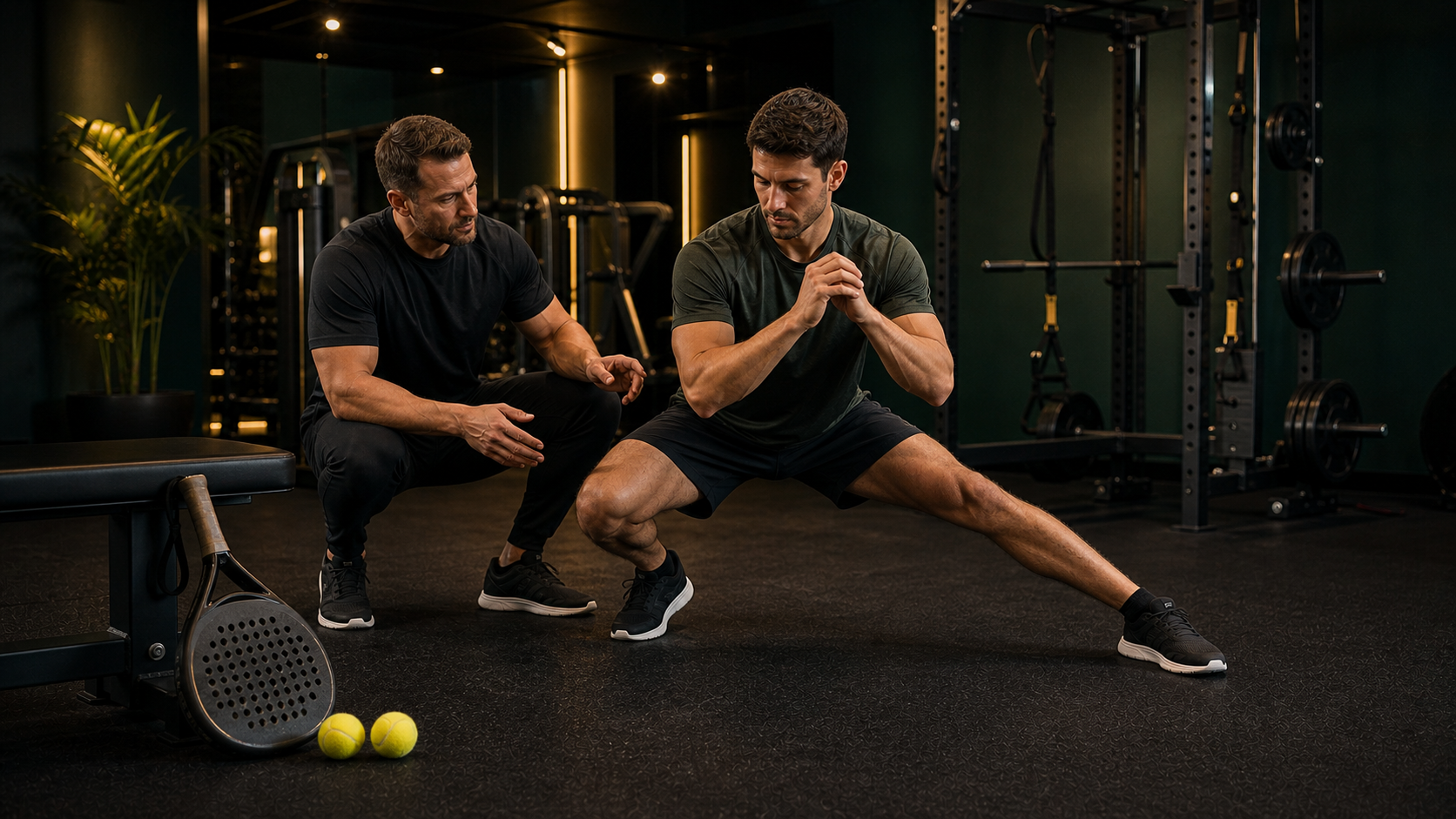
Physical preparation for padel starts with lateral strength, core control and sensible weekly load management.
Strength Training for Padel in Massanassa: Legs, Core and Shoulders for Better Matches
Author
Alphafit Team
Editorial team at Alphafit Gym Massanassa
Reviewed by
Alphafit Technical Coaching Team
Strength training, physical preparation and personal coaching team in Massanassa
Playing padel two or three times per week can feel like enough fitness work. Then the longer matches arrive: low balls, quick turns, a tired shoulder after overhead shots and legs that feel slow in the third set.
At Alphafit Gym Massanassa, we see this profile often: people who enjoy padel, play with friends or enter local tournaments, but do not know what to do in the gym so their body keeps up. The answer is not to copy a bodybuilding plan or bury yourself in random circuits. The answer is to prepare the parts padel uses most: legs, hips, core, upper back, shoulder and the ability to repeat efforts.
This guide is for amateur players in Massanassa and nearby areas who want to move better, play with more confidence and finish the week with fewer aches.
What padel really demands
Padel is played on a 10 x 20 metre court according to the International Padel Federation rules. That sounds compact, but inside that rectangle you repeat many different actions:
- short accelerations,
- lateral movement,
- braking,
- hip turns,
- overhead shots,
- repeated volleys,
- low defensive positions,
- and quick recoveries between points.
That is why padel is not prepared only by running, or only by bench pressing. You need strength to brake, stability to rotate, shoulders that tolerate repetition and enough aerobic base so every point does not send your heart rate through the roof.
The WHO notes that regular physical activity supports health and that muscle-strengthening work matters across ages. For a padel player, that advice becomes very practical: the gym is where you build physical margin for the court.
The goal is not lifting more for its own sake
Strength training for padel does not mean becoming bulky or losing mobility. It means building a body that can:
- get low for difficult balls without punishing the back,
- change direction without losing balance,
- hit through the trunk and hips, not only the arm,
- hold technique during long matches,
- and recover between sessions without collecting the same aches every week.
The CDC recommends at least two weekly days of muscle-strengthening activity that work major muscle groups. If you play padel, those two days can be an excellent base when the exercise selection is smart.
Block 1: legs for braking and pushing off
In padel you are not running in a straight line for minutes. You accelerate, brake, set your position and push again. That demands strong quads, glutes, hamstrings, calves and ankles.
Useful exercises:
| Exercise | Sets | Reps |
|---|---|---|
| Goblet squat or leg press | 3 | 8-10 |
| Romanian deadlift | 3 | 8-10 |
| Lateral lunge | 2-3 | 8-10 each side |
| Low step-up or split squat | 2-3 | 8 each side |
| Standing or machine calf raise | 2-3 | 10-15 |
The lateral lunge deserves a special place. It teaches you to load one leg, open the hip and push back toward the centre, which is exactly what you need when defending a cross-court ball or arriving late to the wall.
If you already train legs, check whether your routine only moves vertically. For padel you also need lateral and single-leg work. Our leg training guide in Massanassa can help you organise that base.
Block 2: core for rotation without losing posture
Many players think core means a few abs at the end of a session. For padel, the core is the bridge between your legs and the racket.
When you hit well, force does not come only from the arm. It starts at the floor, passes through the hips, crosses the trunk and reaches the shoulder. If your core cannot support that transfer, you compensate with the lower back, neck or arm.
Prioritise anti-rotation and stability work:
- Pallof press,
- dead bug,
- side plank,
- farmer carry,
- cable chops with moderate load,
- light medicine-ball rotations if your technique is controlled.
You do not need a hundred crunches. You need to hold position while breathing, rotating and changing support. For a fuller base, read our core training guide in Massanassa.
Block 3: shoulder, upper back and grip
The shoulder works hard in padel: bandejas, viboras, smashes, volleys and wall exits. Problems appear when all that volume lands on a shoulder that rarely trains scapular control, upper back strength and rotator work.
In the gym, think balance:
- rows and pulldowns for the back,
- face pulls or rear-delt flyes,
- external rotations with a band or light cable,
- dumbbell pressing if it feels good,
- carries for grip and stability,
- thoracic mobility work.
The Mayo Clinic highlights proper technique, balance between muscle groups and reducing load when form breaks down. In padel terms: it makes little sense to hit hard overheads on Saturday and then force heavy presses on Monday if your shoulder is already warning you.
If you feel your neck more than your shoulder, or you finish every match tight, review our shoulder training guide in Massanassa.
Block 4: conditioning without turning everything into cardio
Padel demands repeated short efforts, but that does not mean you need brutal HIIT every week.
A good base can include:
- 1 easy bike, rower or brisk walking session of 25-40 minutes,
- 1 short block of controlled intervals every 7-10 days if you recover well,
- hip, ankle and thoracic mobility,
- and consistent daily steps.
If you play intense matches, those matches already count as load. The gym should help you sustain the week, not pile on fatigue without a reason.
Example week if you play padel
For an amateur player with 1-2 matches per week:
| Day | Session | Goal |
|---|---|---|
| Monday | Strength A | Legs, push pattern, anti-rotation core |
| Tuesday | Padel | Technique or moderate match |
| Wednesday | Active recovery | Steps, mobility, sleep |
| Thursday | Strength B | Hips, back, shoulder and grip |
| Friday | Free or easy cardio | Arrive fresh |
| Saturday | Padel | Higher-intensity match |
| Sunday | Recovery | Walk and light mobility |
If you play three matches, do not add two very hard gym sessions on top. Lower the volume, keep the basic strength work and protect recovery.
Quick warm-up before playing
Before you step on court:
- 3-5 minutes of general movement.
- Ankle and hip mobility.
- 8 easy lateral lunges.
- 10 thoracic rotations per side.
- 12 band face pulls or upper-back activation reps.
- Progressive rallying, not a first point at maximum speed.
Warming up does not guarantee you will never feel discomfort, but it prepares the body better for fast efforts. A British Journal of Sports Medicine review found that exercise programmes, especially strength training programmes, reduced sports injuries in the trials analysed, although it was not a padel-specific amateur study (BJSM). The practical idea is clear: strength and preparation are not extras; they are part of the sport.
Common mistakes among padel players
1. Only playing matches
Playing improves court reading, but it does not always fix physical gaps. If the same area always hurts or you are late to the same balls, the missing piece may not be the racket. It may be specific strength or mobility.
2. Training legs as if padel had no lateral movement
Squats and leg press help, but add lateral lunges, single-leg work and braking control.
3. Training shoulders only with presses
Pressing can be useful, but the shoulder also needs upper back work, rear delts, rotators and technique. More weight does not always mean better performance.
4. Adding HIIT when you are already tired
If you play hard matches, extra HIIT may be unnecessary. Sometimes you progress more with well-executed strength, easy cardio and sleep.
5. Ignoring repeated pain
Normal muscle fatigue is not the same as a sharp pain, loss of strength or discomfort that changes your stroke. If something persists, reduce load and speak with a professional.
How to start at Alphafit
At Alphafit Gym Massanassa we can help you turn the gym into an advantage for your padel: assess your starting point, choose exercises that suit you and adjust load around your matches.
You do not need to train like a professional. You need a structure that makes you stronger, more stable and more consistent.
If you want to prepare your body to play better padel, contact Alphafit Gym Massanassa and we will help you build a realistic week.
Sources
- Rules of Padel · International Padel Federation
- Physical activity · World Health Organization
- Adult Activity: An Overview · Centers for Disease Control and Prevention
- Weight training: Do's and don'ts of proper technique · Mayo Clinic
- The effectiveness of exercise interventions to prevent sports injuries: a systematic review and meta-analysis of randomised controlled trials · British Journal of Sports Medicine