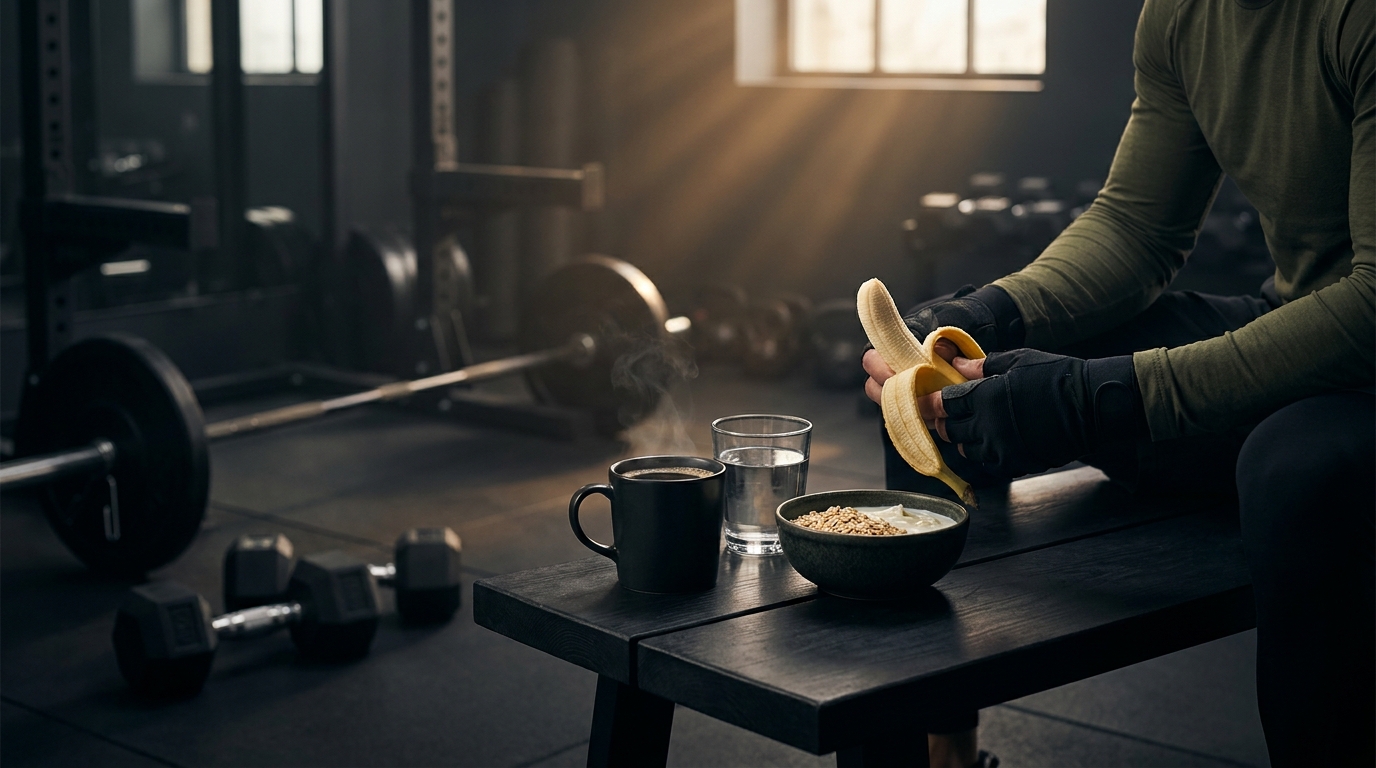
The best pre-workout is not always a supplement: it is often a simple mix of food, water, timing, and digestive tolerance.
What to Eat Before Training in Massanassa: A Realistic Pre-Workout Guide
Author
Alphafit Team
Editorial team at Alphafit Gym Massanassa
Reviewed by
Alphafit Technical Coaching Team
Strength training and personal coaching team in Massanassa
You leave work, you have one hour to train in Massanassa, and the same question appears: should I eat something now, have a coffee, train fasted, or wait until dinner?
The useful answer is not a universal rule. It depends on the time of day, what you ate earlier, the type of session, and how your body handles food. Online, people argue about bananas, fasted training, and whether pre-workout supplements are essential. In the gym, the real question is usually simpler: how do I arrive with energy without feeling heavy?
At Alphafit Gym Massanassa, we see it this way: before training, you do not need perfect nutrition. You need enough fuel, basic hydration, and a choice that does not ruin the session.
The basic rule: energy, lightness, and context
Sports nutrition is not just about specific foods. It is about matching food, fluid, and timing to the workout. The joint position paper from the Academy of Nutrition and Dietetics, Dietitians of Canada, and ACSM emphasizes that nutrition should match the exercise type, goal, and individual tolerance (sports nutrition position paper).
For someone training strength, cardio, or HIIT at Alphafit, that means:
- if you ate well 2-4 hours ago, you may not need anything special;
- if you have gone many hours without food, a light snack may improve session quality;
- if you eat a heavy meal right before training, you may feel sluggish or uncomfortable;
- if the session is short and easy, you do not need the same strategy as for leg day, HIIT, or a long workout.
A pre-workout meal does not need to be impressive. It needs to be compatible with training well.
If you have 3-4 hours before training
This is the easiest scenario: you have time for a normal meal.
Aim for a simple meal with:
- carbohydrates you digest well: rice, potatoes, pasta, bread, oats, fruit;
- moderate protein: chicken, eggs, yogurt, fish, tofu, or legumes if they sit well;
- some fat, without turning it into a very heavy meal;
- water during the afternoon, not only when you walk into the gym.
Practical examples:
| Timing | Simple option |
|---|---|
| Lunch before afternoon training | Rice with chicken and cooked vegetables |
| Larger snack before a long session | Yogurt with oats, fruit, and a little honey |
| Leg day after work | Simple turkey or omelet sandwich, plus fruit |
If your goal is muscle gain, this meal fits into the bigger daily picture. Pair it with our nutrition guide for muscle gain.
If you have 60-90 minutes
Here, reduce fiber, fat, and total volume. You want something easy to digest.
Good options:
- banana or ripe fruit;
- toast with jam or honey;
- plain yogurt with some fruit;
- milk or a simple plant-based drink with cocoa;
- rice cakes with a little peanut butter if you tolerate it well.
There is no single magic food. A banana may work beautifully for one person and feel uncomfortable for another. The key is to test options during normal training days, not on the day you want a personal best.
If you often arrive hungry but food sits badly, start with half a serving. Often the issue is not the food itself, but the amount and the rush.
If you have 15-30 minutes
With so little time, think small or liquid. Do not try to squeeze in a full meal.
Reasonable options:
- half a banana;
- a couple of dates;
- fruit puree;
- a drink with some carbohydrate if the session will be intense;
- water and coffee if you already ate a few hours ago.
If you recently had a meal, you may not need anything. If breakfast was your last real meal and it is now 7:30 p.m., a light snack is probably a good idea.
Coffee and caffeine: useful, not mandatory
Caffeine can improve some aspects of performance, especially alertness, perceived energy, and the ability to sustain effort. The International Society of Sports Nutrition notes that it tends to work best in moderate ranges and that responses vary a lot between individuals (ISSN on caffeine).
For a recreational gym member, this does not need to become an aggressive formula. Think of it this way:
- if you train in the morning or around midday, coffee may help;
- if you train late, be careful with sleep;
- if caffeine gives you anxiety, palpitations, or digestive issues, do not force it;
- do not combine coffee, energy drinks, and pre-workout products without counting total caffeine.
The NIH Office of Dietary Supplements notes that caffeine can help with fatigue and performance in some situations, but more is not always better and side effects can increase (NIH ODS). The FDA uses about 400 mg per day as a general reference for many healthy adults, although tolerance varies and some people should limit intake or ask a clinician (FDA).
In short: coffee can help. Losing sleep because of coffee costs much more.
What to avoid right before training
There are no forbidden foods for everyone, but some choices often fail when they are too close to a workout:
- fried or very fatty meals;
- a large fiber load, such as legumes, huge salads, or whole grains right before training;
- pastries or sugar alone, if you tend to crash later;
- large energy drinks without tracking caffeine;
- trying something new before a demanding session;
- arriving dehydrated and trying to fix it with a full liter of water at once.
If it is hot in Valencia, this matters even more. In summer, it helps to arrive hydrated and adjust effort. We cover that in more detail in our guide to training in summer heat in Massanassa.
Match it to your goal
Strength and hypertrophy
Prioritize energy without heaviness. If you are training legs, back, or a long session, do not rely only on coffee. A meal 2-4 hours before training and a light snack if needed usually works better.
If you also use supplements, separate the ideas: creatine monohydrate is a daily consistency tool, not an immediate energy hit.
Fat loss
Fasted training is not magic. It can fit if the session is easy and you feel good, but if it reduces strength quality, makes you dizzy, or leads to uncontrolled eating later, it is not helping.
To lose fat while keeping muscle, the priorities are still strength training, enough protein, steps, sleep, and consistency.
Cardio or HIIT
The more intense the session, the more important it is not to arrive empty. For HIIT, hard intervals, or demanding cardio, a small carbohydrate snack 30-90 minutes before training is usually more sensible than improvising fasted.
Training at night
Here, the main enemy is sleep. If you train late, avoid huge meals before the session and watch your caffeine. A simple post-workout dinner with protein and carbohydrates is usually more sustainable than ending the night grazing on random snacks.
Quick template for Massanassa
Use this as a starting point:
| Situation | What to do |
|---|---|
| Early morning training | Optional coffee + fruit or yogurt if you wake up empty |
| Midday training | Complete breakfast and a light snack if many hours pass |
| Training after work | Snack 60-90 min before: fruit, yogurt, toast, or a simple sandwich |
| Late training | Light dinner after and caffeine only if it does not affect sleep |
| Hot weather | Water before arriving and small sips during the session |
You can also review our guide to the best time to train in Massanassa if your main challenge is fitting schedule, meals, and energy together.
How we apply this at Alphafit
When someone tells us “I have no energy,” we do not start by selling them a pre-workout.
First, we look at:
- what time they train;
- how long it has been since their last meal;
- whether they arrive hydrated;
- whether they sleep enough;
- whether the routine matches their level;
- and whether digestive discomfort keeps showing up.
From there, the fix is often simple: move the meal, change snack size, control caffeine, or adjust the session volume.
The goal is not to make you depend on a supplement to train. It is to give you a structure that lets you repeat good sessions week after week.
If you want to organize training, nutrition, and schedule around a realistic plan, visit Alphafit Gym Massanassa or write to us through contact. We will help you arrive at the gym with energy, not doubts.
Sources
- Nutrition and Athletic Performance · Journal of the Academy of Nutrition and Dietetics
- International Society of Sports Nutrition position stand: caffeine and exercise performance · Journal of the International Society of Sports Nutrition
- Dietary Supplements for Exercise and Athletic Performance · NIH Office of Dietary Supplements
- Spilling the Beans: How Much Caffeine is Too Much? · U.S. Food and Drug Administration