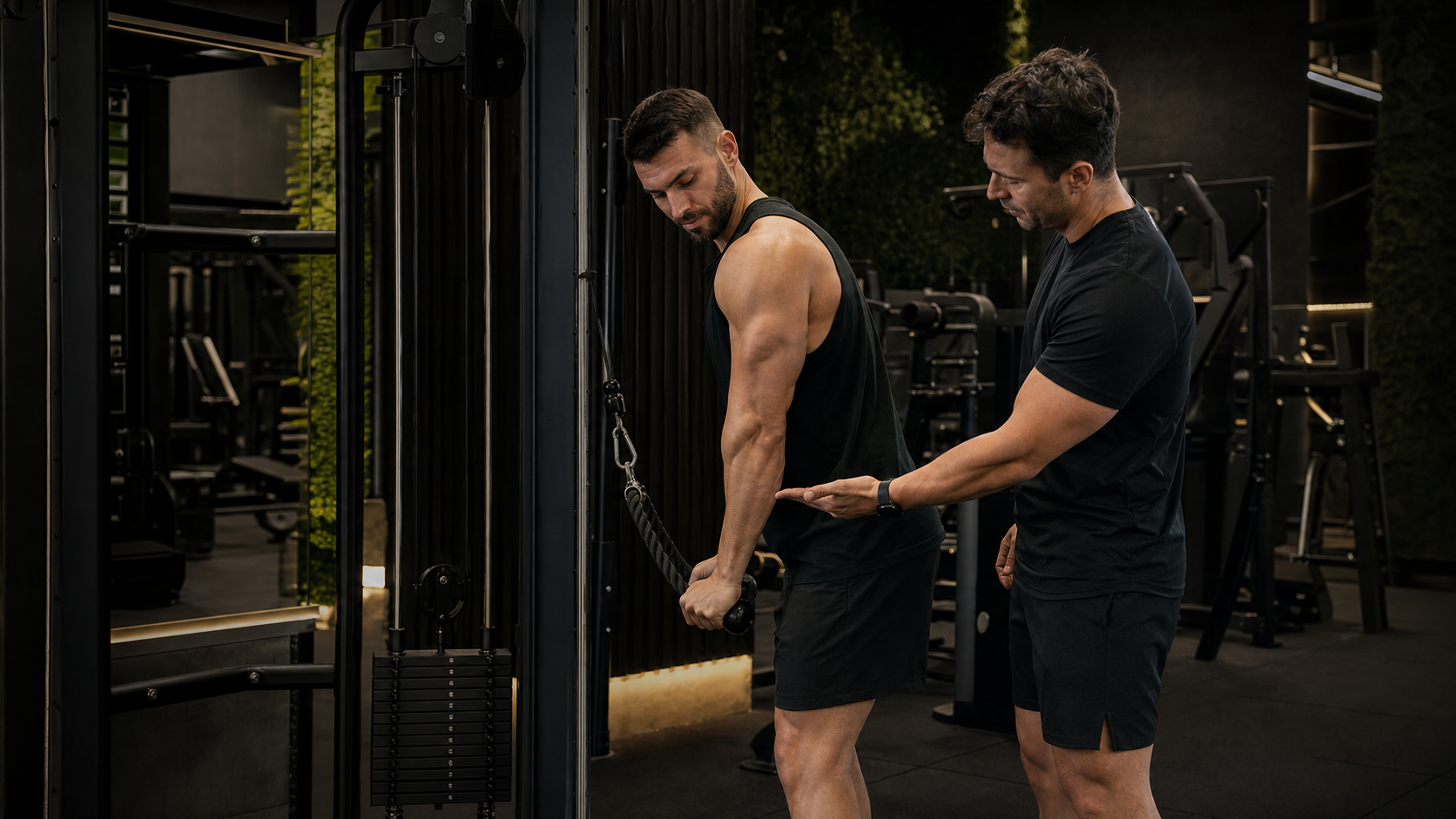
Effective arm training combines pressing, pulling and direct accessory work with controlled technique.
Arm Training in Massanassa: Biceps, Triceps and a Routine That Does Not Waste Time
Author
Alphafit Team
Editorial team at Alphafit Gym Massanassa
Reviewed by
Alphafit Technical Coaching Team
Strength training and personal coaching team in Massanassa
Arm training looks simple: a few curls, a few triceps extensions and a good pump before you leave. The problem is that many people repeat that for months without much changing: the same weights, the same swinging, the same feeling that the arms are working but not really progressing.
At Alphafit Gym Massanassa, we see this often. Some members already train chest, back and shoulders, then add arms at the end with no clear logic. Others are beginners who start with biceps because that is what they notice in the mirror, while the rest of the week has no structure.
This guide helps you train arms with purpose: how much direct work you need, how to split biceps and triceps, which exercises to choose and how to progress without turning every set into an elbow problem.
What Arm Training Really Means
Your arms do not work only when you curl. They are already involved in almost every upper-body session:
- biceps assist pulldowns, rows and pull-ups,
- triceps assist chest presses, shoulder presses and dips,
- forearms and grip limit many back exercises,
- and shoulder position affects how well biceps and triceps can work.
That is why arm training should not compete with chest and back. It should fit around them.
The CDC recommends adults do muscle-strengthening activity at least 2 days per week covering the major muscle groups, including arms, shoulders, chest, back, abdomen, hips and legs. In gym terms: arms matter, but they are not separate from the rest of the plan.
The Common Mistake: Arms as Filler
There are two extremes worth avoiding.
The first is never doing direct arm work because “they already train with back and chest.” That can work for a while, but many people need some specific work to improve technique, volume and muscle feel.
The second is doing too many direct sets at the end of every session. If you train heavy chest, then shoulders, then four triceps exercises, you may not be training better. You may just be building fatigue you cannot recover from.
The updated resistance training guidance from the ACSM makes a useful point: for most healthy adults, consistency and regular participation in strength training matter more than chasing complicated programs. It also notes that load and volume should be matched to the goal. For arms, that means choosing a few useful variations and repeating them long enough to measure progress.
Biceps: It Is Not All Barbell Curls
The biceps flex the elbow and also help when you turn the palm upward. But if your only biceps work is heavy curling with momentum, many reps become lower back, shoulder and impatience.
To train biceps well, think in three families:
1. Stable Curl
This is for controlled loading and measurable progress. Options:
- EZ-bar curl,
- standing dumbbell curl,
- machine curl,
- low cable curl.
Look for relatively stable elbows, a firm torso and a controlled lowering phase. You do not need to pin your arms to your sides, but if every rep starts with a hip drive, the weight is doing more than the biceps.
2. Supported-Arm Curl
This reduces cheating and helps you feel the muscle better. Options:
- preacher curl,
- incline bench curl,
- supported dumbbell curl,
- single-arm cable curl.
Here it usually helps to lower the weight and protect the range of motion. This is a good option if every curl tends to become a full-body pull.
3. Hammer Curl or Neutral Grip
This trains the biceps, brachialis and forearms in a more balanced way. Options:
- dumbbell hammer curl,
- rope hammer curl,
- cross-body curl,
- neutral-grip bar curl if the equipment is available.
This block helps if you want stronger arms for pulldowns, rows and grip work.
Triceps: More Important Than It Looks
The triceps make up a large part of upper-arm size and contribute to every press. If your chest or shoulder press stalls, the missing link is sometimes not chest. It is triceps strength and positioning.
Use three exercise families:
1. Cable Pushdown
This is the easiest option to adjust and repeat. You can use a rope, straight bar or V-bar.
Keys:
- elbows close to the body,
- shoulders quiet,
- full extension without aggressive locking,
- controlled return,
- and firm wrists.
If you feel it more in your shoulder or neck than your triceps, reduce the load and reset your position.
2. Overhead Extension
This trains the triceps from a more lengthened position. You can do it with a rope cable, dumbbell or machine.
Do not chase the heaviest possible load. Look for a comfortable stretch, elbows pointing forward and a pain-free range.
3. Close-Grip Press or Assisted Dips
Here the triceps work together with chest and shoulders. Options:
- close-grip press if your technique is solid,
- assisted dips,
- elevated close-grip push-ups,
- machine press with a narrower grip.
They are useful, but not mandatory. If they bother your shoulder or wrist, cables and extensions may fit better.
How Much Volume Should You Do?
You do not need 25 direct arm sets to improve. Remember that biceps and triceps already receive indirect work.
A practical reference:
- beginner: 4-6 direct biceps sets and 4-6 direct triceps sets per week,
- intermediate: 6-10 direct sets per muscle,
- advanced: more only if recovery is good and the rest of your upper-body training does not suffer.
The ACSM notes that more weekly volume can make sense for hypertrophy, but it should match the goal and the person’s tolerance. A Sports Medicine review found better hypertrophy outcomes when a muscle group was trained at least twice weekly compared with once weekly, although the exact dose depends on total volume and training level (Schoenfeld et al., 2016).
In the gym, the practical version is simple: spreading arms over 2 days often beats cramming everything into one endless Friday session.
A Practical 2-Day Arm Routine
This structure fits well with upper-lower, full body or push/pull/legs. Choose loads that let you finish most sets with 1-3 reps in reserve.
Day A: Strong Biceps and Controlled Triceps
| Exercise | Sets | Reps |
|---|---|---|
| EZ-bar curl or machine curl | 3 | 8-12 |
| Cable triceps pushdown | 3 | 10-15 |
| Dumbbell hammer curl | 2 | 10-12 |
| Overhead rope extension | 2 | 12-15 |
Day B: Technique, Range and Useful Pump
| Exercise | Sets | Reps |
|---|---|---|
| Preacher curl or incline bench curl | 3 | 10-15 |
| Close-grip machine press or assisted dips | 2-3 | 8-12 |
| Single-arm cable curl | 2 | 12-15 per side |
| Single-arm cable triceps extension | 2 | 12-15 per side |
If you train arms only once per week, do not paste both days together. Choose one stable biceps exercise, one cable triceps exercise, one hammer curl and one overhead extension.
How It Fits With Chest, Back and Shoulders
This is what decides whether the plan works.
If you train full body, add 1 biceps exercise and 1 triceps exercise to two sessions. You do not need a whole arm day.
If you train upper-lower, put biceps at the end of an upper day where back is the main focus, and triceps at the end of a day where chest or shoulders are the main focus.
If you train push/pull/legs, the natural setup is:
- triceps at the end of push,
- biceps at the end of pull,
- and possibly a small extra arm touch on another day if you recover well.
Look at your week honestly. If your chest training in Massanassa already includes a lot of pressing, your triceps may not need extra punishment. If your back training in Massanassa includes hard pulldowns and rows, your biceps already arrive with work in them.
Signs of a Good Rep
The Mayo Clinic highlights correct technique, control and not ignoring pain as important parts of safer weight training. With arms, that shows quickly.
Look for these signs:
- elbows stable, not moving around every rep,
- firm wrists,
- quiet torso,
- controlled lowering phase,
- comfortable range,
- clear muscle tension,
- and high effort without joint pain.
If your elbow hurts, do not hide it by turning up the music and lowering faster. Change grip, reduce load, try cables or ask someone to check your technique.
Progress Without Cheating
Use double progression.
Example with an EZ-bar curl:
| Week | Load | Sets |
|---|---|---|
| 1 | 20 kg | 10, 9, 8 |
| 2 | 20 kg | 11, 10, 9 |
| 3 | 20 kg | 12, 11, 10 |
| 4 | 22.5 kg | 9, 8, 8 |
That is progress. You do not need to swing your body to force three more reps. You need to repeat better and increase load when it is earned.
For more detail, pair this guide with load progression in the gym.
Common Arm-Training Mistakes
1. Always Starting With Biceps When Your Main Goal Is Overall Strength
If your main goal is to improve chest, back or shoulders, do not spend your freshest energy on curls. Exercise order matters.
2. Doing Too Many Similar Variations
Barbell curl, dumbbell curl, cable curl, preacher curl and concentration curl in the same session is usually redundant. Pick two that are meaningfully different and progress them.
3. Turning Triceps Into Elbow Pain
Not every extension suits every elbow. Cables are often more forgiving than some heavy barbell variations. Adjust before you keep pushing.
4. Treating Pump as the Only Scoreboard
A pump feels good, but it is not enough. Track reps, load, range, control and recovery.
5. Forgetting Shoulders and Upper Back
A strong arm needs a stable shoulder. If your pressing, rowing and scapular control are weak, arm accessories have a poorer base. Our shoulder training guide can help.
When to Ask for Help
Ask for help if you always feel your elbow before the muscle, if you do not know how to split arms around chest and back, if you have been stuck with the same weights for months or if every curl needs body swing to move.
At Alphafit, we can check technique, choose variations that fit you and adjust volume so your arms progress without stealing energy from the rest of your body.
If you want structured arm training in Massanassa, visit Alphafit Gym Massanassa or contact us through contact. We will help you turn biceps, triceps and grip work into progress you can measure.
Sources
- ACSM Unveils Landmark 2026 Resistance Training Guidelines · American College of Sports Medicine
- Adult Activity: An Overview · Centers for Disease Control and Prevention
- Weight training: Do's and don'ts of proper technique · Mayo Clinic
- Effects of Resistance Training Frequency on Measures of Muscle Hypertrophy: A Systematic Review and Meta-Analysis · Sports Medicine