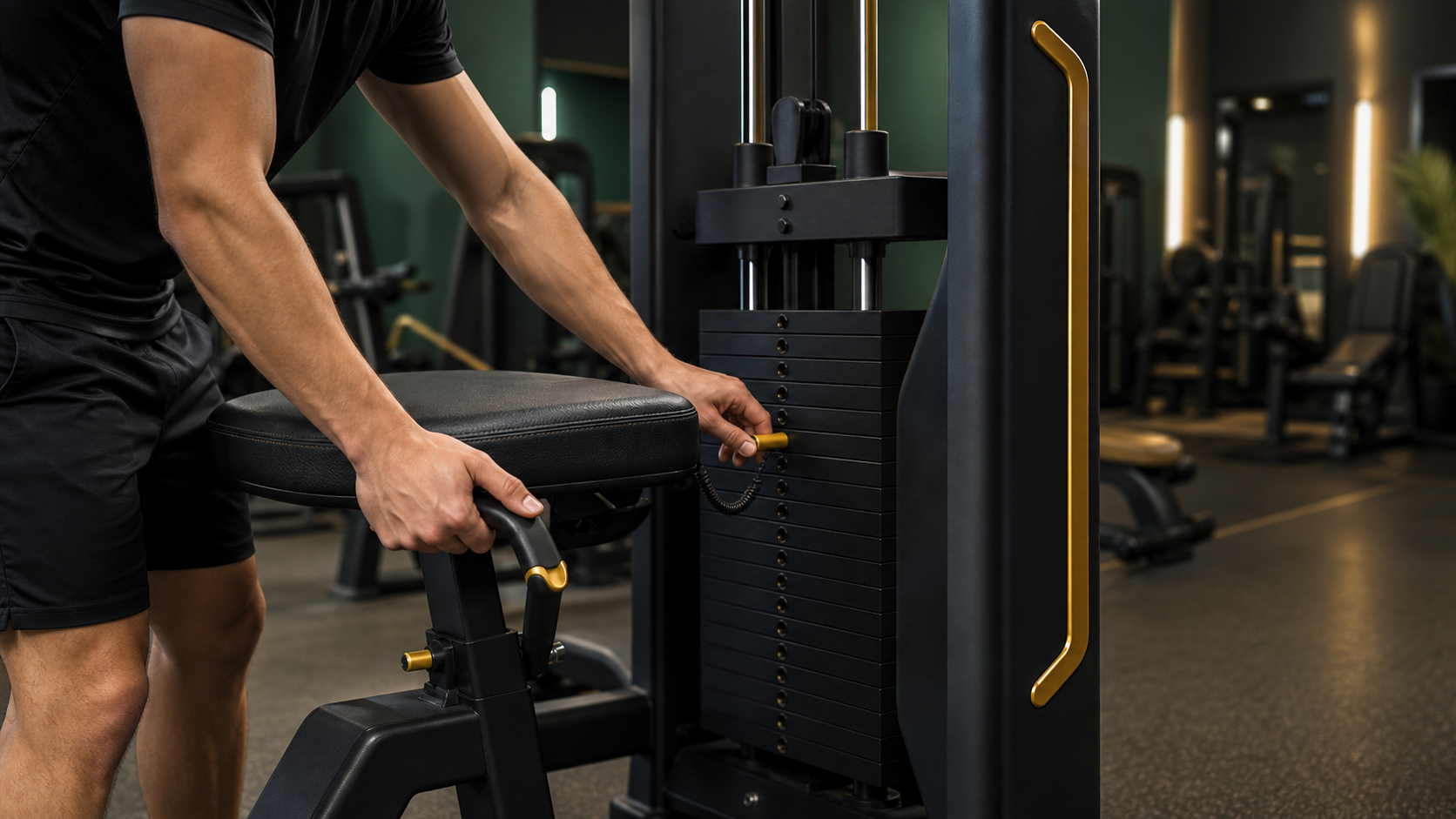
A good seat and load setup turns a simple machine into a useful tool for real progress.
Gym Machines Guide in Massanassa: Setup, Technique, and a Simple Plan Without Guesswork
Author
Alphafit Team
Editorial team at Alphafit Gym Massanassa
Reviewed by
Alphafit Technical Coaching Team
Strength training and personal coaching team in Massanassa
Gym machines look simple until you sit down and wonder whether the seat is too high, whether the handle should line up with your shoulder, whether your back should stay on the pad, or whether the weight is far too light.
At Alphafit Gym Massanassa, we see this every day: many people do not need a more complicated routine. They need to know how to set up 6 or 7 key machines, choose a sensible load, and repeat good reps for several weeks.
That is what this guide is for. It is not here to argue that machines are better than free weights, or to treat them as a lower-level phase. Machines are tools. Used well, they can help you train strength safely, regulate effort, and build a very solid base.
Machines are not only for beginners
Two mistakes are very common.
The first is thinking machines are “easy”, so they do not count. The second is believing that if you are not using a barbell for squats or bench press, you are not really training.
The evidence is more balanced. A systematic review and meta-analysis in BMC Sports Science, Medicine and Rehabilitation compared free-weight and machine-based training for at least 6 weeks in adults, and found no clear differences in the direct comparison of strength, jump performance, or hypertrophy (Haugen et al., 2023). The practical takeaway is simple: your body responds to stimulus, progression, and consistency, not to the status of the equipment.
Machines can be especially useful when:
- you are starting from zero and want less uncertainty,
- you are returning after a break,
- you want to isolate a muscle more clearly,
- you need training volume with less technical fatigue,
- you train alone and want more security,
- or you are learning to push effort without losing posture.
If you are completely new, pair this guide with our post on how to start at the gym from scratch in Massanassa.
Before you move weight: set up the machine
Most machine mistakes happen before the first rep.
A poorly adjusted machine can make it harder to feel the target muscle, shorten your range of motion, or load joints in an awkward way. It is not always dangerous, but it is usually less effective.
Use this order:
- Adjust the seat or back pad. The handle, axis, or support should line up with the joint doing the movement.
- Set your feet and supports. They should not slide around or force you to compensate.
- Test a very light set. If the path feels odd, adjust before adding load.
- Look for symmetry. Shoulders, hips, and feet should start stable.
- Write down your setting. If the machine has numbers, record seat 4, back pad 2, or whatever detail helps you repeat it.
This may sound minor, but it changes the session. If you place the leg press seat differently every week, you do not know whether you progressed or simply changed the exercise.
How to set up common machines
Leg press
The leg press is often a great base for stable lower-body strength work.
Key points:
- keep your back and hips well supported;
- place your feet at a comfortable width, usually around shoulder width;
- lower as far as you can control without the pelvis lifting;
- do not slam the knees into lockout at the top;
- think about driving the platform, not bouncing through reps.
If you want to improve your squat later, the leg press does not have to disappear. It can remain a strong leg exercise or a useful accessory.
Machine chest press
The handle should usually sit near the middle line of your chest, not too high toward the neck and not too low toward the abdomen.
Before adding load, check:
- shoulder blades supported and chest stable;
- feet firm;
- shoulders away from the ears;
- controlled range to a comfortable depth;
- pressing without peeling your back off the pad.
If you feel mostly shoulder and very little chest, the seat may be wrong or your elbows may be too flared.
Lat pulldown
The pulldown is excellent for learning a vertical pull before mastering pull-ups.
Key points:
- adjust the thigh pad so your legs do not lift;
- start with long arms without hanging from your lower back;
- pull the elbows down, not just the hands;
- avoid turning every rep into a swing;
- return under control instead of letting the weight drop.
If you want more detail on pulling work, read our back training guide in Massanassa.
Seated row
The seated row usually fails in two opposite ways: pulling only with the arms, or moving the whole torso as if it were a hinge.
Look for:
- chest supported if the machine allows it;
- stable spine;
- shoulders moving back and down, not up toward the ears;
- a short pause at the end of the pull;
- a controlled return without rounding forward.
Hamstring curl and leg extension
On these machines, the axis matters a lot.
For the leg extension, the knee should sit close to the machine’s pivot point. For the hamstring curl, same idea: adjust so the joint is not too far forward or backward relative to the machine’s motion.
You do not need momentum here. Use less weight, a clear range, and a contraction you can actually control.
How to choose weight without guessing
Use this simple rule for most machines:
- start with a light set of 10-12 reps;
- add load until the final 2 or 3 reps require focus;
- usually leave 1-3 good reps in reserve;
- if technique changes a lot, lower the load;
- if you could do 20 reps easily, add a little.
The ACSM frames strength as a minimum part of health: adults should perform activities that maintain or increase muscular strength and endurance at least 2 days per week (ACSM). For that to be training rather than just movement, the load needs to create a real stimulus.
You do not need to fail every set. Machines may let you get closer to failure more safely than very technical lifts, but if every set becomes a grind, session quality and recovery suffer.
A machine-based routine for 2 or 3 days
This template works for beginners, people returning to training, or members who want a more guided phase.
Day A
| Block | Exercise | Sets and reps |
|---|---|---|
| Legs | Leg press | 3 x 8-12 |
| Push | Machine chest press | 3 x 8-12 |
| Pull | Seated row | 3 x 10-12 |
| Hamstrings | Hamstring curl | 2-3 x 10-15 |
| Core | Pallof press or plank | 2-3 sets |
Day B
| Block | Exercise | Sets and reps |
|---|---|---|
| Legs | Leg extension or guided hack squat | 2-3 x 10-15 |
| Pull | Lat pulldown | 3 x 8-12 |
| Push | Machine shoulder press | 2-3 x 8-12 |
| Glutes | Guided hip thrust or glute machine | 3 x 8-12 |
| Accessory | Calf, biceps, or triceps | 2-3 x 10-15 |
If you train 2 days per week, alternate A and B. If you train 3 days, do A-B-A one week and B-A-B the next.
The key is not changing exercises all the time. The key is repeating enough to measure. Our guide to load progression in the gym will help with that.
When to move from machines to free weights
You do not need to abandon machines to progress. You can use machines and free weights for years.
But it may make sense to add dumbbells, barbells, or cables when:
- you can set up machines without overthinking;
- you understand which muscle is working in each pattern;
- you regulate effort without cheating;
- you want more movement variety;
- you need to transfer strength to less guided patterns;
- or your current routine has become too limited.
Move by pattern, not ego:
| Machine | Natural transition |
|---|---|
| Leg press | Goblet squat or split squat |
| Chest press | Dumbbell press |
| Seated row | Supported dumbbell row |
| Pulldown | Assisted pull-up or cable pulldown |
| Hamstring curl | Light Romanian deadlift |
The AS article on machines, cables, and free weights captures a useful gym-floor idea: there are no mandatory exercises for everyone; what matters is whether the movement fits your structure, lets you progress, and keeps technique solid (AS). At Alphafit, we put it this way: the best exercise is the one you can do well, repeat, and load with judgement.
Common machine mistakes
1. Adjusting nothing
Sitting down and pushing without checking the seat, back pad, or stops often turns a good machine into an awkward experience.
2. Moving too fast
If the weight stack bangs or the lowering phase drops by itself, you are not controlling the set. Lower with intent.
3. Using a tiny range of motion
More weight with half reps is not always better. Look for a range that is broad, comfortable, and repeatable.
4. Turning every machine into cardio
Short rests can work for accessories, but main exercises need room to breathe. If you are unsure, read how long to rest between sets.
5. Not recording loads
Without a log, progression becomes guesswork. Write down the machine, setting, load, reps, and one technique note.
How we coach this at Alphafit
At Alphafit, we do not use machines as filler. We use them to teach patterns, build strength, manage fatigue, and create confidence.
A good machine session should leave you with clear answers:
- which exercise is next;
- how to set it up;
- what load you used;
- how many clean reps you completed;
- what to repeat or increase next week.
If you currently move around the room trying random machines, you are not missing willpower. You are missing a map.
Come to Alphafit Gym Massanassa and we will help you set up machines, choose loads, and turn each session into measurable progress. You can see our training services or contact us from the contact page.
Sources
- Effect of free-weight vs. machine-based strength training on maximal strength, hypertrophy and jump performance - a systematic review and meta-analysis · BMC Sports Science, Medicine and Rehabilitation
- Physical Activity Guidelines · American College of Sports Medicine
- Progression Models in Resistance Training for Healthy Adults · American College of Sports Medicine
- Ni máquinas ni poleas: el entrenador Ángel Real señala los ejercicios que más te hacen progresar en el gimnasio · AS